


In the world of precision measurement, load cells are the backbone of reliable weighing and force monitoring systems. They convert mechanical force into tiny electrical signals—often just a few millivolts. To make these signals usable, they must be amplified and conditioned before reaching displays, controllers, or data acquisition systems.
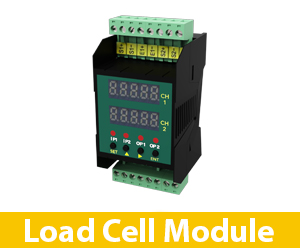
This is where load cell amplifiers (or signal conditioners) come in. But here’s the challenge: not every amplifier is suitable for every load cell. For accurate and stable measurements, you must ensure the amplifier’s gain, bandwidth, and linearity specifications are well-matched with the load cell output.
In this blog, we’ll break down what these terms mean, why they matter, and how to choose the right amplifier for your weighing system.
Why Amplifier Matching Matters
Load cells typically produce signals in the range of 2–3 mV/V at full scale. If the excitation voltage is 10 V, the maximum output might be just 20–30 mV. Without proper amplification, this tiny signal is prone to:
- Electrical noise and interference
- Signal loss over long cables
- Poor resolution in displays or PLCs
An amplifier must boost the signal without distortion. Choosing the wrong specifications can lead to inaccurate measurements, signal clipping, or sluggish performance.
Key Amplifier Specifications to Match with Load Cell Output
1. Gain
What it is: Gain refers to how much the amplifier increases the load cell’s output signal.
Why it matters: If the gain is too low, the output signal remains weak and unreadable. If it’s too high, the signal can saturate (clip), resulting in distorted or unusable readings.
How to match:
- Determine your load cell’s maximum output (in mV) at full load.
- Decide the input range required by your controller, indicator, or ADC (e.g., 0–10 V or 4–20 mA).
- Choose an amplifier with adjustable gain so you can fine-tune it to match the load cell’s signal range.
✅ Example: A load cell producing 20 mV at full scale can be amplified with a gain of 500 to output 10 V.
2. Bandwidth
What it is: Bandwidth defines the range of frequencies the amplifier can accurately handle.
Why it matters: If your application involves dynamic forces (fast-changing loads, impacts, or vibrations), the amplifier must have sufficient bandwidth to capture those variations without lag. For static or slow measurements (e.g., tank weighing), lower bandwidth is sufficient.
How to match:
- For static weighing (e.g., silos, batching systems): 1–10 Hz bandwidth is enough.
- For dynamic applications (e.g., crash testing, vibration monitoring): you may need bandwidths in the kHz range.
✅ Rule of thumb: The amplifier’s bandwidth should be at least 10 times higher than the highest frequency component of the load signal.
3. Linearity
What it is: Linearity measures how closely the amplifier’s output follows its input over the full range. Ideally, a doubling of input should result in a doubling of output.
Why it matters: Non-linear amplifiers distort measurements, especially at low or high load ranges, reducing overall system accuracy.
How to match:
- Ensure the amplifier’s linearity error is less than 0.01% of full scale for precision applications.
- Match with load cells that already have high linearity to avoid compounding errors.
✅ Tip: For high-precision industries (pharmaceuticals, aerospace, laboratory testing), prioritize linearity as much as gain.
Steps to Select the Right Amplifier
- Calculate Load Cell Output
- Multiply sensitivity (mV/V) by excitation voltage and full-scale load.
- Match Gain
- Ensure the amplifier can boost this output to the desired signal range (0–10 V, 4–20 mA, etc.).
- Check Bandwidth Needs
- Choose bandwidth based on whether your application is static or dynamic.
- Verify Linearity
- For critical accuracy, ensure both load cell and amplifier have excellent linearity specs.
- Consider Extra Features
- Noise filtering, digital outputs (RS-485, Modbus), temperature compensation, and isolation for harsh environments.
Common Mistakes to Avoid
- Over-Amplification – Causes signal clipping and distorted readings.
- Ignoring Bandwidth – Leads to lag in dynamic applications.
- Overlooking Linearity – Causes cumulative measurement errors.
- Poor Shielding – Not using amplifiers with noise rejection in high-EMI environments.
Conclusion
Matching amplifier specifications with load cell output is essential for achieving accurate, reliable, and noise-free measurements.
- Use the right gain to bring weak signals into usable ranges.
- Choose appropriate bandwidth depending on whether loads are static or dynamic.
- Prioritize linearity for high-precision applications to maintain measurement integrity.
By carefully aligning these specifications, you ensure that your weighing system operates at peak performance, delivering both accuracy and durability.