


In every weighing and force measurement system, the load indicator plays a vital role by converting signals from load cells into meaningful data. Over the years, these indicators have evolved from analog displays to sophisticated digital interfaces, each offering unique benefits. Choosing between analog and digital load indicators is not always straightforward—it depends on your application, environment, and automation requirements.
In this blog, we’ll compare analog vs digital load indicators, highlight their differences, and help you decide which is best suited for your needs.
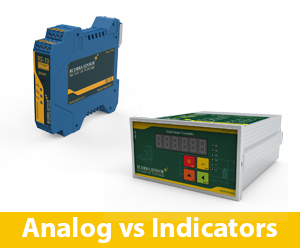
What is a Load Indicator?
A load indicator is the interface that interprets the electrical signal from a load cell and displays the weight, tension, or force measurement. Depending on its type, it may:
- Simply display the reading.
- Provide outputs for automation systems.
- Connect with external devices for monitoring and data collection.
Analog Load Indicators
How They Work
Analog indicators typically use needle gauges or analog meters that move in proportion to the load cell signal. Some may also provide analog electrical outputs (0–10 V or 4–20 mA) for further processing.
Advantages
- Simplicity: Easy to read and use.
- Cost-Effective: Lower upfront cost.
- Durability: Fewer electronic components mean fewer failure points.
- Real-Time Responsiveness: Continuous output with no digital sampling delay.
Limitations
- Limited Precision: Hard to detect small variations.
- No Data Logging: Cannot store or transmit data easily.
- Susceptible to Human Error: Reading depends on operator interpretation.
- Limited Integration: Not ideal for modern automation systems.
Best Applications
- Mechanical testing in labs.
- Environments where rugged simplicity is more important than high precision.
- Standalone systems without data recording or connectivity needs.
Digital Load Indicators
How They Work
Digital indicators use microprocessors and digital displays (LED or LCD) to show readings. They also support a variety of outputs—serial (RS232/RS485), analog, Ethernet, USB, or wireless—for integration with automation systems.
Advantages
- High Accuracy and Resolution: Displays even minute load changes.
- Data Logging and Storage: Can record measurements for analysis and compliance.
- Connectivity: Seamless integration with PLCs, SCADA, and IoT systems.
- Programmable Functions: Tare, zero, setpoints, alarms, and batch control.
- Remote Monitoring: Support for Bluetooth, Wi-Fi, or cloud-based systems.
Limitations
- Higher Cost: More advanced features come at a premium.
- Complexity: Requires training and setup.
- Electronics Sensitivity: Can be affected by harsh environments if not well protected.
Best Applications
- Industrial automation and process control.
- Applications requiring high accuracy and compliance (food, pharma, chemicals).
- Systems where remote monitoring or integration with PLC/SCADA is needed.
Key Differences: Analog vs Digital Load Indicators
| Feature | Analog Indicator | Digital Indicator |
|---|---|---|
| Accuracy | Basic, lower resolution | High precision and resolution |
| Ease of Use | Simple, manual reading | User-friendly digital display |
| Data Logging | Not available | Available with storage options |
| Connectivity | Limited (analog output only) | RS232, RS485, Ethernet, USB, Wireless |
| Integration with Automation | Minimal | Seamless with PLC, SCADA, IoT |
| Cost | Lower | Higher |
| Best Fit | Simple, standalone use | Advanced, automated systems |
Which One Suits Your Application Best?
- Choose Analog Load Indicators if:
- You need a budget-friendly
- Your application does not require connectivity or data recording.
- Simplicity and ruggedness matter more than precision.
- Choose Digital Load Indicators if:
- You need high accuracy and advanced features.
- Your system requires integration with automation or IoT platforms.
- Compliance, traceability, and data analysis are critical.
Conclusion
The decision between analog and digital load indicators ultimately depends on your application requirements. Analog indicators provide simplicity and cost efficiency for basic weighing tasks, while digital indicators deliver the accuracy, connectivity, and automation capabilities that modern industries demand.
By aligning the indicator type with your operational needs, you can ensure that your weighing system is not only accurate but also future-ready for automation and data-driven decision-making.