


In industrial weighing and measurement systems, signal transmission is just as important as the sensor itself. A high-quality load cell may deliver precise readings, but if its signal degrades during transmission, accuracy and reliability are compromised. This is why amplifiers play a key role—they condition, strengthen, and format the signal for effective transmission over long distances.
Among the most common output types are mV/V (millivolt per volt), 4–20 mA (current loop), and digital signals. Each has its advantages and limitations, especially when used in environments where cable lengths, electrical noise, and environmental factors matter.
In this blog, we’ll compare these output types to help you select the right amplifier for long-distance signal transmission in load cell and weighing applications.
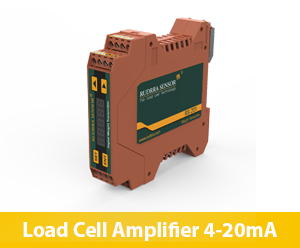
Why Amplifier Output Type Matters
Load cells naturally generate very small signals (typically 2–3 mV/V). These weak signals are prone to interference and loss during transmission. An amplifier converts this into a stronger, more robust format. The choice of output type affects:
- Transmission distance
- Resistance to electrical noise (EMI/RFI)
- Integration with PLCs, SCADA, or data acquisition systems
- Overall system cost and complexity
Common Amplifier Output Types
1. mV/V (Millivolt per Volt) Output
This is the raw load cell signal proportional to excitation voltage.
Advantages:
- Provides the purest, most direct representation of load cell output.
- Ideal for short-distance connections (a few meters).
- Low-cost, as no extra signal conditioning is needed.
Limitations:
- Extremely sensitive to electrical noise and voltage drops.
- Signal degradation increases with cable length.
- Requires precise instrumentation amplifiers for accurate reading.
Best For: Laboratory testing, short-distance connections, or environments with minimal interference.
2. 4–20 mA Current Loop Output
The 4–20 mA standard is widely used in industrial automation. Instead of transmitting voltage, the amplifier converts the load signal into a current loop.
Advantages:
- Excellent for long-distance transmission (hundreds of meters).
- Immune to voltage drops and electrical noise.
- Universal compatibility with PLCs, DCS, and SCADA systems.
- Easy fault detection: if the signal drops below 4 mA, it indicates a wiring fault or failure.
Limitations:
- Limited bandwidth—best for steady or slowly changing signals.
- Higher system cost due to additional transmitter circuitry.
Best For: Industrial weighing, process control, and remote monitoring applications.
3. Digital Output (RS232, RS485, Modbus, CANbus, Ethernet)
Digital amplifiers convert the load cell signal into serial or network protocols, enabling direct communication with computers, PLCs, and automation networks.
Advantages:
- Immune to analog noise and signal drift.
- High accuracy with minimal loss, even over long distances.
- Supports advanced features: multi-sensor networking, data logging, diagnostics.
- Scalable for Industry 4.0 and IIoT applications.
Limitations:
- More complex setup and higher initial cost.
- Requires compatible devices/software to decode the signal.
- Transmission distance depends on protocol (RS232: short; RS485/Modbus: hundreds of meters; Ethernet: kilometers with fiber).
Best For: Smart factories, digital weighing systems, remote monitoring, and high-integration automation environments.
Common Load Cell Housing Materials
1. Aluminum
Aluminum is one of the most widely used materials in load cells, especially for single-point and low-capacity load cells.
Advantages:
- Lightweight and cost-effective.
- Excellent thermal conductivity, reducing temperature gradients.
- Easy to machine, keeping manufacturing costs low.
Limitations:
- Limited corrosion resistance compared to stainless steel.
- Lower mechanical strength, not suitable for heavy-duty or harsh environments.
Best Applications: Retail scales, bench scales, small packaging machines, and controlled environments.
2. Stainless Steel
Stainless steel is the gold standard for load cells used in harsh and corrosive environments.
Advantages:
- Exceptional corrosion resistance (ideal for marine, chemical, and food industries).
- High mechanical strength and fatigue resistance.
- Can be hermetically sealed for IP68 and IP69K protection.
Limitations:
- Higher cost compared to aluminum.
- Lower thermal conductivity than aluminum, requiring compensation in precision applications.
Best Applications: Food & beverage processing, pharmaceuticals, chemical plants, marine weighing systems.
3. Tool Steel (Alloy Steel)
Tool steel load cells are rugged, economical, and widely used in industrial and heavy-duty weighing systems.
Advantages:
- Excellent mechanical protection and load-bearing capacity.
- Cost-effective compared to stainless steel.
- Good fatigue strength for repetitive loading.
Limitations:
- Prone to corrosion if not adequately coated.
- Requires protective finishes such as nickel plating.
Best Applications: Truck scales, railway weighing systems, heavy industrial platforms.
4. Specialized Coatings and Composites
Some load cell housings are enhanced with nickel plating, anodized aluminum, or polymer coatings for added durability.
Advantages:
- Extra corrosion resistance at lower cost.
- Customizable to specific industrial needs.
Best Applications: Where budget is a constraint but added protection is necessary.
Comparative Analysis
| Output Type | Distance Capability | Noise Immunity | Integration | Cost | Best Use Case |
|---|---|---|---|---|---|
| mV/V | <5 m | Low | Requires special amplifier | Low | Labs, test setups, short runs |
| 4–20 mA | Up to 300–500 m | High | PLC/DCS/SCADA ready | Medium | Industrial weighing, remote sensors |
| Digital | 100 m–several km (protocol dependent) | Very High | Direct to PLC/PC/Network | High | Automation, IIoT, multi-sensor networks |
Choosing the Right Output for Your Application
- Use mV/V when cost is critical and the amplifier is located close to the load cell.
- Choose 4–20 mA for rugged, long-distance industrial installations where reliability matters more than speed.
- Opt for digital outputs when you need smart functionality, networking, and scalability in automated environments.
Conclusion
When it comes to long-distance signal transmission, the choice of amplifier output type directly impacts system performance and reliability. While mV/V is cost-effective for short runs, 4–20 mA remains the industry standard for robust, noise-resistant long-distance transmission. For future-ready automation and IIoT applications, digital outputs offer unmatched flexibility and accuracy.
By carefully matching the amplifier output type to your application requirements, you can ensure that your weighing system delivers precise, real-time data without compromise—even across long distances.