


Introduction
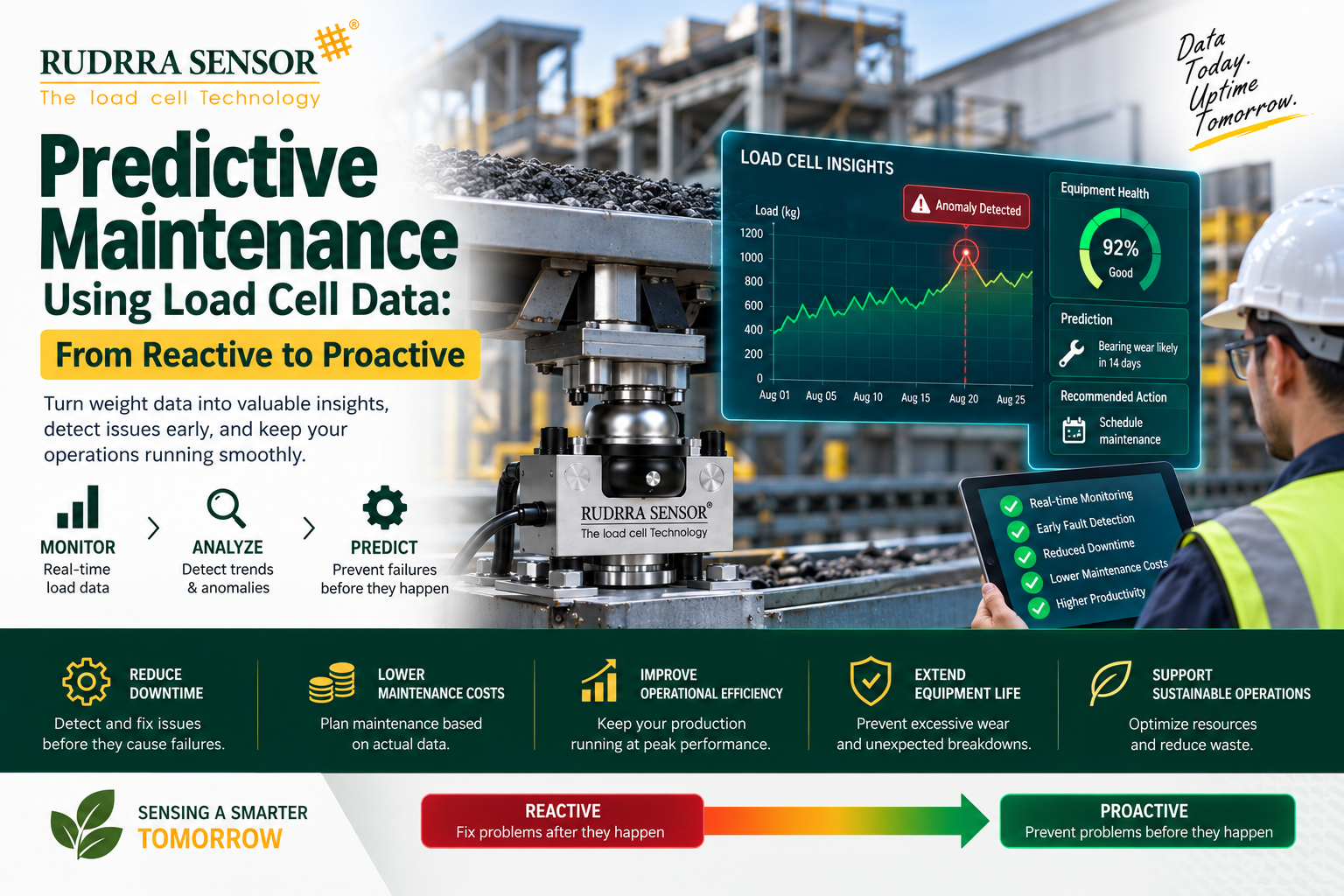
For most of industrial history, maintenance has followed one of two philosophies: fix it when it breaks, or fix it on a fixed schedule whether it needs it or not. Reactive maintenance is cheap right up until the moment a critical asset fails unexpectedly, taking a production line, a crane, or an entire plant down with it. Preventive maintenance — replacing components on a calendar or run-hour schedule regardless of their actual condition — avoids the worst surprises of reactive maintenance, but at the cost of replacing perfectly good parts early and still occasionally missing a failure that develops faster than the schedule anticipated. Predictive maintenance offers a genuinely different approach: using real, continuously monitored condition data to identify when a specific asset actually needs attention, rather than guessing based on either a failure event or a generic calendar interval.
Load cells, already installed throughout industry for their primary measurement purpose — weighing, tension monitoring, force verification — turn out to be an unusually rich and underused source of exactly the kind of condition data predictive maintenance programs depend on. A load cell doesn’t just report a single weight or force value; over time, its output carries a continuous record of how a machine is actually behaving under load: whether tension is drifting outside its normal range, whether a bearing is beginning to introduce mechanical noise into what should be a smooth signal, whether a structural support is gradually taking on more or less load than its neighbors, or whether the pattern of loading cycles a component experiences is accelerating toward a fatigue limit faster than originally assumed. Much of this data is already being collected by load cells installed for entirely different primary purposes — it simply isn’t being analyzed with predictive maintenance in mind.
This blog is a deep, practical look at how load cell data — much of it already flowing through existing industrial systems — can be used to move maintenance programs from reactive or purely schedule-based approaches toward genuinely predictive, condition-based maintenance. We’ll cover the specific signal characteristics and analysis techniques that make this possible, the technical and organizational trust factors that determine whether a predictive maintenance program built on load cell data actually delivers value, real-world case studies spanning several industries, and the common mistakes that undermine otherwise well-intentioned predictive maintenance initiatives.
At Rudrra Sensor, we see load cell data increasingly recognized not just as a primary measurement output, but as a genuine diagnostic asset in its own right. This article is written for maintenance engineers, reliability specialists, and plant management who want to understand what’s genuinely achievable — and what isn’t — when using load cell data to build a more proactive maintenance program.
It’s worth framing why this topic deserves treatment as its own discipline rather than simply a footnote to conventional load cell application literature. Every other application discussed elsewhere in load cell literature — cranes, mining conveyors, pipelines, railways, aerospace testing, packaging lines, agriculture — installs load cells to solve a specific, immediate measurement problem: weighing, tension control, overload protection, compliance verification. Predictive maintenance is different in kind, not just degree: it asks what additional value can be extracted from data that is, in the majority of cases, already being generated as a byproduct of solving that original problem. This makes predictive maintenance using load cell data one of the more capital-efficient opportunities available to industrial organizations, since the primary sensor investment has often already been made and justified on entirely separate grounds.
The Maintenance Spectrum: Reactive, Preventive, and Predictive
Reactive maintenance: waiting for failure
Reactive maintenance — running equipment until it fails, then repairing or replacing it — is the default approach in the absence of any other strategy, and it remains appropriate for genuinely low-consequence, low-cost components where the cost of monitoring or scheduled replacement exceeds the cost of simply dealing with an occasional failure. For anything more consequential than that, however, reactive maintenance carries real risk: unplanned downtime at the worst possible moment, secondary damage to surrounding equipment when a component fails catastrophically rather than being caught early, and, in safety-critical applications, genuine safety risk if a failure occurs without warning.
Preventive maintenance: scheduled intervention regardless of actual condition
Preventive maintenance improves on pure reactive maintenance by replacing or servicing components on a fixed schedule — a defined number of run-hours, load cycles, or calendar time — based on the statistically expected service life of the component. This significantly reduces unplanned failure risk compared to reactive maintenance, but it has two persistent weaknesses: it wastes the remaining useful life of components replaced before they actually needed it, and it can still miss failures that develop faster than the statistical average the schedule was based on, particularly when an individual asset experiences a duty cycle or operating condition more severe than the fleet-average assumption the schedule was built around.
Predictive maintenance: condition-based intervention informed by real data
Predictive maintenance addresses both weaknesses by using actual, continuously or periodically monitored condition data — vibration signatures, temperature trends, oil analysis, and, as this article focuses on, load and force data — to identify when a specific asset’s actual condition indicates a developing problem, allowing intervention to be planned and scheduled before failure occurs, but without the waste of replacing components that still have useful life remaining. The central promise of predictive maintenance is intervening at the right time for the specific asset in question, rather than at a generic, fleet-average time that may be too early for some assets and too late for others.
Why load cell data is an underused predictive maintenance resource
Vibration analysis, thermal imaging, and oil analysis are relatively well-established predictive maintenance tools across many industries, with dedicated sensors, analysis software, and trained specialists supporting their use. Load cell data, by contrast, is frequently collected for an entirely different primary purpose — weighing, tension control, force verification — and while the data is often already flowing into a control system or data historian, it is rarely analyzed with predictive maintenance objectives in mind. This represents a genuine opportunity: in many facilities, meaningful predictive maintenance capability is achievable simply by applying new analytical attention to load cell data that is already being collected, rather than requiring an entirely new sensor investment.
What Load Cell Data Actually Reveals About Equipment Condition
Drift and zero-point stability trends
A load cell’s zero-point reading — its output when no load is applied — should remain stable over time within its specified drift tolerance. A gradually shifting zero point, tracked over weeks or months, can indicate developing mechanical issues in the load cell’s mounting, a structural change in the equipment it’s attached to, or in some cases, early degradation of the load cell itself, providing an early warning signal well before the drift becomes large enough to visibly affect the primary measurement application the load cell was installed for.
Creep and recovery behavior under sustained load
Creep — a load cell’s tendency to show a gradually changing output under a sustained, unchanging load — and its related recovery behavior once the load is removed, are well-understood load cell performance characteristics in their own right, but tracking how creep behavior changes over an installation’s service life can also reveal developing issues in the load cell’s mounting or structural support system, since abnormal creep patterns often indicate mechanical factors beyond the sensor’s own intrinsic performance.
Noise and vibration signature embedded in the raw load signal
Beyond the primary, filtered weight or force value a system typically reports, the raw, unfiltered load cell signal often carries meaningful vibration and noise information related to the mechanical condition of the equipment the load cell is monitoring — a developing bearing fault, gear wear, or structural looseness can introduce characteristic noise patterns into a load cell’s raw signal well before the issue is severe enough to be caught by other means, similar in principle to dedicated vibration analysis but derived from a sensor already installed for a different primary purpose.
Load distribution imbalance across multi-point systems
For applications using multiple load cells at different points on a single structure or asset — bin leg weighing, multi-point platform scales, structural support monitoring — tracking how load distribution across those points changes over time can reveal developing structural, alignment, or foundation issues well before they become visually apparent or affect the primary application’s accuracy enough to trigger a conventional alarm threshold.
Cycle counting and cumulative fatigue exposure tracking
For applications where fatigue life is a key design and maintenance consideration — structural load monitoring, tension roller applications, dynamic force measurement — continuously logging actual load cycle counts and magnitudes allows an asset’s cumulative fatigue exposure to be tracked against its design fatigue life far more precisely than a generic run-hour or calendar-based assumption, particularly valuable for assets that experience meaningfully variable duty cycles depending on operating conditions, product mix, or seasonal factors.
Peak and transient load event logging
Beyond steady-state trend data, logging peak and transient load events — a sudden shock load, an overload excursion, an unusual dynamic event — provides a record of exactly what stress an asset has actually experienced over its service life, supporting both root cause investigation when a failure does occur and more informed decisions about when an asset may warrant inspection following an unusual event, rather than only following a fixed schedule.
Correlation with other process and environmental variables
Load cell trend data becomes considerably more diagnostically powerful when correlated with other available process data — temperature, speed, production rate, product type — since many developing mechanical issues manifest as a load signature that changes specifically under certain operating conditions rather than uniformly across all conditions, a pattern that is much easier to identify with correlated multi-variable analysis than by examining load data in isolation.
Where Predictive Maintenance Using Load Cell Data Applies Across Industries
Cranes and heavy machinery
Load pin and load cell data from crane hoist lines and outrigger systems, originally installed for overload protection and safe working load verification, can also be analyzed for gradual drift, unusual noise signatures, and load distribution changes that indicate developing mechanical issues in sheaves, bearings, or structural components — extending the value of instrumentation already justified primarily for safety compliance into a genuine maintenance planning tool.
Mining conveyor systems
Belt weigher and tension monitoring load cells generate continuous data streams well suited to trend analysis — gradual changes in take-up tension behavior, developing idler misalignment signatures, and belt condition indicators can all be extracted from data that is, in many facilities, already being collected for production accounting and safety protection purposes without being fully exploited for predictive maintenance value.
Batching and process plants
Load cells on batching hoppers and process vessels, primarily installed for dosing accuracy, can also reveal developing issues such as material buildup, mounting degradation, or structural support problems through trend analysis of zero-point stability and load distribution across multi-cell configurations, providing maintenance insight that complements the primary process control function these sensors already serve.
Oil and gas pipeline infrastructure
Tension monitoring load cells on suspended crossings, riser tensioner systems, and anchor points generate exactly the kind of long-term trend data that supports comparing actual structural loading against original design assumptions over time, an application where predictive insight has direct safety and integrity management value, not simply maintenance cost avoidance.
Railway and rolling stock systems
Axle load and bogie instrumentation data, combined with structural load monitoring on track-side infrastructure, supports both safety-focused applications and a genuine predictive maintenance capability — tracking gradual changes in structural loading patterns or bogie suspension behavior that can indicate developing maintenance needs before they manifest as an operational issue.
Aerospace and defense test and in-service monitoring
Beyond certification testing applications, there is growing interest in applying similar trend analysis principles to in-service structural health monitoring, tracking actual accumulated fatigue loading on airframe and landing gear components to support more individualized, data-driven maintenance decisions than fleet-average assumptions alone provide.
Packaging and checkweigher systems
Many aerospace test applications, particularly wind tunnel force balances and some structural and flight control test configurations, require simultaneous measurement of force and moment across multiple axes rather than a single-axis load measurement, a more mechanically and electronically complex sensor category than the majority of single-axis load cells used across most other industrial sectors.
Agricultural and livestock operations
Grain bin weight monitoring and livestock scale data, beyond their primary inventory and animal management purposes, can also reveal developing structural issues in storage infrastructure or scale mounting degradation through the same drift and trend analysis principles applied across every other sector discussed in this article.
How Predictive-Maintenance-Ready Load Cell Systems Differ From Basic Installations
Data logging and historian integration, not just real-time display
A load cell system supporting predictive maintenance needs its data — not just its current real-time value, but a continuous historical record — captured and stored in a form suitable for trend analysis over weeks, months, and years, a meaningfully different requirement than a system designed only to display or act on a current instantaneous reading.
Sufficient resolution and sampling rate to capture meaningful trend and noise information
Basic weighing or force monitoring applications often only need enough resolution and sampling rate to support the primary application’s accuracy requirement. Predictive maintenance analysis, particularly noise signature and vibration-related analysis, can require finer resolution and higher sampling rates than the primary application alone would demand, an important consideration when specifying a system with predictive maintenance objectives in mind from the outset rather than retrofitting analysis onto data collected at an inadequate resolution.
Access to raw, unfiltered signal data where relevant
As discussed above, much of the diagnostically valuable noise and vibration information in a load cell’s signal is removed by the filtering applied to produce a clean, stable primary measurement value. Systems intended to support predictive maintenance analysis, particularly for mechanical condition monitoring applications, need to preserve access to raw or lightly filtered signal data, not just the final filtered output most operational systems are designed to provide.
Integration with broader condition monitoring and analytics platforms
The full value of predictive maintenance using load cell data is generally realized when it’s integrated with, and correlated against, other available condition monitoring and process data — vibration sensors, temperature data, production records — rather than analyzed in complete isolation, meaning system architecture and data integration capability matter as much as the load cell’s own specification.
Long-term calibration stability and drift characterization
Since predictive maintenance analysis often depends on identifying genuine equipment condition trends distinguished from the load cell’s own inherent drift characteristics, a load cell with well-characterized, documented long-term stability — ideally with its own baseline drift behavior established through initial calibration and verification — provides a much more reliable foundation for trend analysis than a sensor whose own baseline stability characteristics are not well understood or documented.
Analytical capability and organizational readiness, not just sensor technology
Perhaps the most important distinguishing factor is not a technical sensor specification at all, but organizational readiness — having the analytical capability, whether through dedicated reliability engineering staff, third-party analysis services, or increasingly, automated analytics software, to actually interpret load cell trend data and translate it into meaningful maintenance decisions, since even excellent sensor data delivers no value if nobody is positioned to analyze and act on it.
A Practical Specification Checklist
Before building or upgrading a predictive maintenance program around load cell data, working through a structured checklist helps clarify what’s genuinely achievable and what additional investment might be required:
- Existing load cell infrastructure inventory, cataloging what load cells are already installed, what they currently measure, and what data is currently being captured versus discarded.
- Data logging and historian capability, confirming whether existing systems can capture and retain continuous historical data at a resolution and duration suitable for trend analysis, or whether this requires additional investment.
- Raw signal access requirements, determining whether the specific predictive maintenance objectives (drift trending versus noise/vibration signature analysis) require access to raw, unfiltered signal data beyond what current systems provide.
- Priority assets and failure modes, identifying which specific assets and failure modes represent the greatest maintenance cost or risk reduction opportunity, rather than attempting to apply predictive analysis uniformly and unfocused across every load cell in a facility.
- Correlation data availability, assessing what other process, environmental, or condition monitoring data is available to correlate against load cell trends for more powerful diagnostic insight.
- Analytical capability and ownership, confirming who within the organization (or which external partner) will actually own the analysis and interpretation of load cell trend data, not just its collection.
- Baseline characterization plan, establishing how a new or existing load cell’s own baseline drift and stability characteristics will be documented to distinguish genuine equipment condition trends from the sensor’s own inherent behavior.
- Alert and threshold strategy, defining how trend analysis findings will translate into actionable maintenance triggers, avoiding both excessive false alarms and missed genuine developing issues.
- Integration with existing maintenance management systems, ensuring predictive maintenance insights feed into the organization’s actual work order and maintenance planning processes rather than existing as a standalone analysis exercise.
- Return on investment tracking plan, establishing how the program’s value — in terms of avoided failures, extended component life, or reduced unplanned downtime — will actually be measured and demonstrated over time.
Trust Factors: Technical Benchmarks for Predictive-Maintenance-Ready Load Cells
| Trust Factor | Why It Matters | Typical Benchmark |
| Long-term drift characterization | Distinguishes genuine equipment trends from sensor behavior | Well-documented baseline stability specification and verification history |
| Data logging resolution and rate | Captures meaningful trend and noise information | Sufficient resolution/sampling rate for the specific analysis objective |
| Raw signal accessibility | Enables noise and vibration signature analysis | System architecture preserving access to lightly filtered signal data |
| Historian/data retention capability | Supports trend analysis over meaningful time periods | Continuous data retention over months to years, not just real-time display |
| Multi-point calibration matching | Ensures reliable load distribution trend analysis | Consistent calibration across all points in multi-cell configurations |
| Correlation/integration capability | Enables powerful multi-variable diagnostic analysis | Compatible data formats and timestamps with other plant data sources |
| Calibration traceability | Confirms measurement accuracy underlying trend confidence | Certificate traceable to a recognized national/international standard |
| Communication reliability | Ensures consistent, gap-free data collection | Robust signal transmission suited to continuous, long-term data capture |
| Environmental stability | Minimizes environmentally-driven false trend signals | Adequate temperature compensation to avoid confusing seasonal drift with equipment condition |
| Sensor health self-diagnostics | Supports distinguishing sensor faults from equipment faults | Onboard diagnostic reporting where available |
Why distinguishing sensor drift from equipment condition trends is the central analytical challenge
The single most important, and most commonly underappreciated, challenge in using load cell data for predictive maintenance is correctly distinguishing a genuine equipment condition trend from the load cell’s own inherent drift, environmental sensitivity, or gradual calibration change. A poorly characterized sensor with its own unaccounted-for drift can easily be misread as evidence of a developing equipment problem, leading to unnecessary maintenance intervention on a healthy asset — or, just as problematic, a genuine equipment trend can be dismissed as “just sensor drift” if the organization lacks confidence in distinguishing the two, allowing a real developing issue to go unaddressed. This is precisely why well-documented, long-term sensor stability characterization is listed as a foundational trust factor above: without it, the entire analytical foundation for predictive maintenance using load cell data is built on an unreliable baseline.
Why environmental compensation matters more for trend analysis than for primary measurement
A load cell’s temperature compensation might be entirely adequate for its primary weighing or force measurement application, where a small seasonal accuracy variation is within acceptable tolerance — but that same seasonal variation, if not properly understood and accounted for, can easily be misread as an equipment condition trend in predictive maintenance analysis, since seasonal load or tension patterns driven by ambient temperature can look superficially similar to a genuine developing mechanical issue unless the analysis specifically accounts for and separates out this environmental effect.
Relevant standards and reference frameworks
- ISO 17359 provides general guidelines for condition monitoring and diagnostics of machines, offering a useful reference framework for structuring a predictive maintenance program, even though it is not load cell-specific.
- ISO 13374 addresses data processing, communication, and presentation requirements for condition monitoring and diagnostics systems, relevant to how load cell trend data should be structured and integrated into a broader monitoring architecture.
- ISO/IEC 17025 calibration traceability remains a relevant general metrology benchmark, providing the accuracy foundation that trend analysis confidence ultimately depends on.
- Industry-specific reliability and maintenance standards, which vary by sector, provide additional context for how predictive maintenance findings should translate into maintenance planning and risk management decisions within a specific industry’s broader safety and reliability framework.
Case Study 1: Detecting Developing Bearing Wear on a Crane Hoist System Through Load Signal Trend Analysis
The situation: A crane operator running a fleet of tower cranes on long-term infrastructure projects wanted to explore whether the load pin data already being collected for overload protection purposes could also support earlier detection of developing mechanical issues in the crane’s hoist sheave bearings, given that bearing failures had historically been identified primarily through routine physical inspection or, in some cases, only after a noticeable operational issue developed.
The challenge: The existing load pin data was being used only for its primary real-time overload protection function, with historical data retained for only a short period and no established baseline for what “normal” load signal noise characteristics looked like for a healthy sheave bearing, making it difficult to initially distinguish a genuine developing bearing issue from normal signal variation.
The solution: The operator worked with its instrumentation supplier to extend data retention and establish a baseline noise signature analysis approach, comparing raw load pin signal characteristics across the fleet’s cranes to identify what a “normal,” healthy bearing signature looked like, then monitoring for deviation from that baseline on an ongoing basis as an early indicator of developing bearing wear.
The outcome: Within the following operating period, the trend analysis approach successfully flagged a developing bearing issue on one crane’s hoist sheave well before it had progressed to a level detectable through routine visual inspection, allowing the bearing to be replaced during a planned maintenance window rather than risking an unplanned failure or the kind of operational disruption a more advanced bearing failure might have caused. The operator subsequently extended the baseline analysis approach across its full fleet as a standard ongoing practice.
Lessons for similar projects: This case demonstrates the core value proposition of predictive maintenance using load cell data discussed throughout this article: instrumentation already installed and justified for an entirely different primary purpose (overload protection) provided meaningful additional maintenance value once analyzed with a specific diagnostic objective in mind, requiring primarily an investment in data retention and baseline analysis capability rather than new sensor hardware. It’s also worth noting how the baseline itself was built — not from a single crane in isolation, but by comparing signal characteristics across the operator’s full fleet, which gave the analysis a meaningfully larger and more reliable reference population than any single asset’s history alone could have provided, a fleet-level approach worth considering wherever an organization operates multiple similar assets.
Case Study 2: Predicting Take-Up Tension System Degradation on a Mining Conveyor
The situation: A mining operation running a long overland conveyor system wanted to reduce the frequency of unplanned take-up tension system issues, which had historically been identified only when tension had drifted far enough out of normal range to trigger the system’s basic alarm threshold, often with limited advance warning before intervention became urgent.
The challenge: The existing take-up tension monitoring system provided real-time tension data and basic threshold alarming, but had not previously been used to track gradual, longer-term trend behavior that might indicate a developing mechanical issue in the take-up system itself — such as gradual wear in a winch mechanism or hydraulic system degradation — well before tension drift became severe enough to trigger the existing basic alarm.
The solution: The mine’s reliability engineering team began systematically tracking take-up tension trend data over extended periods, correlating gradual changes in tension control behavior (such as increasingly frequent or larger tension correction events, even while remaining within the basic alarm threshold) against the take-up system’s maintenance history, building a predictive indicator based on the rate and pattern of tension correction activity rather than simply the tension value itself.
The outcome: The trend-based approach successfully identified a developing hydraulic system issue in the take-up mechanism significantly earlier than the previous threshold-based alarming would have caught it, allowing planned maintenance intervention that avoided what had, in a previous similar incident before this approach was implemented, resulted in an unplanned conveyor stoppage and associated production loss.
Lessons for similar projects: This case illustrates an important analytical technique discussed earlier in this article: tracking the pattern and frequency of a control system’s corrective activity, not just the primary measured value itself, can reveal developing mechanical issues well before the primary value crosses a conventional alarm threshold — a more sophisticated but often more valuable analytical approach than simple threshold-based alarming alone.
Case Study 3: Extending Component Life Through Fatigue Cycle Tracking on a Structural Test Rig
The situation: A test facility operating structural fatigue test rigs, used across multiple test programs over an extended period, wanted to move away from a conservative, fixed-schedule replacement policy for certain load-bearing test rig components — a policy that had been set conservatively in the absence of detailed usage data, resulting in components being replaced well before their actual fatigue life had been consumed in many cases.
The challenge: Accurately assessing actual remaining fatigue life required detailed, reliable historical load cycle and magnitude data for each individual component across its full service history — data that had not previously been systematically captured and analyzed in a way that supported confident, component-specific fatigue life assessment rather than a generic, conservative fleet-wide assumption.
The solution: The facility implemented systematic load cycle counting and magnitude logging across its test rig load cells, building a detailed, component-specific loading history that could be compared against each component’s actual fatigue design curve, allowing genuine remaining life assessment for individual components rather than relying on the previous conservative, generic replacement schedule.
The outcome: The detailed usage tracking allowed the facility to extend the service life of several components well beyond the previous conservative replacement schedule, based on genuine, documented confidence in their actual remaining fatigue life, while also identifying one component that had actually experienced a more severe loading history than the generic schedule assumed, prompting an earlier-than-previously-scheduled replacement for that specific component — illustrating that the approach improved accuracy in both directions, not simply extending every component’s service life uniformly.
Lessons for similar projects: This case demonstrates a key value proposition of predictive maintenance specifically relevant to fatigue-critical applications: component-specific, data-driven fatigue life assessment can both extend the service life of components that have experienced lighter-than-average loading and catch components that have experienced heavier-than-average loading earlier than a generic, fleet-average schedule would — delivering value in both directions simultaneously rather than simply defaulting toward longer intervals across the board.
Case Study 4: Reducing False Alarms Through Environmental Correlation on an Outdoor Structural Monitoring System
The situation: An infrastructure operator running a permanently instrumented structural monitoring system on a major load-bearing structure was experiencing a persistent rate of alarm events that, upon investigation, did not correspond to any genuine developing structural issue, creating “alarm fatigue” that risked undermining confidence in the monitoring system and, potentially, causing a genuine future alarm to be treated with less urgency than it warranted.
The challenge: Initial investigation of the false alarm pattern found no consistent correlation with any specific mechanical or structural factor, until a more detailed analysis considered the structure’s outdoor exposure and found that the false alarms were closely correlated with specific combinations of ambient temperature and load conditions that had not been adequately accounted for in the original alarm threshold configuration.
The solution: The monitoring system’s analysis approach was revised to incorporate temperature-compensated trend analysis, explicitly separating genuine load trend behavior from the seasonal and diurnal temperature-driven variation that had previously been contributing to false alarm events, along with a more sophisticated multi-variable alarm logic that considered temperature alongside load data rather than treating load in isolation.
The outcome: Following the revised analysis approach, the false alarm rate dropped substantially, restoring confidence in the monitoring system’s alerts and, importantly, ensuring that any future genuine alarm event would be treated with appropriate urgency rather than being viewed through the lens of a system that had previously generated frequent false alarms.
Lessons for similar projects: This case reinforces a theme discussed earlier in this article: environmental factors, particularly temperature, can easily be mistaken for genuine equipment condition trends if not explicitly accounted for in the analysis approach, and addressing this properly is not merely a data cleanliness exercise but a critical factor in maintaining the credibility and effectiveness of a predictive maintenance or structural monitoring program over its operational life.
Common Mistakes That Undermine Load Cell-Based Predictive Maintenance Programs
Given how many of the mistakes in this section stem from analytical and organizational factors as much as from load cell specification itself, this list draws on patterns seen across every industry sector discussed throughout this article.
Failing to establish a proper baseline before beginning trend analysis
As Case Study 1 demonstrated, meaningful trend analysis depends on understanding what “normal” looks like for the specific asset and sensor combination in question. Beginning analysis without a properly established baseline risks misinterpreting normal variation as a developing issue, or missing genuine developing issues that don’t stand out clearly without a proper comparison reference.
Relying solely on simple threshold alarming rather than trend and pattern analysis
As Case Study 2 demonstrated, tracking the pattern and rate of change in a system’s behavior — not just whether a primary value has crossed a fixed threshold — can reveal developing issues considerably earlier than threshold-based alarming alone, a more sophisticated analytical approach that is often underutilized relative to its potential value.
Failing to distinguish sensor behavior from genuine equipment condition trends
As discussed in the trust factors section, a load cell’s own inherent drift and environmental sensitivity can easily be mistaken for a genuine equipment condition trend, and vice versa, without well-documented sensor baseline characterization and, where relevant, environmental compensation in the analysis approach.
Applying a generic, fleet-average maintenance schedule despite having asset-specific data available
As Case Study 3 demonstrated, detailed, asset-specific usage data allows meaningfully more accurate maintenance planning than a generic fleet-average schedule, in both directions — extending life for lightly-used components and catching heavily-used components earlier. Organizations that collect detailed load cell data but continue to apply only generic scheduling are leaving significant value unrealized.
Overlooking environmental correlation in outdoor or variable-temperature applications
As Case Study 4 demonstrated, failing to account for environmental factors such as temperature in trend analysis can generate persistent false alarms that undermine confidence in a monitoring program, a particularly important consideration for any application involving significant outdoor or seasonal temperature exposure.
Treating data collection as sufficient without dedicated analytical capability
Collecting extensive load cell trend data delivers no maintenance value if no one within the organization, or through an external partner, is actually analyzing it with predictive maintenance objectives in mind. This is one of the most common gaps between the theoretical potential of predictive maintenance using load cell data and its actual realized value in practice.
Underestimating data retention and resolution requirements at the outset
As discussed in the trust factors section, predictive maintenance analysis, particularly noise and vibration signature work, often requires finer resolution and longer data retention than a system’s primary measurement application alone would demand. Retrofitting these requirements onto an existing system after the fact is often more difficult and expensive than specifying them from the outset.
Failing to integrate predictive maintenance findings into actual maintenance planning processes
A predictive maintenance analysis program that identifies genuine developing issues but doesn’t have a clear, established pathway for translating those findings into actual scheduled maintenance work orders delivers limited practical value, regardless of how sophisticated the underlying analysis is.
The common thread: technology alone does not deliver predictive maintenance value
Across all four case studies and the mistakes listed above, a consistent theme emerges that is worth emphasizing as this article’s central point: the load cells themselves, in the majority of these cases, were already installed and functioning correctly for their primary purpose. The value unlocked in each case study came from a deliberate analytical and organizational investment — establishing baselines, developing pattern-recognition approaches, correlating with environmental data, and building the organizational processes to act on findings — layered on top of existing sensor infrastructure, reinforcing that successful predictive maintenance using load cell data is fundamentally an analytical and organizational capability, not simply a sensor procurement decision.
Cost vs. Value: Justifying Investment in Predictive Maintenance Capability
Building genuine predictive maintenance capability around load cell data — whether through new sensor investment, data infrastructure upgrades, or primarily through new analytical capability applied to existing sensors — represents a meaningful organizational investment. The value case is strong when considered against the maintenance cost and risk reduction achieved:
- Avoided unplanned downtime: As Case Studies 1 and 2 demonstrated, catching developing mechanical issues before they progress to failure allows maintenance to be planned and scheduled rather than responding to unplanned, often more costly and disruptive, failure events.
- Extended component service life: As Case Study 3 demonstrated, asset-specific fatigue and usage tracking can meaningfully extend the service life of components that would otherwise be replaced early under a conservative, generic schedule, directly reducing replacement part and labor cost.
- Improved maintenance program credibility and effectiveness: As Case Study 4 demonstrated, reducing false alarms through better analytical practice protects the credibility of a monitoring program over its operational life, ensuring genuine future alerts are treated with appropriate urgency.
- Better utilization of existing sensor investment: Across every case study, much of the value was unlocked from load cells already installed and paid for, meaning the incremental investment required — primarily in data retention, analytical capability, and process integration — often delivers a favorable return relative to the cost of entirely new monitoring technology investment.
- Reduced secondary damage from catastrophic failure: Beyond the direct cost of a failed component, unplanned failures often cause secondary damage to surrounding equipment or create safety incidents that a planned, predictive intervention avoids entirely.
- More efficient allocation of maintenance resources: Moving from a generic, calendar-based schedule to genuinely condition-based maintenance allows maintenance resources — both labor and replacement parts — to be allocated to the assets that genuinely need attention, rather than spread evenly and inefficiently across an entire fleet regardless of actual condition.
Framing predictive maintenance investment in terms of unlocking value from existing sensor infrastructure, rather than solely as a new technology purchase, reflects the reality illustrated across the case studies in this article: much of the achievable value comes from analytical and organizational investment layered onto instrumentation that, in many cases, is already installed and operating.
Choosing the Right Approach and Partners for Load Cell-Based Predictive Maintenance
Given how much of the value in this domain comes from analytical capability rather than sensor hardware alone, building the right internal and external partnerships matters significantly:
- Instrumentation suppliers with genuine data architecture expertise, not just sensor supply, since data logging, resolution, and raw signal accessibility considerations discussed throughout this article require system-level engineering input, not just component selection
- Reliability engineering and analytical capability, whether developed internally or accessed through external partners, since collected data delivers no value without dedicated analysis
- Experience with baseline characterization and trend analysis techniques specific to load cell data, given how central proper baselining is to avoiding the misinterpretation risks discussed throughout this article
- Integration capability with existing maintenance management and broader condition monitoring systems, ensuring predictive maintenance findings translate into actual planned maintenance work rather than existing as an isolated analysis exercise
- A pragmatic, prioritized approach focused on the specific assets and failure modes offering the greatest value, rather than attempting to apply predictive analysis uniformly and unfocused across an entire facility’s full sensor population from day one
At Rudrra Sensor, we recognize that the most successful predictive maintenance programs using load cell data are built on a foundation of well-characterized, properly specified sensors combined with genuine analytical and organizational commitment — and we work with maintenance and reliability teams to understand both the technical sensor requirements and the broader program context needed to realize genuine predictive maintenance value from load cell data already flowing through their facilities. This typically starts with a focused conversation about which specific assets and failure modes represent the greatest opportunity, rather than a broad, unfocused audit of every sensor in a facility — the case studies throughout this article all began with a specific, well-defined problem, not a generic “let’s see what the data shows” starting point, and that focus is often what separates a predictive maintenance initiative that delivers measurable results from one that stalls out as an interesting but ultimately unfunded analysis exercise.
Emerging Trends in Predictive Maintenance Using Load Cell Data
Growing use of machine learning and automated pattern recognition
As the volume of load cell trend data available across industrial facilities continues to grow, there is increasing interest in applying machine learning and automated pattern recognition techniques to identify subtle developing issues that might not be obvious through simple manual trend review, potentially extending predictive maintenance capability to organizations without extensive dedicated reliability engineering staff.
Increasing integration with broader digital twin and asset management platforms
Load cell trend data is increasingly being integrated into broader digital twin and enterprise asset management platforms, correlating condition data across multiple sensor types and systems to build a more complete, holistic picture of asset health than load cell data analyzed in isolation can provide.
Growing recognition of existing sensor infrastructure as an underused data asset
As illustrated throughout this article’s case studies, there is a broader industry recognition developing that much of the infrastructure needed for meaningful predictive maintenance is often already installed — the opportunity increasingly lies in better analytical use of existing data rather than solely in new sensor investment, a shift in perspective that is making predictive maintenance capability more accessible to organizations without large capital budgets for entirely new monitoring systems.
Edge computing enabling more sophisticated on-site analysis
Advances in edge computing capability are increasingly allowing more sophisticated trend and pattern analysis to be performed locally, close to the sensor, rather than requiring all raw data to be transmitted to a central system for analysis — supporting more responsive, real-time predictive insight, particularly valuable for remote or bandwidth-constrained installations.
Standardization of predictive maintenance data practices across industries
As predictive maintenance using load cell data matures as a discipline, there is a growing trend toward more standardized approaches to baseline characterization, data retention, and analysis methodology, reducing the reliance on ad hoc, facility-specific approaches and supporting more consistent, transferable predictive maintenance practice across an organization’s full asset base and across the broader industry.
Frequently Asked Questions (FAQs)
Q1: Do I need to install new load cells to start a predictive maintenance program, or can I use what’s already installed?
In many cases, as illustrated across the case studies in this article, meaningful predictive maintenance value can be unlocked from load cells already installed for their primary measurement purpose, primarily through improved data retention, baseline characterization, and analytical attention — though some applications may benefit from additional sensor investment if existing systems lack adequate resolution, data retention, or raw signal access.
Q2: How do I distinguish a genuine developing equipment problem from normal load cell drift or environmental variation?
This requires establishing a well-documented baseline for the specific sensor and application, understanding the sensor’s own inherent drift characteristics, and, where relevant, explicitly accounting for environmental factors such as temperature in the analysis, as illustrated in Case Study 4 — without this discipline, distinguishing genuine equipment trends from sensor or environmental noise is genuinely difficult and prone to error in either direction.
Q3: Is predictive maintenance using load cell data only relevant for very large, expensive assets?
No — while the case studies in this article include some large infrastructure examples, the underlying principles apply across asset sizes and industries, and the key consideration is whether a specific asset or failure mode represents enough maintenance cost or risk to justify the analytical attention required, which can apply to moderately sized equipment just as much as major infrastructure.
Q4: What’s the most common reason predictive maintenance programs using load cell data fail to deliver expected value?
Based on the patterns discussed throughout this article, the most common gap is not sensor technology but analytical and organizational capacity — collecting data without dedicated analysis, or analyzing data without a clear pathway to translate findings into actual maintenance action, both undermine the practical value a predictive maintenance program can deliver regardless of how good the underlying sensor data is.
Conclusion
Predictive maintenance using load cell data represents a genuinely accessible opportunity for many industrial organizations — not because it requires an entirely new category of sensor technology, but because it makes better analytical use of load cells already installed and operating for other primary purposes across cranes, mining conveyors, batching plants, pipelines, railways, aerospace testing, packaging lines, and agricultural operations alike. The four case studies above — bearing wear detection through crane load signal analysis, take-up tension system degradation prediction on a mining conveyor, fatigue-based component life extension on a structural test rig, and false alarm reduction through environmental correlation on a structural monitoring system — all point to a consistent theme: the technical sensor infrastructure was, in each case, largely already in place; the value came from deliberate analytical investment in baselining, trend and pattern analysis, and environmental correlation, layered on top of that existing infrastructure.
If your organization is considering or building out predictive maintenance capability around load cell data, the questions worth asking align with the themes running throughout this article: what load cell data is already being collected but not fully analyzed? Has a proper baseline been established to distinguish genuine equipment trends from sensor or environmental variation? Is there dedicated analytical capability — internal or external — actually positioned to interpret this data and translate findings into maintenance action? And is the effort focused on the specific assets and failure modes that represent genuine maintenance cost or risk, rather than spread thin across every available data source?
At Rudrra Sensor, we see predictive maintenance using load cell data as one of the most practically accessible opportunities available to industrial organizations today, precisely because so much of the necessary sensor infrastructure is often already in place — the opportunity lies in the analytical and organizational commitment to use it well.
Interested in unlocking predictive maintenance value from your existing load cell infrastructure, or specifying new instrumentation with this capability in mind? Get in touch with the Rudrra Sensor engineering team to discuss your current sensor infrastructure, data capabilities, and maintenance priorities, and we’ll help you identify a practical path from reactive or scheduled maintenance toward genuine, data-driven predictive maintenance.