


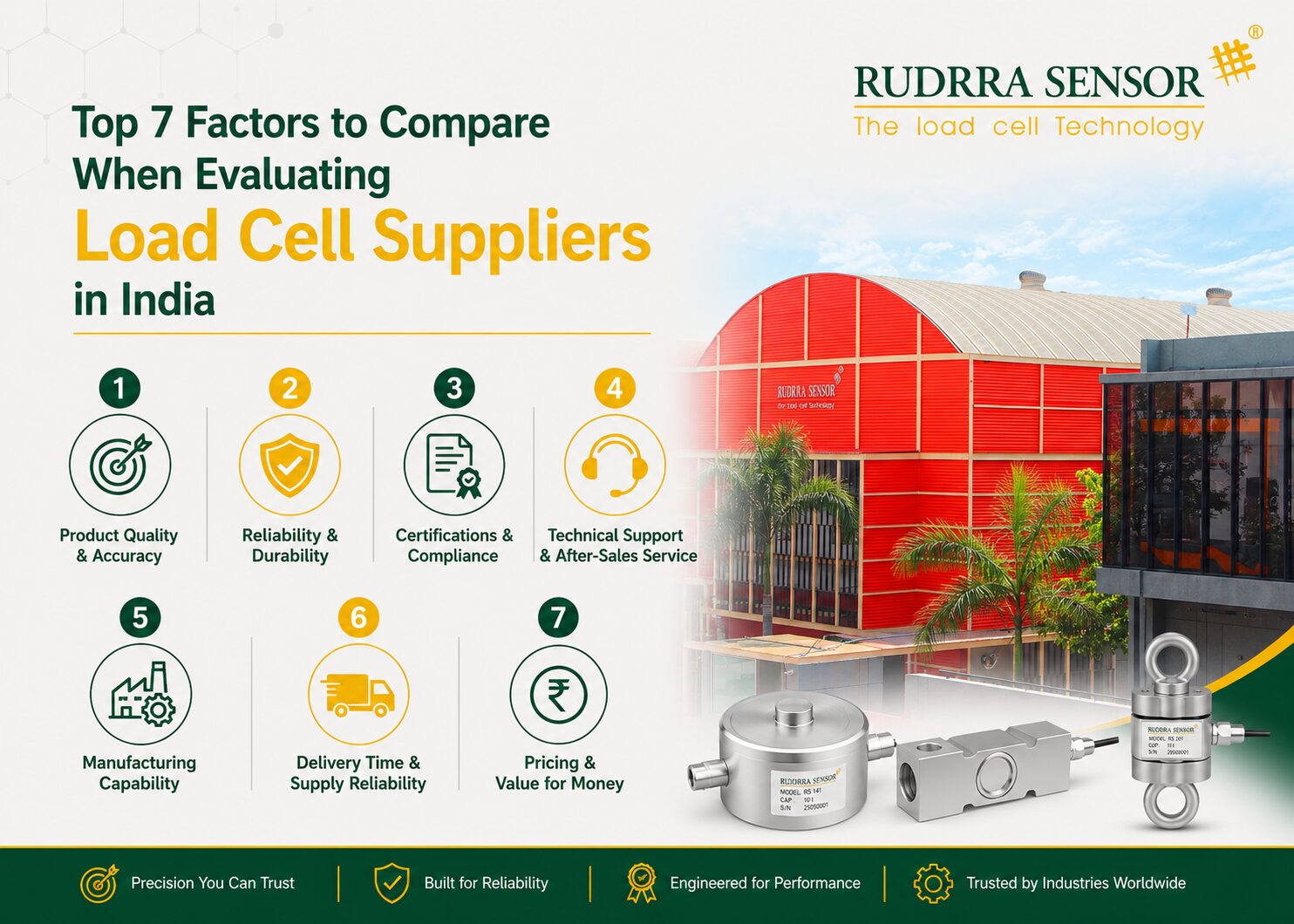
A Strategic Buyer’s Guide for Procurement Managers, Plant Engineers, and Business Owners Across Indian Industries
Introduction: Why Supplier Selection Matters More Than the Product Itself
In India’s rapidly expanding industrial landscape, load cells have evolved from being a niche instrumentation product to a mission-critical component across dozens of sectors — cement and steel manufacturing, pharmaceutical production, food processing, chemical and petrochemical plants, automotive assembly, infrastructure projects, defence and aerospace, and the rapidly growing e-commerce logistics industry. As India pushes forward with its Make in India initiative and modernises its industrial infrastructure, the demand for accurate, durable, and reliable force measurement solutions has never been higher.
Yet here is a paradox that many procurement managers and plant engineers discover too late: two load cells with near-identical technical specifications on paper can deliver completely different real-world outcomes — not because of differences in the load cells themselves, but because of differences in the suppliers behind them. The supplier you choose determines not just what you receive in the first shipment, but how your weighing systems perform six months after installation, who answers the phone when something goes wrong at 2 AM during a critical production run, whether your system remains calibrated and legally compliant when the weights and measures inspector visits, and whether your operation benefits from advances in sensing technology as they emerge.
The Indian load cell supplier landscape is genuinely diverse. It ranges from globally recognised multinational brands with dedicated service networks across the subcontinent, to respected domestic manufacturers who have built strong reputations over decades of supplying Indian industries, to a large middle tier of regional distributors and resellers whose quality, reliability, and after-sales capability vary enormously. Navigating this landscape intelligently — separating the suppliers who will be genuine long-term partners from those who will disappoint you after the purchase order is signed — requires a structured evaluation framework rather than a simple price comparison.
This guide presents the seven most important factors to evaluate when comparing load cell suppliers in India. Each factor is examined in depth, with specific questions you should ask, red flags you should watch for, and practical strategies for gathering reliable information. Whether you are selecting a supplier for a small batch of platform scales or specifying force measurement systems for a greenfield plant with dozens of weighing points, this framework will help you make a decision you can be confident in.
The Indian Load Cell Market: Context and Challenges
Before examining the evaluation factors, it is worth understanding the specific characteristics of the Indian load cell market that make supplier evaluation both important and complex.
Market Size and Growth
India’s weighing and force measurement market has grown substantially over the past decade, driven by expanding manufacturing capacity, increasingly stringent regulatory requirements for pharmaceutical and food industries, the growth of organised logistics, and the wide-scale adoption of automated production processes. Industry analysts estimate the Indian weighing instruments market at several thousand crore rupees annually, with load cells representing a significant portion of the instrumentation component value. Growth projections remain strong, supported by continued infrastructure investment and the digitisation of industrial processes.
Supplier Categories in India
Understanding the different types of suppliers operating in the Indian market helps set realistic expectations about what each type can and cannot deliver:
- International OEM brands with direct India presence — Companies such as HBK (formerly HBM), Vishay, Mettler Toledo, Flintec, and others operate either through wholly-owned subsidiaries, joint ventures, or exclusive distribution arrangements. They typically offer the highest technical specifications and global certification pedigrees, but often at premium price points. Their service depth varies significantly by region — typically strong in major industrial hubs, less reliable in Tier-2 and Tier-3 locations.
- Established Indian manufacturers — Several Indian companies have built genuine engineering depth over decades of manufacturing load cells domestically. These suppliers often offer competitive pricing, strong understanding of Indian operating conditions, and service networks that extend into interior India. Product quality among the best domestic manufacturers is genuinely comparable to international brands for most standard applications.
- Regional distributors and system integrators — A large population of companies operate as distributors for one or more brands, adding local support capability. The quality of this tier varies enormously. Some distributors add real value through deep application expertise and responsive local support; others are essentially order-fulfilment operations with limited technical depth.
- Online and commodity suppliers — The growth of industrial e-commerce in India has created a category of low-price suppliers whose value proposition rests primarily on cost. Product quality and after-sales support in this category is highly variable and often inadequate for demanding industrial applications.
Unique Indian Operating Challenges
India’s geographic and climatic diversity creates operating conditions that stress load cells in ways that are less common in temperate industrial countries. High ambient temperatures (routinely above 45°C in many industrial locations), extreme humidity in coastal and tropical regions, dust and particulate contamination in cement and mining operations, voltage fluctuations and power quality issues, and the combination of high ambient temperatures with chemical atmospheres in process industries — all create a demanding environment where supplier support and product quality are especially critical.
Additionally, India’s Legal Metrology Act and its associated regulations impose specific requirements on weighing systems used in trade and commerce. Compliance with these regulations requires load cells and weighing systems to be evaluated and stamped by Weights and Measures authorities. Navigating this regulatory landscape requires a supplier who understands Indian legal requirements, not just international standards.
Product Quality, Accuracy Standards, and Certification Credentials
The foundational question in any load cell supplier evaluation is whether the products themselves meet the technical requirements of your application. However, evaluating product quality is considerably more complex than comparing specification sheets, and this is where many procurement decisions go wrong.
Understanding Accuracy Classes and What They Mean for Your Application
Load cells are classified according to international accuracy standards, most commonly OIML R 60 (the International Organization of Legal Metrology recommendation for load cells) and NTEP (National Type Evaluation Program, a US standard also referenced in India for imported products). These standards define accuracy classes: C3, C4, C5, and C6 are the most common for industrial load cells, with higher numbers indicating higher accuracy and more verified performance over temperature and time.
The accuracy class you need depends critically on your application. A hopper scale in a ready-mix concrete plant has very different accuracy requirements from a pharmaceutical checkweigher or a jewellery scale. Many procurement decisions fail by specifying a higher accuracy class than the application demands (paying a significant cost premium for capabilities you do not use) or, more dangerously, by accepting a lower accuracy class that cannot meet the process requirements.
Key Question: Ask your potential supplier not just what accuracy class the load cell is rated to, but what uncertainty in measured weight that corresponds to in your specific application — accounting for temperature range, capacity utilisation, number of load cells in the system, and the accuracy of the weighing indicator.
The Certification Landscape in India
A credible load cell supplier should be able to provide proper certification documentation for their products. The relevant certifications for the Indian market include:
- OIML R 60 Certificate of Conformity — Issued by OIML member bodies (including NABL-accredited laboratories in India), this is the primary international quality certification for load cells used in weighing applications. Verify that the certificate is current, that it covers the specific model and capacity range you are purchasing, and that it was issued by a genuinely accredited body.
- Legal Metrology Act Compliance (India) — For weighing systems used in commercial transactions, load cells must comply with the Weights and Measures (Packaged Commodities) Rules and associated regulations. Products must have Indian MC (Model Approval Certificate) from the Director of Legal Metrology. This is a frequently overlooked requirement that can cause serious compliance problems at installation.
- IS:9281 Compliance — The Bureau of Indian Standards standard for weighing instruments used in legal trade provides an Indian-specific framework that any serious domestic market supplier should be familiar with.
- Hazardous Area Certifications — For applications in explosive or flammable atmospheres (petrochemical plants, grain silos, paint and solvent facilities), ATEX (European) or IECEx (international) certification, and increasingly IS/IEC 60079-compliant Indian certification, are mandatory. Verify that the certifications are valid for the specific protection concept and temperature class required by your installation.
- ISO 9001 Manufacturing Certification — Confirms that the supplier’s manufacturing processes are subject to a quality management system. Note that ISO 9001 certifies the quality system, not the product — it is a necessary but not sufficient indicator of product quality.
- NABL-Accredited Calibration — For calibration certificates to have legal standing in India, they should be issued by a NABL (National Accreditation Board for Testing and Calibration Laboratories) accredited laboratory, or by a laboratory with recognised international accreditation (ILAC mutual recognition).
Evaluating Product Quality Beyond the Datasheet
Specification sheets and certificates tell you what a load cell is supposed to do. Evaluating what it actually does requires additional investigation:
- Request production test reports for the specific batch or serial numbers you are being quoted. A reputable manufacturer tests every load cell and should be able to provide individual calibration data showing actual performance figures, not just the nominal specification.
- Ask about the long-term stability data for the product. How much zero drift and span drift has been observed over 12 and 24 months in field conditions? Reputable suppliers have this data; suppliers who cannot answer this question are flagging a significant uncertainty.
- Inquire about the failure rate or Mean Time Between Failures (MTBF) data from the installed base. High-quality suppliers track field reliability data; this information is genuinely differentiating.
- Visit reference installations in your industry. Seeing a load cell that has been in service for three years in conditions comparable to your application is more informative than any specification sheet.
Pro Tip: Always ask for the actual calibration certificate for the specific load cell you are receiving, not a generic product specification. Each individual load cell should have its own calibration record showing measured performance against the specification.
Watch Out: Be cautious of suppliers who offer prices significantly below the market rate for apparently similar specifications. In load cell manufacturing, material quality, strain gauge quality, and manufacturing process control are major cost drivers. A supplier cutting price significantly is almost certainly cutting something — the question is what.
Product Range, Application Expertise, and Technical Depth
A supplier’s product range and technical knowledge are often underweighted in procurement evaluations that focus primarily on price and delivery. Yet the supplier’s ability to understand your specific application and specify the right product for it has enormous implications for total cost of ownership.
The Importance of Correct Product Selection
Load cells come in a remarkable variety of types: compression load cells, tension load cells, shear beam load cells, bending beam load cells, single-point load cells, S-beam load cells, canister load cells, pancake load cells, and more. Each type has specific strengths and limitations relating to how it handles side loads, off-center loads, overloads, and environmental exposure. In addition to cell type, capacity, sensitivity, accuracy class, and environmental protection rating must all be correctly matched to the application.
The consequences of incorrect product selection are serious. An undersized load cell will be subject to overloads that cause premature failure and measurement errors. An incorrectly typed cell — say, a bending beam cell installed in an application that generates significant side loads — will produce systematic measurement errors and potentially fail early. A load cell specified without adequate environmental protection for the actual installation environment will deteriorate rapidly.
A supplier with genuine technical depth can prevent these problems at the specification stage. A supplier whose team consists primarily of salespeople and order processors cannot.
Assessing Technical Depth During the Evaluation
The way a supplier responds to your technical enquiry is itself diagnostic. Strong technical suppliers will ask detailed questions about your application before recommending a product:
- What is the maximum load the system will ever be subject to, including dynamic and impact loads?
- In what environment will the load cell be installed — temperature range, humidity, presence of dust, chemicals, water, or explosive atmospheres?
- What is the structure the load cell will be mounted in — vessel, hopper, conveyor, press, crane, axle weigher?
- What are the accuracy requirements of the complete weighing system, not just the load cell in isolation?
- What is the required service life, and what maintenance access is available?
A supplier who answers your enquiry with a quick price quote without asking these questions is telling you something important about the quality of the advice you will receive throughout the relationship.
Evaluating Product Range Breadth
A supplier with a broad and deep product range is better equipped to serve you across a variety of applications and to grow with your needs over time. Key aspects to evaluate:
- Standard capacities and types — Does the supplier cover the full range of capacities and cell types needed for your industry? A supplier who covers 80% of your needs and requires you to source the remaining 20% from elsewhere creates complexity and potential compatibility issues.
- Speciality and custom products — Can the supplier provide load cells for specialised applications: intrinsically safe cells for hazardous areas, high-temperature cells for furnace weighing, submersible cells for underwater or tank bottom installations, cells for high-cycle fatigue applications?
- System solutions versus components — Does the supplier offer complete weighing system solutions — including mounting hardware, junction boxes, summing electronics, and indicators — or just load cell components? A supplier who can provide a complete, pre-validated system reduces integration risk.
- Accessories and consumables — Can the supplier provide cables, connectors, mounting hardware, and calibration weights? Single-source supply for a complete weighing system simplifies procurement, maintenance, and technical support.
After-Sales Service Infrastructure and Response Capability
Of all the factors in this evaluation framework, after-sales service capability is the one most consistently underestimated during procurement and most bitterly regretted afterward. A load cell that fails during a production run at 11 PM on a Saturday is not a technical problem — it is a business problem. The supplier’s ability to respond effectively in that moment determines whether it remains a manageable incident or escalates into a costly production stoppage.
The Real Cost of Inadequate Service
Consider a scenario that is far from hypothetical: a critical process weighing system fails during a cement plant’s production cycle. The plant produces 5,000 tonnes per day at a contribution margin of Rs. 800 per tonne. A 24-hour downtime costs Rs. 40 lakh in lost contribution. A supplier with on-site service available within four hours versus a supplier who requires three days to dispatch a technician from a distant city represents the difference between a two-hour repair and a Rs. 40 lakh loss.
Multiply this scenario across an industrial complex with dozens of weighing points, and the economic case for evaluating service capability with the same rigour applied to product specification becomes self-evident.
Key Dimensions of Service Capability to Evaluate
Geographic Service Coverage
Map the supplier’s service network against your installation locations. A supplier with strong service presence in Mumbai and Pune but limited coverage in Rajasthan or Odisha may be excellent for urban industrial plants but inadequate for operations in less-developed industrial regions. Ask specifically:
- Where are your service engineers located, and what is their maximum travel time to my installation site?
- Do you have service partners or authorised service centres in regions where you do not have direct service employees?
- What is your documented response time commitment for emergency service calls, and how is it backed up contractually?
Service Team Technical Competence
The quality of service depends on the technical competence of the service team, not just their proximity. Evaluate:
- Are service engineers formally trained and certified on the products they service? Ask for evidence of training records.
- What diagnostic tools does the service team carry — portable load cell indicators, millivolt meters, insulation testers, calibration weights? A service engineer without proper tools cannot diagnose problems effectively.
- Can the service team perform in-situ calibration with traceable weights, or must every calibration require a return to a laboratory?
- Does the service team have experience with your specific industry and application type? A service engineer experienced in pharmaceutical checkweighers may not be the best resource for a 200-tonne crane load cell.
Spare Parts Availability
Rapid repair depends not just on the availability of service engineers but on the ready availability of spare parts. Investigate:
- What is the standard stock of spare load cells, cables, and electronics at the supplier’s nearest depot to your location?
- What is the committed lead time for non-stocked spare parts?
- Does the supplier recommend carrying a defined set of critical spares on-site, and can they help specify and supply this emergency stock?
Service Contract Options
Evaluate what Annual Maintenance Contract (AMC) or Service Level Agreement (SLA) options the supplier offers. A well-structured AMC should include scheduled preventive maintenance visits with calibration verification, priority response commitments for breakdowns, discounted pricing for parts and repairs, and documentation of all service activities for regulatory compliance purposes.
Pro Tip: Request a list of the supplier’s existing service contract customers in your industry or region, and speak directly with their maintenance managers about actual service experience — not the experience the supplier presents in marketing materials.
Watch Out: Beware of suppliers who offer attractive product pricing bundled with multi-year service contracts at high rates. Calculate the total cost of ownership including service contracts, not just the initial purchase price.
Manufacturing Capability, Supply Chain Reliability, and Delivery Performance
In an era of supply chain disruptions, the ability of your load cell supplier to deliver reliably — in standard conditions and under stress — is a critical dimension of value that deserves rigorous evaluation. A supplier who cannot deliver on time does not merely inconvenience your procurement team; they can halt your production lines, delay project commissioning, and force costly emergency sourcing from alternative suppliers.
Understanding Supply Chain Depth
India’s load cell market has suppliers with very different supply chain structures, each with different risk profiles:
- Domestic manufacturers with end-to-end Indian manufacturing — These suppliers are least exposed to international supply chain disruptions. Their key risks are domestic raw material availability (specialist steel alloys, strain gauges, and certain electronic components are imported) and domestic logistics reliability. They typically offer the best lead times for standard products.
- Indian manufacturers who import partially assembled subcomponents — A common model is importing strain gauge rosettes or semi-finished spring elements and completing manufacturing and calibration in India. This provides better cost control than full import while retaining some domestic flexibility.
- Distributors of imported products — These suppliers are most exposed to international supply chain risk. Their lead time reliability depends on their import stocking strategy, and during supply disruptions (as demonstrated painfully during the COVID-19 period), lead times can extend dramatically and unpredictably.
Evaluating Delivery Performance
Past delivery performance is the best predictor of future delivery performance. Gather concrete data:
- Request on-time delivery (OTD) statistics for the past 12 months. A credible supplier will have this data and should be able to provide it. An OTD rate consistently above 95% for standard products indicates a well-managed supply chain.
- Ask about the supplier’s approach to managing demand peaks. Indian industries often have capital expenditure cycles that create demand peaks — can the supplier manage these without extended lead time slippage?
- Understand the supplier’s policy for priority orders. When your plant needs a replacement load cell urgently, what process exists and what premium, if any, applies?
- Evaluate the supplier’s inventory strategy. Do they maintain finished goods stock of the most common products, or do they build to order? Stocking suppliers can offer much shorter lead times for urgent requirements.
Manufacturing Quality Management
The supplier’s manufacturing quality management practices determine the consistency of product quality over time, not just for the samples and demonstrations provided during the evaluation:
- Visit the manufacturing facility if practical. The physical state of a manufacturing facility — cleanliness, organisation, calibration of manufacturing equipment, environmental controls — tells you a great deal about quality culture.
- Ask about the statistical process control (SPC) methods used in manufacturing. Are process parameters monitored and controlled, or does quality rely primarily on end-of-line testing?
- Understand the calibration traceability of manufacturing test equipment. Are the load cells used to calibrate outgoing products themselves calibrated against traceable standards? What is the calibration interval?
- Inquire about the supplier’s approach to managing quality non-conformances. A mature quality management system will have clear processes for identifying, containing, and correcting quality problems.
Pro Tip: Request copies of the supplier’s Quality Management System documentation, particularly the sections relating to calibration and test. The quality of this documentation is often a reliable indicator of manufacturing quality culture.
Pricing Transparency, Total Cost of Ownership, and Commercial Terms
Price is inevitably a central consideration in supplier evaluation, but the way price is evaluated matters enormously. A procurement approach that focuses exclusively on the purchase price per unit — ignoring installation costs, calibration costs, maintenance costs, the cost of unplanned downtime, and the expected service life of the product — will routinely make decisions that appear financially attractive in the short term and prove very costly over time.
The Total Cost of Ownership Framework for Load Cells
A complete total cost of ownership (TCO) analysis for a load cell system should include the following cost categories:
Initial Acquisition Costs
- Load cell unit price (for all cells in the system)
- Associated hardware: cables, junction boxes, mounting hardware, indicators/transmitters
- Freight, insurance, and customs duties (for imported products)
- Installation and commissioning costs (often underestimated for systems in difficult locations)
- Initial calibration costs (including certified reference weights or external calibration service)
Operating and Maintenance Costs
- Scheduled preventive maintenance costs (annual calibration, inspection, and documentation)
- Spare parts carrying cost (the cost of holding emergency spare load cells and components on-site)
- Service contract costs (AMC or SLA fees)
- Power consumption of the weighing electronics (relevant for large multi-cell systems)
Failure and Downtime Costs
- Expected number of load cell failures per year, based on supplier’s reliability data and your operating conditions
- Cost per failure event: parts, labour, and — critically — lost production during downtime
- Cost of emergency expediting for replacement parts when a failure is unplanned
End-of-Life Costs
- Expected service life of the load cell in your operating conditions
- Decommissioning and disposal costs (particularly relevant for hazardous area installations)
- Cost of technology obsolescence: will spare parts and compatible electronics be available for the expected life of the system?
Evaluating Price Transparency
Beyond the total cost framework, the way a supplier presents and discusses pricing reveals important information about their commercial culture:
- Is the quotation detailed, itemised, and clear about what is included? Or is it a single-line total that obscures what you are and are not receiving?
- Are prices for accessories, spare parts, and services clearly stated, or do these emerge later at higher-than-expected levels?
- What is the supplier’s approach to price escalation on long-term contracts or repeat orders? Are price adjustment mechanisms transparent and tied to objective indices?
- Does the supplier offer volume pricing, and are volume discount thresholds reasonable for your actual purchasing patterns?
Commercial Terms and Contract Risk
Evaluate the commercial terms offered by each supplier beyond the unit price:
- Payment terms — Standard Indian industry terms are 30-60 days. Suppliers requiring advance payment for standard products, or offering extended payment terms as a differentiator, warrant careful scrutiny.
- Warranty terms — What is the warranty period and scope? What does the supplier cover under warranty — just product defects, or also consequential effects of a product failure on your process? Who bears the cost of installation and removal during a warranty replacement?
- Lead time commitments and penalties — Are quoted lead times contractually committed, and are there agreed consequences for late delivery?
- Dispute resolution — In the event of a commercial or technical dispute, what is the agreed resolution mechanism? Is it arbitration, litigation, or a structured escalation process?
Regulatory Compliance, Legal Metrology Knowledge, and Industry-Specific Standards
India has a detailed regulatory framework governing weighing and measuring instruments, and compliance with this framework is not optional for many applications. A supplier who is not thoroughly familiar with Indian regulatory requirements — and who cannot support you in achieving and maintaining compliance — creates regulatory risk that can result in penalties, forced equipment replacement, and in commercial applications, potential prosecution under the Legal Metrology Act.
The Indian Legal Metrology Framework
The Legal Metrology Act, 2009, and its associated rules and regulations govern all weighing instruments used in trade and commerce in India. Key provisions relevant to load cell system procurement include:
- Type Approval — Weighing instruments used in trade must be of a type that has been approved by the Legal Metrology authority (Central or State). Type approval is based on pattern evaluation and testing. A supplier who does not have or cannot obtain type approval for their products cannot legally supply instruments for trade use.
- Verification and Stamping — Each instrument must be verified (tested for compliance with accuracy requirements) and stamped by a Legal Metrology Inspector at the time of initial installation and at defined periodic intervals (typically annually). Instruments that are not current on verification are illegal for trade use.
- Calibration Traceability — All calibration must be traceable to national standards maintained by the National Physical Laboratory of India (NPLI). Calibration certificates issued by NABL-accredited laboratories satisfy this requirement.
- Record-Keeping — Operators of trade instruments must maintain records of verification, calibration, and maintenance. A supplier who can provide documentation support for these records — and whose service team understands the documentation requirements — adds real compliance value.
Industry-Specific Regulatory Requirements
Beyond the general Legal Metrology framework, many industries have sector-specific standards and requirements:
- Pharmaceuticals and food processing — CDSCO (Central Drugs Standard Control Organisation) and FSSAI (Food Safety and Standards Authority of India) requirements impose GMP (Good Manufacturing Practice) and GHP (Good Hygiene Practice) standards that include requirements for weighing instrument qualification, calibration, and documentation consistent with FDA 21 CFR Part 11 (for electronic records) and EU GMP Annex 11. A supplier experienced in pharmaceutical applications should understand IQ/OQ/PQ validation documentation requirements.
- Petroleum and chemical industries — The Petroleum and Explosives Safety Organisation (PESO) and related authorities regulate equipment used in hazardous areas. Load cells installed in classified hazardous areas must comply with relevant Indian Electricity Rules and the IS/IEC 60079 series of standards for equipment in explosive atmospheres.
- Automotive and aerospace — These sectors typically require supplier quality systems to be certified to IATF 16949 (automotive) or AS9100 (aerospace) in addition to ISO 9001. If your application falls in these sectors, check whether the load cell supplier’s quality management system meets these more stringent requirements.
- Defence and government procurement — DPP (Defence Procurement Procedure) and GFR (General Financial Rules) impose specific requirements on procurement processes and supplier credentials for government and defence applications.
Evaluating Regulatory Competence
The following questions help assess a supplier’s regulatory competence:
- Can you provide copies of your Legal Metrology type approval certificates relevant to the products you are quoting?
- Is your calibration laboratory NABL-accredited, and can you provide the NABL certificate number?
- What is your experience supporting customers through Legal Metrology verification and stamping?
- For pharmaceutical applications: have you completed IQ/OQ/PQ validation projects? Can you provide validation documentation templates and references?
- For hazardous area applications: what ATEX/IECEx/IS certifications do your products hold, and can you support the zone classification documentation for my instsallation?
Pro Tip: Request a copy of a supplier’s NABL calibration certificate and verify its authenticity directly on the NABL website (nabl-india.org). NABL accreditation can be easily fabricated by unscrupulous suppliers; always verify independently.
Watch Out: Do not assume that an internationally certified product is automatically compliant with Indian Legal Metrology requirements. International OIML certificates support but do not substitute for Indian Legal Metrology type approval. Always verify Indian compliance status explicitly.
Supplier Financial Stability, Track Record, and Long-Term Partnership Potential
The final factor in the evaluation framework addresses a dimension that many procurement processes neglect entirely: the long-term viability and trustworthiness of the supplier as a business partner. Load cell systems installed today will be in service for ten, fifteen, or even twenty years. The supplier you choose today needs to be the supplier who can support you throughout that service life — providing spare parts, calibration services, technical upgrades, and responsive support for as long as your system is in operation.
Why Financial Stability Matters
A supplier who cannot sustain their business cannot sustain their service commitments. The consequences of a supplier failure are severe: spare parts become unavailable, service engineers move to other companies, technical documentation and calibration records become inaccessible, and your installed base of weighing systems gradually degrades from lack of support. Finding and qualifying a replacement supplier, re-verifying all instruments, and in some cases replacing non-supportable equipment — all represent costs that can far exceed the savings achieved by choosing a financially marginal supplier based on low price.
India has seen several cases where locally prominent load cell distributors have exited the market, leaving their installed customer base without support. Evaluating supplier financial stability is not being pessimistic — it is prudent risk management.
Assessing Financial Stability and Business Continuity
The following approaches provide useful information about a supplier’s financial stability and business continuity:
- Request audited financial statements for the past two to three years. For listed companies, these are publicly available. For private companies, request Chartered Accountant certified accounts. Look for positive EBITDA, manageable debt levels, and a trend of growth rather than contraction.
- Review the supplier’s credit rating if available (CRISIL, ICRA, and other Indian rating agencies rate many industrial companies). A strong credit rating indicates financial resilience.
- Assess the supplier’s years in business and trajectory. A company that has operated in the Indian market for fifteen or twenty years, growing its customer base and product range, is a very different risk profile from a company that has been operating for two years or one that appears to be contracting.
- Check for legal or regulatory actions against the supplier through Ministry of Corporate Affairs filings and public records. Unresolved regulatory non-compliance or significant litigation is a warning sign.
- Evaluate the depth of the supplier’s management team. Is the business heavily dependent on one or two key individuals? If so, what succession planning is in place? A business with strong institutional depth is more resilient than one that depends on a single founder or leader.
Evaluating Track Record Through References
Nothing validates a supplier’s claims like the direct testimony of existing customers. A rigorous reference check should be a standard part of every major supplier evaluation:
- Request at least five customer references, specifically including customers in your industry, with installations of comparable scale and complexity to yours.
- Request references from customers whose installations have been in service for at least three years — long enough that the quality of ongoing service is apparent.
- Conduct reference calls or visits with a structured set of questions. Do not rely on written testimonials provided by the supplier — these are inevitably selective.
- Ask references specifically about their experiences with service response, spare parts availability, and the supplier’s behaviour when things went wrong. A supplier’s true character is revealed in how they handle problems, not how they manage smooth operations.
- If possible, visit a reference customer’s installation to see the equipment in service and speak informally with maintenance and operations staff, not just the procurement manager.
Assessing Long-Term Partnership Potential
Beyond financial stability and past track record, assess the supplier’s orientation toward long-term partnership versus transactional relationships:
- Does the supplier invest in understanding your business needs and processes, or do they focus exclusively on individual transactions?
- Does the supplier proactively share relevant technical information — application notes, industry developments, regulatory changes — or do they communicate only when you initiate contact?
- Does the supplier have a product development roadmap that is aligned with the direction your industry is heading? As Industry 4.0 principles reshape Indian manufacturing, load cell suppliers who are investing in digital connectivity, predictive maintenance capabilities, and smart sensor integration will be more valuable partners than those who are not.
- How does the supplier handle a situation where their standard product is not quite right for your application? Do they help you find the best available solution, even if it means recommending a product modification or an alternative approach? Or do they push their standard product regardless of fit?
Pro Tip: Structure your reference calls around specific scenarios: ‘Tell me about a time when a load cell failed urgently and how the supplier responded.’ The specificity of the answer — the names, dates, and details — tells you whether you are hearing a genuine experience or a rehearsed generalisation.
Watch Out: A supplier who is reluctant to provide customer references, or who provides only references from very recent customers, is signalling something important. Long-term customers who are satisfied with a supplier are typically happy to recommend them.
Emerging Trends Shaping Load Cell Supplier Evaluation in India
The criteria for evaluating load cell suppliers in India are not static. Several significant trends are reshaping what good looks like, and forward-looking procurement decisions should incorporate these developments.
Digital Integration and Industry 4.0
Indian manufacturing is in the midst of a digital transformation. Load cells and weighing systems are increasingly expected to integrate with manufacturing execution systems (MES), enterprise resource planning (ERP) systems, and plant-wide Industrial Internet of Things (IIoT) platforms. Suppliers who offer load cells with integrated digital communication (IO-Link, EtherNet/IP, PROFIBUS, Modbus TCP) and who have experience integrating with common Indian manufacturing IT environments (SAP, Oracle) are increasingly valuable partners.
Ask potential suppliers specifically about their digital integration capabilities and their experience with Indian digitalisation projects. This is a rapidly evolving area, and suppliers who are investing in it are better positioned as long-term partners than those who remain purely analogue in their product and service thinking.
Predictive Maintenance Capabilities
Advanced load cell systems are beginning to offer embedded diagnostic capabilities — continuous monitoring of insulation resistance, bridge balance, temperature, and other parameters that give early warning of developing problems. These capabilities, properly supported by supplier analytics and alert systems, represent a transition from reactive maintenance (fix it when it breaks) to predictive maintenance (address issues before they cause failures). Suppliers who can support this transition offer a genuinely superior total cost of ownership proposition that can justify a premium over simpler alternatives.
Environmental and Sustainability Considerations
India’s sustainability agenda — driven by regulatory pressure, customer requirements, and corporate governance standards — is increasingly influencing procurement decisions. Evaluating load cell suppliers through an ESG (Environmental, Social, and Governance) lens includes:
- Environmental sustainability of manufacturing processes — energy consumption, waste management, use of hazardous materials
- Product recyclability and end-of-life management
- Supply chain sustainability — the environmental and social practices of the supplier’s own supply chain
- Supplier’s approach to energy efficiency in product design
While these considerations may not yet be decisive factors in most Indian procurement decisions, their importance is growing and will continue to grow. Suppliers who are proactively addressing sustainability are better positioned for the medium-term.
Make in India and Domestic Supply Chain Development
The Make in India initiative continues to shape the policy environment for industrial equipment procurement. For government and PSU buyers, domestic manufacturing content requirements create a preference for Indian-manufactured load cells. For private sector buyers, the initiative has strengthened the case for domestic suppliers by improving manufacturing quality standards and government support for domestic manufacturing investment.
Evaluating a supplier’s domestic manufacturing depth — not just assembly of imported components, but genuine manufacturing of key components in India — is increasingly relevant both for policy compliance and for supply chain resilience.
Why Many Indian Industries Consider Rudrra Sensor as a Reliable Load Cell Partner
When evaluating load cell suppliers in India against the criteria outlined in this guide, many procurement professionals, plant engineers, and system integrators look for suppliers that combine product quality, application expertise, responsive support, and long-term reliability. Rudrra Sensor is an Indian manufacturer of load cells and force measurement solutions serving industries such as manufacturing, process automation, material handling, logistics, pharmaceuticals, food processing, infrastructure, and OEM equipment manufacturing.
The company offers a comprehensive range of load cells, weighing modules, force measurement solutions, and related instrumentation designed to address diverse industrial requirements. With a focus on Indian operating conditions, quality-focused manufacturing practices, application-specific engineering support, and responsive customer service, Rudrra Sensor supports customers throughout the project lifecycle—from product selection and system integration to calibration assistance and after-sales support.
For organisations seeking a supplier that understands local industry challenges while delivering dependable performance, technical guidance, and long-term support, Rudrra Sensor represents a strong option to include in any supplier evaluation process. As with any procurement decision, buyers should independently assess certifications, technical suitability, service capabilities, and application fit based on their specific operational and regulatory requirements.
Conclusion: From Evaluation to Partnership
The seven factors examined in this guide — product quality and certification, application expertise and product range, after-sales service capability, supply chain reliability, total cost of ownership and commercial terms, regulatory compliance, and supplier financial stability — provide a comprehensive framework for evaluating load cell suppliers in India. Together, they address the full spectrum of value that a supplier relationship delivers over its lifetime, from the technical performance of the product on day one to the quality of support ten years into an installation’s life.
The investment required to conduct a rigorous evaluation using this framework is real. It requires more time than a simple price comparison, involves visiting supplier facilities and reference customers, demands detailed documentation review, and necessitates conversations that go beyond what many suppliers are accustomed to in a standard sales process. Some suppliers will be uncomfortable with the depth of scrutiny; others will welcome it as an opportunity to differentiate themselves.
That reaction itself is diagnostic. A supplier who is confident in their product quality, service capability, financial stability, and regulatory compliance will embrace rigorous evaluation. A supplier who pushes back against detailed questioning, is unable to provide the documentation you request, or steers the conversation relentlessly back to price is signalling the limits of their value proposition.
The goal of this evaluation process is not to find the cheapest supplier, or even the supplier with the most impressive specification sheet. The goal is to find the supplier who will be the most valuable partner over the full lifecycle of your load cell investment — the supplier who will help you specify the right products, support you through installation and commissioning, keep your systems calibrated and compliant, respond effectively when problems arise, and grow their capabilities alongside yours as technology and regulatory requirements evolve.
In India’s dynamic and demanding industrial environment, that kind of partnership is not a luxury. It is a competitive advantage. The organisations that recognise this and invest in rigorous supplier selection consistently achieve better outcomes than those who treat load cell procurement as a commodity purchase to be won by the lowest bidder. May this guide help you build the supplier relationships that will serve your operations well for years to come.