


Introduction
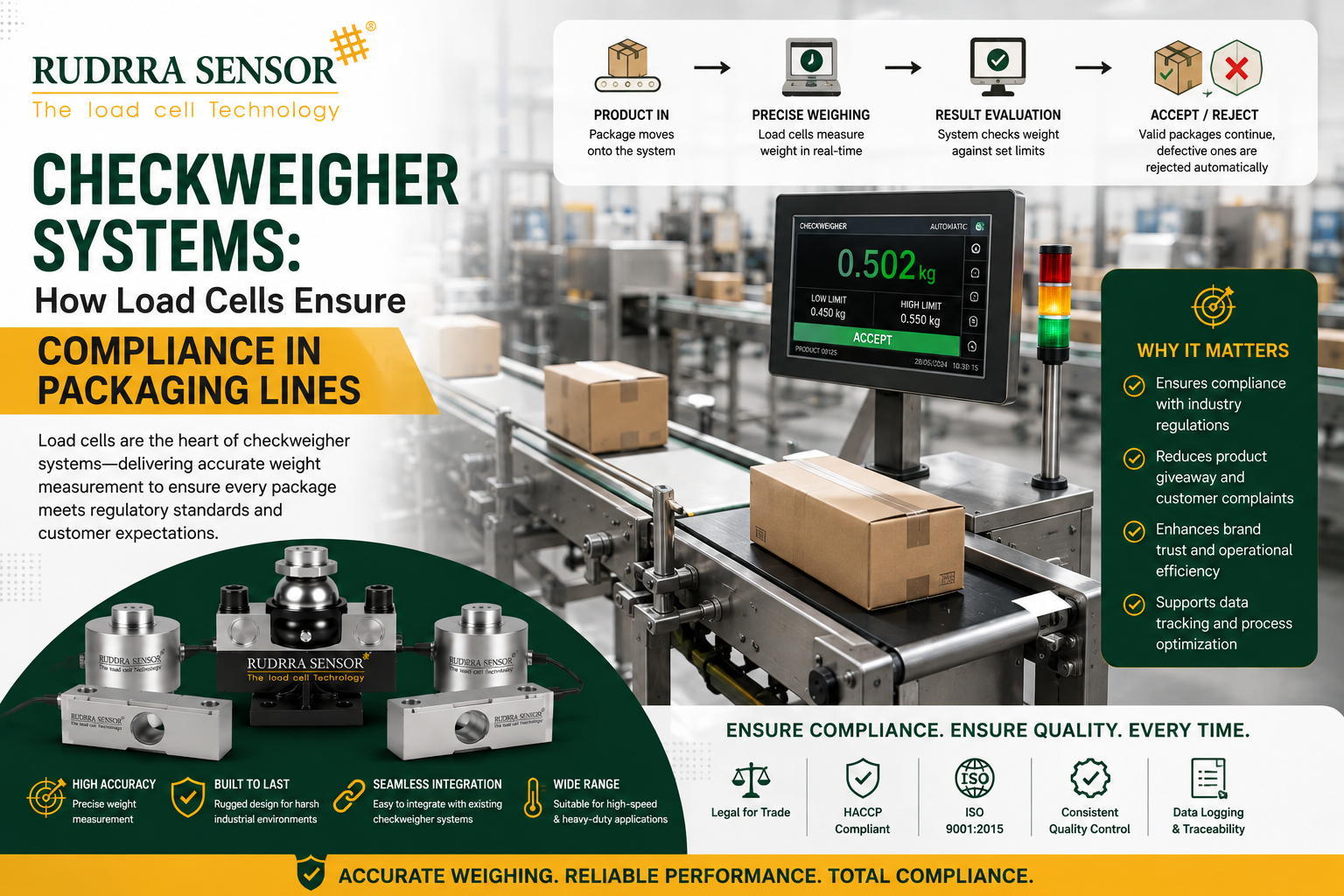
Walk into almost any modern food, pharmaceutical, or consumer goods packaging facility and, somewhere along the production line, you’ll find a checkweigher — a compact, unassuming piece of equipment that quietly weighs every single package moving through it, at speeds that can exceed several hundred packages per minute, rejecting anything outside its allowed weight tolerance before it ever reaches a customer or retail shelf. It’s easy to overlook how much engineering sophistication sits inside that unassuming box. A checkweigher has to extract an accurate weight reading from a package that never stops moving, do it fast enough to keep up with some of the highest-speed production lines in industry, and do it reliably enough that a manufacturer can stake its regulatory compliance, its brand reputation, and its profit margin on the result.
Checkweighers exist because weight-based compliance is not optional in most consumer packaged goods markets. Regulations governing “average quantity” or “net content” labeling require that packaged goods, on average, contain at least the declared weight, with defined limits on how far any individual package can fall short. Get this wrong — systematically underfilling packages — and a manufacturer faces regulatory penalties, product recalls, and serious reputational damage. Get it wrong in the other direction — consistently overfilling to stay safely clear of any compliance risk — and a manufacturer quietly gives away product margin on every single unit sold, a cost that compounds into a very significant figure across a high-volume production line running continuously for months and years.
Load cells are the sensing technology that makes accurate, high-speed checkweighing possible. This blog is a deep, practical look at how checkweigher systems work, why they matter so much for both regulatory compliance and commercial profitability, the technical trust factors that separate a genuinely reliable, production-grade checkweigher from an inadequately specified one, real-world case studies showing measurable outcomes, and the standards — including average quantity system rules and legal-for-trade certification frameworks such as NTEP and OIML — that govern how these systems are designed, certified, and operated.
At Rudrra Sensor, we understand that a checkweigher sits at a uniquely high-stakes point in a production line: it is simultaneously a quality control tool, a compliance safeguard, and a direct driver of packaging cost efficiency. This article is written for packaging engineers, quality assurance teams, and plant management who need to understand not just what a checkweigher does, but what genuinely matters when specifying, operating, and troubleshooting one.
It’s worth framing why checkweighing deserves this level of dedicated technical attention rather than being treated as a routine, interchangeable piece of line equipment. Unlike many other measurement applications where a modest accuracy shortfall simply means a slightly less precise number, a checkweigher operates at the exact intersection of legal compliance and commercial margin — every decision about tolerance configuration, fill target, and measurement accuracy has a direct, quantifiable effect on both regulatory risk exposure and the manufacturer’s bottom line, often simultaneously and in tension with each other. Set the tolerance too loose or the fill target too conservative, and the business gives away margin unnecessarily; set it too aggressively without the underlying measurement confidence to support the decision, and the business risks a genuine compliance failure. Navigating that tension well is precisely what separates a checkweigher installation that delivers real business value from one that merely exists as a regulatory checkbox.
Why Checkweighing Matters in Packaging Operations
Regulatory compliance depends on statistical, not just individual, accuracy
Most weight and measures regulations governing packaged goods — commonly referred to as average quantity system (AQS) rules in many jurisdictions, and closely related frameworks elsewhere — do not simply require every single package to meet or exceed its declared weight. Instead, they typically require that the average weight of a production batch meets or exceeds the declared quantity, while also limiting how far below the declared weight any individual package can fall, and limiting the proportion of packages that can fall within a defined “tolerable” shortfall range. This means compliance is fundamentally a statistical exercise, not a simple pass/fail check on each package, and a checkweigher’s accuracy and repeatability directly determine how confidently a manufacturer can demonstrate compliance with these statistical requirements.
Underfilling risk carries direct regulatory and reputational consequences
A manufacturer found to be systematically underfilling packages — whether from a genuine process control failure or from a poorly calibrated or malfunctioning checkweigher failing to catch the issue — faces a range of consequences depending on jurisdiction and severity: fines, mandated corrective action plans, product recalls, and in serious or repeated cases, more significant regulatory enforcement action. Beyond formal regulatory consequences, publicized underfilling issues can cause lasting reputational damage with both retailers and consumers, particularly in an environment where “shrinkflation” and packaging integrity have become subjects of considerable public and media scrutiny in many consumer goods categories.
Overfilling is a direct, continuous cost to the business
While overfilling doesn’t carry the same regulatory risk as underfilling, it represents a direct, ongoing cost — every gram of product given away above the declared weight (and above whatever margin a manufacturer’s process control genuinely requires to maintain compliance confidence) is product that could have been sold rather than given away for free. On a high-volume production line, even a very small average overfill percentage translates into a substantial cumulative cost over a year of continuous production, making minimizing “giveaway” — the industry term for this excess fill — a significant driver of checkweigher and broader process control investment, often with a faster and more directly quantifiable return on investment than the compliance risk-avoidance argument alone.
Checkweighers provide the feedback loop that enables tighter fill control
Beyond simply catching out-of-tolerance packages after the fact, modern checkweigher systems commonly feed weight data back to the upstream filling or dosing equipment in a closed-loop configuration, allowing the filling process to be automatically and continuously adjusted to keep the average fill weight tracking as close as possible to the target — minimizing giveaway while maintaining compliance margin — rather than relying on periodic manual filler adjustment based on infrequent sample checks.
Checkweighing supports broader quality and traceability objectives
Beyond weight compliance specifically, checkweigher data is increasingly integrated into broader manufacturing quality and traceability systems, providing a continuous, complete record of every package’s weight (rather than a sampled subset), supporting statistical process control analysis, root cause investigation when quality issues arise, and, in regulated industries such as pharmaceuticals, formal batch record documentation requirements.
Detecting missing components or foreign material
In many packaging applications, particularly multi-component products (a box containing several individual items, a kit product, or a package that should contain a specific accessory or insert), checkweighing serves an additional quality function beyond simple net content compliance: detecting packages that are missing a component (registering as underweight) or that may contain foreign material or an incorrect additional item (registering as overweight), providing a valuable quality control function distinct from, but complementary to, pure weight compliance verification.
How Checkweigher Systems Work
The basic measurement challenge: weighing a package in motion
Unlike a static platform scale, which allows a load cell’s output to settle to a stable reading before the value is captured, a checkweigher must extract an accurate weight from a package that is moving continuously across the weighing platform — a fundamentally more demanding measurement problem, since the raw load cell signal includes not just the true static weight but also dynamic effects from the package’s motion, vibration transmitted through the conveyor structure, and mechanical noise from the weighing platform’s own construction.
Load cell types commonly used in checkweighing
Checkweighers typically use one of several load cell technologies depending on the required speed, accuracy, and product weight range: strain gauge load cells remain the most common choice across the majority of checkweighing applications, offering a good balance of accuracy, cost, and robustness; for very high-speed, high-precision applications, some checkweighers use specialized digital load cells or electromagnetic force restoration (EMFR) technology, which can offer superior dynamic response and resolution for the most demanding high-speed, high-accuracy requirements, particularly in pharmaceutical and other regulated industries where both speed and precision requirements are unusually stringent.
The choice between these technologies is rarely a simple “better versus worse” decision — it’s a matter of matching the specific combination of speed, resolution, and cost tolerance the application demands. A moderate-speed line packaging a relatively heavy, low-value product with a generous tolerance band has little need for the added cost of EMFR technology; a high-speed pharmaceutical line packaging a low-weight, high-value product with an extremely tight tolerance band may find that only EMFR or specialized high-resolution digital load cell technology can reliably deliver the required combination of speed and precision simultaneously. Understanding where a specific application genuinely sits on this spectrum, rather than defaulting to either the cheapest or the most sophisticated available technology, is an important part of a properly engineered checkweigher specification.
Signal processing and digital filtering are as important as the sensor itself
Given the dynamic, noisy nature of the raw signal a checkweigher’s load cell produces, sophisticated digital signal processing — filtering out vibration and mechanical noise while still responding fast enough to capture an accurate weight within the brief window each package is on the weighing platform — is at least as important to overall system accuracy as the load cell’s own base specification. This is a critical point often underappreciated in checkweigher specification: two systems built around load cells with identical datasheet specifications can perform very differently in practice depending on the quality of the signal processing and filtering algorithm applied to the raw signal.
Conveyor design and mechanical isolation affect achievable accuracy
The weighing section of a checkweigher — typically a short, dedicated conveyor belt section mechanically isolated from the rest of the production line’s conveyor system — is engineered specifically to minimize the transmission of vibration and mechanical disturbance from adjacent equipment into the weighing platform. Poor mechanical isolation design, or a checkweigher retrofitted into an existing line without adequate attention to this isolation, can significantly degrade achievable accuracy regardless of the underlying load cell quality.
Reject mechanisms remove out-of-tolerance packages automatically
Once a package’s weight is measured and compared against the configured tolerance limits, checkweighers use one of several reject mechanism types — pusher arms, air blast rejection, diverter gates, or drop-through mechanisms — to automatically remove out-of-tolerance packages from the line without requiring operator intervention, typically directing rejected packages to a separate collection point for inspection, rework, or disposal depending on the specific quality procedure in place.
Statistical reporting and closed-loop feedback capability
Beyond individual package accept/reject decisions, modern checkweigher systems typically provide statistical process control reporting — tracking average weight, standard deviation, and reject rate trends over time — and, as discussed above, many systems support closed-loop feedback to upstream filling equipment, automatically nudging fill target settings to correct for any drift detected in the ongoing weight data.
Where Checkweighers Are Used Across Packaging Industries
Food and beverage packaging
Food and beverage manufacturing represents one of the largest application areas for checkweighing, spanning everything from high-speed snack food and confectionery lines running many hundreds of packages per minute, to lower-speed but higher-value applications such as premium meat and cheese packaging, where accuracy at relatively low package weights is particularly demanding given the tight tolerance typically required.
Pharmaceutical and nutraceutical packaging
Pharmaceutical packaging applications place unusually stringent demands on checkweigher accuracy and validation documentation, given the regulatory scrutiny applied to pharmaceutical manufacturing quality systems generally, and the direct patient safety consequences of under- or over-filled medication packaging in certain product categories, particularly for products where precise dosing matters significantly.
Personal care and household products
Checkweighing is standard practice across personal care products (cosmetics, toiletries) and household goods (detergents, cleaning products) packaging lines, where net content compliance operates under the same general average quantity system regulatory framework as food products in most jurisdictions.
Chemical and industrial product packaging
Bagged and packaged chemical products, agricultural inputs, and industrial goods also commonly incorporate checkweighing, often at higher individual package weights than typical consumer food or personal care applications, requiring load cells and mechanical platform designs scaled appropriately for the higher capacity range involved.
E-commerce and logistics parcel verification
Beyond primary product packaging, checkweighing technology (in a somewhat different but technically related form) is increasingly used in e-commerce fulfillment and logistics operations to verify parcel weight against expected order contents — catching picking errors (missing or extra items) before a parcel is shipped, an application that shares core measurement technology with traditional packaging line checkweighing but serves a different primary purpose (order accuracy verification rather than net content compliance).
Multi-head and combination weighing integration
In many food packaging applications, particularly for products packed by count or by a combination of variable-weight pieces (such as fresh produce, snack foods, or frozen items), checkweighers work downstream of multi-head combination weighing systems, providing a final verification check on the combined output of the upstream weighing and filling process rather than being the primary weight-determining step itself.
How Checkweigher Load Cells Differ From Standard Industrial Load Cells
Extremely high dynamic response requirements
As discussed above, checkweighers must extract an accurate weight reading from a package that is on the weighing platform for a very brief period — often well under a second at high line speeds — requiring load cells and signal processing with dynamic response characteristics far exceeding what most static industrial weighing applications require.
High resolution relative to capacity
Checkweighing applications frequently require distinguishing very small weight differences relative to the overall package weight — a tight tolerance band on a moderately sized package requires a load cell capable of resolving a small fraction of its rated capacity reliably and repeatably, a demanding resolution requirement compared to many general industrial weighing applications where a coarser resolution relative to capacity is acceptable.
Hygienic design for food and pharmaceutical washdown environments
Checkweighers used in food and pharmaceutical production frequently require washdown-compatible, hygienic design — sealed to a high IP rating, constructed from stainless steel, and designed without crevices or mounting features that could harbor bacterial growth or trap cleaning residue, similar in principle to the hygienic design considerations discussed for livestock and dairy applications, but with even more stringent requirements in many pharmaceutical contexts given the regulatory quality standards involved.
Mechanical isolation and vibration damping integrated into the platform design
Unlike a general industrial load cell that might be mounted on a simple support structure, checkweigher load cells are typically integrated into a purpose-designed weighing platform and conveyor section engineered specifically to minimize vibration transmission from the surrounding production line, a mechanical engineering consideration that is as important to overall system performance as the load cell’s own specification.
Legal-for-trade certification is frequently mandatory
Given that checkweighers directly support net content compliance — a legal requirement in most jurisdictions for packaged consumer goods — many checkweigher applications require formal legal-for-trade certification of the complete system, not just the load cell in isolation, following frameworks such as NTEP in North America or OIML internationally, a certification requirement that governs the complete measurement system’s design, not simply the sensor component.
Integration with line control and data systems
Checkweighers are rarely standalone devices in a modern production environment — they are typically integrated with line control systems, statistical process control software, and in regulated industries, formal quality and batch record documentation systems, requiring load cell and system-level signal output compatible with these broader integration requirements.
A Practical Specification Checklist
Before specifying or procuring a checkweigher system, working through a structured checklist helps ensure the system will actually deliver the accuracy, throughput, and compliance capability the application requires:
- Line speed and required throughput, expressed in packages per minute, since this directly drives the dynamic response and mechanical design requirements of the weighing platform.
- Package weight range and required tolerance, including both the target/nominal weight and the specific tolerance band the application must reliably distinguish.
- Required accuracy and resolution, driven by the tightness of the tolerance band relative to the nominal package weight.
- Regulatory and certification requirements, including whether formal legal-for-trade certification (NTEP, OIML, or the relevant national framework) is required for the specific market and product category.
- Hygienic and washdown requirements, based on the specific food, pharmaceutical, or other regulated production environment the checkweigher will operate in.
- Reject mechanism type and downstream handling, matched to the package type, weight, and the specific rejected-product handling procedure the facility uses.
- Integration requirements with line control, filler feedback, and data/reporting systems, including whether closed-loop filler feedback capability is required.
- Physical space and conveyor integration constraints, particularly important when retrofitting a checkweigher into an existing production line rather than specifying it as part of a new line design.
- Statistical process control and batch record documentation requirements, particularly relevant for regulated industries such as pharmaceuticals.
- Calibration and ongoing verification plan, including how the installed system will be periodically checked against reference standards to maintain compliance confidence over time.
Trust Factors: Technical Benchmarks for Checkweigher Load Cells
| Trust Factor | Why It Matters | Typical Benchmark |
| Dynamic response speed | Enables accurate weighing at high line speeds | Matched to the specific line speed and package dwell time on the platform |
| Resolution relative to capacity | Distinguishes small weight differences within tight tolerances | High resolution appropriate to the tolerance band as a fraction of nominal weight |
| Legal-for-trade certification | Confirms suitability for net content compliance use | NTEP/OIML certification of the complete system where required |
| IP/hygienic sealing | Protects against washdown and food/pharma contamination risk | IP65–IP69K depending on washdown frequency and hygiene requirements |
| Mechanical isolation quality | Minimizes vibration-induced measurement error | Purpose-designed platform and conveyor isolation, not a generic mounting |
| Repeatability | Ensures consistent readings package to package | Very tight repeatability specification relative to tolerance band |
| Reject mechanism reliability | Ensures out-of-tolerance packages are actually removed | High mechanical reliability rated for the line’s continuous duty cycle |
| Signal processing/filtering quality | Extracts accurate weight from dynamic, noisy raw signal | Advanced filtering algorithms matched to line speed and vibration profile |
| Statistical reporting capability | Supports compliance demonstration and process control | Continuous average weight, standard deviation, and reject rate tracking |
| Calibration traceability | Confirms measurement accuracy is verifiable and auditable | Certificate traceable to a recognized national/international standard |
Why resolution relative to capacity is a defining specification parameter
Unlike many general industrial weighing applications where a relatively coarse resolution is entirely adequate, checkweighing frequently demands the ability to reliably distinguish weight differences that are a very small fraction of the package’s overall weight — for example, needing to confidently distinguish a few grams of difference on a package weighing several hundred grams. This resolution requirement, combined with the dynamic measurement challenge discussed throughout this article, is why checkweigher load cells and their associated signal processing represent a genuinely specialized engineering category distinct from general industrial weighing, even though the underlying strain gauge sensing principle is fundamentally the same technology used across the broader load cell industry.
Why legal-for-trade certification applies to the whole system, not just the sensor
A critical point that is sometimes misunderstood in checkweigher procurement: legal-for-trade certification, where required, applies to the complete measurement system as installed and configured — the load cell, the weighing platform, the signal processing and indicating equipment, and in some frameworks, the specific installation and calibration procedure — not simply to the load cell component considered in isolation. A checkweigher assembled from individually certified components does not automatically constitute a certified system; formal system-level certification and, in many jurisdictions, a type approval process specific to the complete assembled configuration, is typically required.
Relevant standards and regulatory frameworks
- NTEP (National Type Evaluation Program) in North America and OIML (International Organization of Legal Metrology) internationally, particularly OIML R51 which specifically addresses automatic catchweighing instruments (the formal metrological category checkweighers fall under), provide the primary legal-for-trade certification frameworks relevant to checkweigher systems in most markets.
- Average quantity system regulations, which vary in specific detail between jurisdictions but share the common statistical compliance framework described earlier in this article, govern the underlying net content compliance requirement that checkweighing exists to support.
- Good Manufacturing Practice (GMP) and pharmaceutical-specific regulatory frameworks impose additional validation, documentation, and change control requirements on checkweighing systems used in pharmaceutical production, beyond the general legal-for-trade certification applicable to consumer goods more broadly.
- ISO 9001 manufacturing quality certification and ISO/IEC 17025 calibration traceability remain relevant general quality and metrology benchmarks applicable to checkweigher systems as in other load cell application sectors.
Case Study 1: Reducing Giveaway on a High-Speed Snack Food Line
The situation: A snack food manufacturer running a high-speed packaging line was operating with a wider-than-necessary average fill weight margin above the declared package weight, a deliberate but costly buffer that had been set conservatively some time earlier to provide confidence against compliance risk, but which the company’s process engineering team suspected was larger than genuinely required given the line’s actual, current fill consistency performance.
The challenge: Reducing the average fill target carried genuine compliance risk if the underlying fill process variability wasn’t well understood and tightly controlled — an overly aggressive reduction in fill target, without confidence in the actual process capability, risked pushing individual package weights below the allowable tolerance threshold too frequently, creating exactly the underfilling compliance exposure the original conservative margin had been set to avoid.
The solution: The manufacturer upgraded its checkweigher to a system with improved dynamic response and resolution suited to the line’s actual operating speed, paired with closed-loop feedback integration to the upstream filling equipment, allowing the fill target to be automatically and continuously fine-tuned based on real, complete weight data from every package rather than periodic manual sample-based adjustment. The improved checkweigher’s more precise, complete dataset also gave the company’s quality team much greater statistical confidence in the line’s true fill weight variability than the previous system’s periodic sampling and coarser resolution had supported.
The outcome: With this improved measurement and control foundation, the company was able to confidently reduce its average fill target while maintaining a comfortable compliance margin verified continuously by the improved checkweigher’s statistical reporting, resulting in a meaningful reduction in average giveaway per package across the line’s full annual production volume — a savings that, cumulated across the line’s high annual throughput, represented a substantial direct cost reduction.
Lessons for similar projects: This case illustrates a theme central to the value proposition of a properly specified checkweigher system: the confidence to reduce giveaway safely depends on genuinely understanding process variability through complete, accurate, high-resolution weight data, not simply reducing a fill target and hoping for the best. An inadequately specified checkweigher, providing only coarse or periodic sample data, cannot support this kind of confident, statistically grounded fill optimization. It’s also worth noting that the improvement here came from two changes working together — better measurement resolution and closed-loop feedback integration — rather than either change in isolation; a more accurate checkweigher alone, without the feedback path back to the filler, would have provided better visibility into the giveaway problem without actually solving it, underscoring that measurement and control need to be considered as a single connected system rather than two separate purchasing decisions.
Case Study 2: Resolving Intermittent False Rejects on a Beverage Packaging Line
The situation: A beverage manufacturer’s packaging line was experiencing an unusually high checkweigher reject rate, well above what the company’s process control data suggested should be occurring given the actual fill consistency of the upstream filling equipment, resulting in unnecessary product loss from packages being incorrectly rejected despite actually being within true tolerance.
The challenge: Initial troubleshooting focused on the filling equipment itself, since the elevated reject rate was assumed to indicate a genuine fill consistency problem — but adjustments to the filling process did not resolve the elevated reject rate, suggesting the actual root cause lay with the checkweigher’s measurement accuracy rather than the underlying fill process.
The solution: Investigation of the checkweigher installation identified inadequate mechanical isolation between the checkweigher’s weighing platform and an adjacent piece of production equipment that had been installed on the line after the checkweigher’s original commissioning, introducing vibration interference into the weighing platform that had not been present, or accounted for, when the system was first installed and validated.
The outcome: After improving the mechanical isolation of the checkweigher’s weighing section — including revised conveyor mounting and additional vibration damping — the false reject rate dropped substantially, closely matching the level the company’s underlying fill process data had suggested should be occurring, confirming that the checkweigher’s true, properly isolated measurement accuracy was consistent with the actual fill process performance all along.
Lessons for similar projects: This case reinforces a theme discussed earlier in this article: checkweigher accuracy depends significantly on proper mechanical isolation of the weighing platform, and changes to a production line’s surrounding equipment — even equipment not directly connected to the checkweigher itself — can introduce vibration interference that degrades measurement accuracy well after a system’s original successful commissioning. Facilities modifying or adding equipment near an existing checkweigher installation should specifically consider whether the change could introduce new vibration transmission paths into the weighing platform.
Case Study 3: Achieving Legal-for-Trade Certification for a New Pharmaceutical Packaging Line
The situation: A pharmaceutical manufacturer commissioning a new packaging line for a solid dosage product needed to achieve formal legal-for-trade certification for the line’s checkweigher system as part of the broader regulatory approval and validation process required before the line could enter commercial production.
The challenge: The manufacturer’s initial system design, while technically capable of meeting the required accuracy in isolated testing, had not been engineered from the outset with the specific documentation, change control, and validation protocol requirements that formal legal-for-trade certification and pharmaceutical GMP compliance both demand, creating a risk of significant project delay if certification gaps were identified only late in the commissioning process.
The solution: The manufacturer engaged checkweigher and instrumentation specialists early in the project to align the system design, installation documentation, and validation protocol with both the specific legal-for-trade certification framework applicable in the target market and the pharmaceutical industry’s GMP validation requirements simultaneously, rather than treating these as two separate, sequential compliance exercises addressed one after the other.
The outcome: The integrated approach allowed the manufacturer to achieve both legal-for-trade certification and pharmaceutical GMP validation approval within the project’s planned commissioning timeline, avoiding the costly schedule delay that addressing these requirements sequentially, or discovering compliance gaps late in the process, would likely have caused.
Lessons for similar projects: This case demonstrates the value of treating legal-for-trade and industry-specific regulatory compliance (such as pharmaceutical GMP) as integrated requirements from the earliest stages of a checkweigher project, rather than sequential hurdles to be cleared one after another. Given how closely related the underlying documentation and validation rigor of these two compliance frameworks typically is, addressing them together from the outset is generally more efficient than treating them as separate workstreams. This case is also a useful reminder that “technically capable” and “certifiable” are not the same thing — a system can perform accurately in isolated bench testing while still lacking the specific documentation trail, change control records, and validation protocol structure that formal certification actually requires, which is precisely the gap that early engagement with certification and validation specialists is designed to close before it becomes a late-stage project risk.
Case Study 4: Improving Multi-Component Product Quality Detection
The situation: A consumer goods manufacturer packaging a multi-component kit product (a primary item plus several smaller accessory components in a single package) was experiencing a low but persistent rate of customer complaints related to missing components, despite the packaging line’s existing checkweigher theoretically being capable of detecting an underweight package resulting from a missing item.
The challenge: Investigation found that the existing checkweigher’s tolerance band, while appropriately set for genuine net content weight variability of the primary product, was wide enough that a missing smaller accessory component — representing only a small fraction of the total package weight — did not reliably push the package outside the configured reject tolerance, meaning some packages missing a smaller component were still passing through the checkweigher without triggering a reject.
The solution: The manufacturer worked with its checkweigher supplier to tighten the weight tolerance specifically calibrated against the known, precise weight contribution of each individual component, taking advantage of the system’s underlying resolution capability (which was adequate for this purpose) but had not previously been configured with a tolerance band tight enough to reliably catch a missing smaller component specifically, as opposed to general net content weight variability of the overall package.
The outcome: Following the tolerance adjustment, the checkweigher began reliably detecting and rejecting packages missing the specific smaller accessory component that had previously been slipping through, and the manufacturer reported a significant reduction in missing-component customer complaints in the following reporting period.
Lessons for similar projects: This case highlights an important distinction for multi-component product applications: a checkweigher’s tolerance configuration should be deliberately set with reference to the specific quality risks the application needs to catch — in this case, a missing small component — not simply set generically based on overall package net content variability alone. The underlying measurement resolution may already be more than adequate to catch a specific quality issue; the tolerance configuration simply needs to be deliberately tightened to take advantage of that available resolution for the specific risk in question.
Common Specification and Operational Mistakes to Avoid
Because checkweigher performance sits at the intersection of dynamic measurement engineering, mechanical platform design, and regulatory compliance, specification and operational mistakes in this application tend to have outsized consequences relative to their apparent simplicity. The following are the issues most frequently encountered across food, pharmaceutical, and general consumer goods packaging applications.
Under-specifying dynamic response for the actual line speed
As discussed throughout this article, checkweigher accuracy depends heavily on dynamic response characteristics matched to the true line speed and package dwell time on the weighing platform. Specifying a system based on a generic or conservative speed assumption, rather than the line’s actual operating speed including any planned future speed increases, risks inadequate accuracy once the system is in full production use.
Assuming a fill process problem before investigating the checkweigher itself
As Case Study 2 demonstrated, an elevated reject rate is not automatically evidence of a genuine upstream fill process problem — checkweigher measurement accuracy issues, particularly related to mechanical isolation and vibration interference, can produce exactly the same symptom and should be investigated alongside, not instead of, the filling process itself.
Treating legal-for-trade and industry-specific regulatory compliance as separate, sequential requirements
As Case Study 3 demonstrated, addressing legal-for-trade certification and industry-specific regulatory validation (such as pharmaceutical GMP) as an integrated requirement from the earliest project stages is generally more efficient and lower-risk than treating them as sequential hurdles addressed one after another.
Configuring generic tolerance bands without reference to specific quality risks
As Case Study 4 demonstrated, a checkweigher’s tolerance configuration should be deliberately set with reference to the specific quality risks relevant to the product — such as detecting a missing component in a multi-part kit — rather than relying solely on a generic tolerance based on overall net content variability, which may not reliably catch every quality risk the checkweigher is theoretically capable of detecting.
Overlooking mechanical isolation changes from surrounding equipment modifications
As Case Study 2 also demonstrated, changes to production line equipment near an existing checkweigher — even equipment not directly connected to it — can introduce new vibration transmission paths that degrade measurement accuracy. Any modification to equipment near a checkweigher installation warrants a review of whether it could affect the weighing platform’s mechanical isolation.
Underestimating the resolution requirement relative to the tolerance band
Specifying a checkweigher with resolution adequate for the general capacity range but not specifically evaluated against how tight the actual required tolerance band is relative to that capacity can result in a system that technically “weighs” packages but cannot reliably distinguish pass from fail within the genuinely required tolerance, undermining the entire purpose of the installation.
Insufficient statistical reporting capability to support compliance demonstration
Given that regulatory compliance for net content is fundamentally a statistical requirement, a checkweigher system without adequate statistical process control reporting capability — average weight, standard deviation, and reject rate tracking over time — makes it more difficult to confidently demonstrate ongoing compliance, particularly during a regulatory audit or inspection.
Delaying fill target optimization due to uncertainty about true process capability
As Case Study 1 demonstrated, manufacturers sometimes maintain unnecessarily conservative fill targets, accepting higher giveaway cost, simply because they lack the complete, high-resolution weight data needed to confidently understand and optimize their true process capability — an opportunity cost that a properly specified checkweigher system, with adequate resolution and statistical reporting, can directly help resolve.
The common thread: checkweigher performance is a system-level outcome
Across all four case studies and the mistakes listed above, a consistent pattern emerges: checkweigher performance — whether measured in terms of compliance confidence, giveaway reduction, false reject rate, or specific quality risk detection — depends on the complete system working together correctly, not simply on the underlying load cell’s datasheet specification in isolation. Mechanical isolation, signal processing quality, tolerance configuration, and integration with upstream filling and downstream quality systems all shape whether a checkweigher installation actually delivers the value it’s capable of providing.
Cost vs. Value: Justifying Investment in Properly Specified Checkweigher Systems
Properly specified checkweigher systems, engineered for the true dynamic response, resolution, and regulatory certification requirements of a specific application, represent a meaningful investment relative to a more basic or generic weighing solution. The value case is strong when considered against the financial and compliance stakes involved:
- Giveaway cost reduction: As Case Study 1 demonstrated, improved checkweigher accuracy and resolution can support confident fill target optimization, directly reducing the ongoing cost of excess product giveaway across a high-volume production line — often one of the most directly quantifiable financial benefits available from a checkweigher upgrade.
- Avoided product loss from false rejects: As Case Study 2 demonstrated, resolving checkweigher measurement accuracy issues can substantially reduce unnecessary product rejection, directly recovering product that was previously being incorrectly discarded despite genuinely meeting specification.
- Faster, lower-risk regulatory certification: As Case Study 3 demonstrated, an integrated approach to certification and regulatory compliance from the earliest project stages reduces the risk of costly schedule delays during commissioning, a particularly significant consideration for regulated industries such as pharmaceuticals where production delays carry substantial financial and, in some cases, product availability consequences.
- Improved quality risk detection: As Case Study 4 demonstrated, properly configured checkweigher tolerance settings can catch specific quality risks — such as missing components — that a generically configured system might miss, reducing customer complaints and associated brand and reputational cost.
- Regulatory compliance risk avoidance: Across all applications, a properly specified and maintained checkweigher system provides ongoing, statistically robust evidence of net content compliance, reducing the financial, reputational, and regulatory risk exposure associated with underfilling incidents.
- Extended service life and reduced maintenance cost: A checkweigher genuinely engineered for its actual line speed, hygiene requirements, and duty cycle will typically deliver more consistent, reliable performance over its service life than an under-specified alternative, reducing the maintenance and troubleshooting burden associated with chronic accuracy or reliability issues.
Framing checkweigher investment in terms of total value delivered — spanning compliance risk reduction, direct giveaway cost savings, and quality improvement — rather than simple unit cost comparison, reflects how the most successful packaging operations already approach this technology investment decision.
Choosing the Right Supplier for Checkweigher Systems
Given the specialized combination of dynamic measurement, hygienic design, and regulatory certification requirements involved, supplier selection matters significantly for checkweigher projects:
- Demonstrated experience with high-speed dynamic weighing applications specifically, since general industrial static weighing experience does not automatically translate into the specialized engineering checkweighing demands
- Legal-for-trade certification expertise and support, including the ability to guide a project through NTEP, OIML, or the relevant national certification framework for your specific market
- Industry-specific regulatory experience where relevant, such as pharmaceutical GMP validation support for regulated production environments
- Mechanical platform and isolation engineering capability, not just load cell supply, given how significantly mechanical design affects overall system accuracy
- Statistical reporting and line integration support, including compatibility with your facility’s control systems, filler feedback requirements, and quality data infrastructure
- Robust calibration and ongoing verification support, given how directly checkweigher accuracy ties to both compliance and profitability
At Rudrra Sensor, we recognize that a checkweigher’s performance depends on far more than the load cell alone, and we work with packaging engineering and quality teams to understand the specific line speed, regulatory, and product-specific requirements of each application before recommending a solution — because, as the case studies above illustrate, checkweigher value is realized at the system level, not simply through component-level sensor specification. This typically means an early conversation covering not just the target line speed and package weight, but the specific tolerance risks the product presents (as Case Study 4 illustrated with its multi-component missing-part scenario), the regulatory and certification landscape applicable to the target market, and how the checkweigher needs to integrate with existing filling, control, and quality data systems already in place on the line.
Emerging Trends in Checkweigher Technology
Increasing integration with Industry 4.0 and plant-wide data systems
Checkweigher data is increasingly integrated into broader plant-wide manufacturing execution and quality data systems, supporting more sophisticated statistical process control analysis and providing manufacturing leadership with real-time visibility into fill weight performance and giveaway cost across multiple lines and facilities, rather than isolated, line-specific reporting.
Advanced signal processing and artificial intelligence-assisted filtering
As discussed throughout this article, signal processing quality is central to checkweigher accuracy at high speed, and manufacturers are increasingly applying more sophisticated filtering algorithms, including machine learning-assisted approaches, to extract accurate weight readings from increasingly challenging high-speed, high-vibration production environments.
Combination of checkweighing with other in-line inspection technologies
Many modern packaging lines combine checkweighing with metal detection, x-ray inspection, and vision-based inspection systems in a single integrated inspection zone, providing comprehensive package quality verification — weight, foreign material contamination, label and seal integrity — at a single point in the line rather than requiring separate, sequential inspection stations.
Growing use of checkweigher data for predictive filler maintenance
Beyond real-time fill target feedback, some manufacturers are beginning to apply trend analysis to checkweigher data to identify gradually developing filler equipment issues — such as valve wear or dosing mechanism degradation — before they progress to the point of generating actual out-of-tolerance packages, supporting a more proactive maintenance approach to upstream filling equipment.
Continued tightening of average quantity system enforcement and consumer scrutiny
Reflecting the broader public and regulatory attention on packaging content accuracy discussed earlier in this article, there is a continuing trend toward more rigorous enforcement of average quantity system compliance in many jurisdictions, along with increased consumer and media scrutiny of packaging fill accuracy, reinforcing the importance of robust, well-documented checkweigher systems as both a compliance safeguard and a brand protection measure.
Sustainability-driven packaging redesign increasing the importance of precise fill control
As manufacturers redesign packaging to reduce material use and environmental footprint — often involving lighter-weight packaging, smaller headspace, or reformulated products — the margin for fill error correspondingly shrinks in many cases, making precise, high-resolution checkweighing an increasingly important enabling technology for sustainability-driven packaging initiatives that would otherwise carry greater compliance risk without correspondingly tighter fill control.
Frequently Asked Questions (FAQs)
Q1: What’s the difference between a checkweigher and a general industrial platform scale?
A checkweigher is specifically engineered to weigh packages accurately while they remain in continuous motion on a production line, at speeds far exceeding what a static platform scale is designed for, requiring specialized dynamic response, signal processing, and mechanical isolation engineering that general industrial static weighing equipment does not need.
Q2: Do all checkweighers need legal-for-trade certification?
Not necessarily — this depends on the specific regulatory framework applicable to your market and product category, and whether the checkweigher’s output is being used as the basis for net content compliance declarations. It’s worth confirming the specific certification requirement applicable to your application with your regulatory or quality team early in the specification process.
Q3: Why did my checkweigher’s reject rate increase after we added new equipment to the line, as in Case Study 2?
This is a common and often overlooked issue — new equipment installed near an existing checkweigher can introduce vibration transmission that interferes with the weighing platform’s mechanical isolation, degrading measurement accuracy even though the checkweigher itself hasn’t changed. Any equipment change near a checkweigher installation warrants a review of its potential impact on mechanical isolation.
Q4: How does closed-loop filler feedback actually reduce giveaway cost?
By continuously feeding accurate, complete weight data back to the filling equipment, closed-loop feedback allows the fill process to be automatically and continuously fine-tuned to track as close as possible to the target weight while maintaining compliance margin, rather than relying on periodic manual adjustment based on infrequent sample checks, which typically requires a wider safety margin to account for the longer feedback delay and less complete data involved.
Q5: Can a single checkweigher handle multiple different products or package sizes on the same line?
Yes, most modern checkweighers support multiple stored product recipes, each with its own target weight, tolerance band, and configuration settings, allowing quick changeover between products without re-specifying the system from scratch — though it’s worth confirming during specification that the changeover process and recipe management capability genuinely fit your production line’s actual product mix and changeover frequency.
Conclusion
Checkweigher systems sit at an unusually consequential point in modern packaging operations — simultaneously a regulatory compliance safeguard, a quality control tool, and a direct driver of packaging cost efficiency through giveaway reduction. The four case studies above — confident fill target optimization enabled by improved measurement resolution, a false reject problem traced to mechanical isolation rather than the filling process, integrated legal-for-trade and pharmaceutical GMP certification avoiding project delay, and tolerance configuration properly tuned to catch a specific missing-component quality risk — all point to a consistent theme: checkweigher value is realized through careful, system-level engineering, not simply through selecting a load cell with an adequate capacity rating.
If your operation is specifying, troubleshooting, or looking to optimize a checkweigher system, the questions worth asking align with the themes running throughout this article: is the system’s dynamic response and resolution genuinely matched to your actual line speed and required tolerance band, not just a generic capacity assumption? If reject rates seem elevated, has the checkweigher’s own mechanical isolation and measurement accuracy been investigated alongside the upstream filling process? Is your certification and regulatory compliance strategy integrated across all applicable frameworks from the outset? And is your tolerance configuration deliberately set to catch the specific quality risks relevant to your product, not just generic net content variability?
At Rudrra Sensor, we approach every checkweigher project with these questions in mind, because in packaging operations, reliable, accurate weighing is inseparable from regulatory compliance, product quality, and bottom-line profitability all at once.
Need a checkweigher or load cell solution engineered for your packaging line? Get in touch with the Rudrra Sensor engineering team to discuss your line speed, tolerance requirements, and regulatory certification needs, and we’ll help you specify a system built for the real demands of your production environment.