


Introduction
Agriculture doesn’t often get discussed in the same breath as cranes, pipelines, or mining conveyors when people think about demanding load cell applications — but it should. Grain storage facilities hold enormous, perishable value in structures exposed to the full range of outdoor weather, seasonal temperature extremes, dust, and biological activity from the stored grain itself. Livestock operations need to weigh animals that are, by nature, unpredictable, mobile, and occasionally quite forceful, in environments involving manure, moisture, and washdown cleaning that would challenge any electronic sensor. Both applications share a common thread with every other sector covered in this series: the load cell is only as good as the engineering judgment applied to fitting it into a genuinely difficult real-world environment.
Grain silo weighing and monitoring matters because unmeasured or poorly measured grain is, quite literally, money at risk — spoilage from moisture buildup, undetected insect or mold activity, and inventory discrepancies between what a farm or elevator believes it has stored and what is actually present all carry direct financial consequences, sometimes severe ones when a large bin of stored grain deteriorates before it can be identified and addressed. Livestock weighing matters because animal weight is one of the most important data points in modern livestock management — it drives feed ration decisions, health monitoring, market timing, and breeding program decisions, and inaccurate or inconsistent weighing data undermines every one of those downstream decisions.
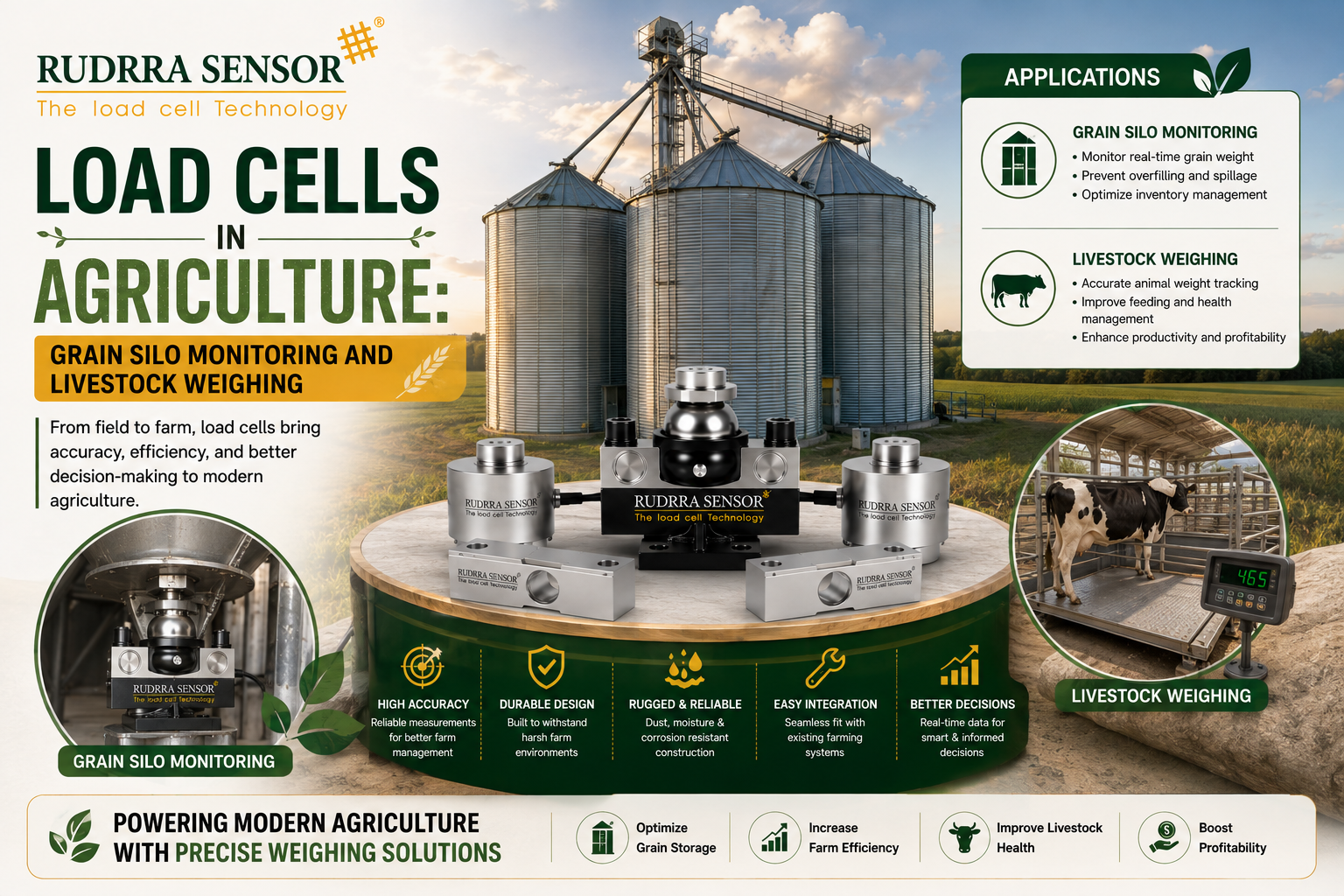
This blog is a deep, practical look at how load cells are used in both grain storage monitoring and livestock weighing across modern agricultural operations. We’ll cover why weight and load data matters so much in each context, the specific engineering considerations that make agricultural load cells different from a typical industrial sensor, the trust factors and technical benchmarks worth understanding before you buy, real-world case studies, and the specification mistakes that most commonly undermine an otherwise well-intentioned agricultural weighing system.
At Rudrra Sensor, we’ve supplied load cells into both grain handling and livestock weighing applications, and the patterns we see repeated across farms, co-ops, feedlots, and grain elevators form the backbone of this article — written for farm managers, agricultural equipment integrators, and procurement teams who want a genuinely useful reference rather than a generic sensor overview.
It’s worth acknowledging why these two application areas — grain storage and livestock weighing — sit comfortably together in a single article despite serving very different purposes. Both involve measuring a variable that changes continuously and unpredictably (a grain bin’s contents shifting with weather and biological activity; a live animal’s weight changing with growth, feed intake, and even how recently it last ate or drank), both operate in environments that combine outdoor exposure with biological material handling, and both ultimately feed decisions with direct financial consequences for the operation. Understanding the specific engineering considerations that make each application reliable is just as important here as it is in any of the more overtly industrial sectors covered elsewhere in this series — arguably more so, given how often agricultural weighing systems are specified and maintained without the dedicated instrumentation engineering support that a large industrial facility would typically have on staff.
Why Weight Monitoring Matters in Grain Storage
Silo weight is the earliest and most reliable indicator of spoilage risk
Stored grain is a living, biologically active material — it respires, it can develop hot spots from moisture migration and microbial or insect activity, and under the wrong combination of temperature and moisture it can spoil rapidly, sometimes within days once conditions turn favorable for mold or insect population growth. While grain moisture sensors and temperature cables are the primary tools for directly detecting these conditions, continuous weight monitoring provides an important complementary signal: a bin’s stored weight should follow a predictable pattern based on known fill and withdrawal activity, and any unexplained weight change — particularly an unexpected loss of weight that isn’t accounted for by deliberate withdrawal — can indicate a structural issue, a leak, or, in some cases, be a secondary confirmation alongside temperature and moisture data that something inside the bin is behaving abnormally.
Inventory accuracy drives both financial and operational decisions
For grain elevators, co-operatives, and larger farm operations managing multiple storage bins, accurate real-time inventory data across a facility is central to marketing decisions (knowing exactly how much grain of a given quality is available to sell or contract), logistics planning (scheduling trucks and rail cars against actual available inventory), and financial reporting, particularly where stored grain serves as collateral for operating loans, a common financing arrangement in commercial grain operations. A significant discrepancy between recorded and actual bin inventory — whether from measurement error, unrecorded spoilage losses, or theft — creates real financial exposure that can go undetected until a physical inventory reconciliation, often only performed periodically, reveals the gap.
Overfilling and structural load limits carry genuine safety consequences
Grain storage structures, whether steel bins, concrete silos, or flat storage buildings, are engineered for a specific maximum load, and overfilling beyond the structure’s design capacity risks structural damage or, in more severe cases, catastrophic bin failure — an event that has resulted in serious injury and death in the agricultural sector, in addition to the obvious financial loss of the structure and its contents. Continuous weight monitoring provides a direct, quantitative safeguard against overfilling that visual estimation of fill level (particularly difficult to judge accurately from outside a tall, enclosed bin) cannot reliably match.
Uneven loading affects structural integrity and grain flow behavior
Beyond simple overfilling, uneven loading — where grain is distributed unevenly within a bin, whether from an off-center fill auger, grain bridging, or uneven settling — can place asymmetric stress on a bin’s structure and supporting legs, as well as creating flow problems during unloading (grain bridging or ratholing) that can be both an operational nuisance and, in serious cases, a safety hazard when personnel enter a bin to break up a blockage. Load cells positioned at multiple support leg locations, rather than a single point, allow uneven loading to be detected and addressed before it becomes a structural or operational problem.
Drying and aeration process control depends on accurate weight data
Modern grain drying and aeration systems, particularly continuous-flow dryers and larger commercial drying operations, increasingly integrate weight data into process control logic — verifying throughput rates, confirming batch completion in batch dryers, and supporting energy efficiency optimization by correlating drying time and energy use against actual grain mass processed, rather than relying on less precise volumetric estimates.
Where Load Cells Are Used in Grain Storage Applications
Bin and silo leg-mounted weighing systems
The most common grain storage weighing application uses load cells installed under each of a bin’s support legs (typically three, four, or more depending on the bin’s design), with the combined signal from all legs summed to provide total bin weight. This configuration also allows individual leg loads to be compared, supporting the uneven-loading detection described above, since a significant imbalance between legs can indicate an off-center fill pattern or a developing structural issue.
Hopper bottom bin and hopper-scale weighing
Hopper-bottom bins, common in on-farm storage and at smaller grain handling facilities, are frequently weighed using load cells integrated into the hopper’s support structure or feet, providing continuous weight data as the bin fills and empties, often integrated with the facility’s control system to manage automated filling and discharge operations.
Flat storage and warehouse-type storage weighing
For flat storage buildings, where grain is piled directly on a floor rather than held in a discrete bin structure, weighing is more commonly achieved through weighing the grain as it passes over a conveyor-mounted belt scale during fill and reclaim operations (similar in principle to the belt weighing technology discussed in mining and bulk material handling applications) rather than through a bin-leg weighing configuration, since the storage structure itself doesn’t lend itself to point-load weighing in the same way a discrete bin does.
Truck and rail scale integration at receiving and load-out
While often considered a separate weighing category, truck scales and rail scales at grain elevators and processing facilities use the same fundamental load cell technology, verifying incoming and outgoing grain shipment weights that feed directly into a facility’s inventory reconciliation process alongside bin-level weight data, forming a complete chain of weight verification from receipt through storage to eventual shipment.
Grain dryer and conveying system weighing
As discussed above, continuous-flow and batch grain dryers, along with the conveying and elevator leg systems that move grain between storage, drying, and processing points within a facility, frequently incorporate load cells for throughput measurement and process control, supporting both operational efficiency and quality control objectives.
Feed mill and grain processing batching systems
At feed mills and grain processing facilities, load cells are used extensively in batching and blending operations — measuring precise ingredient quantities for compound feed formulation, a application that shares significant technical overlap with the industrial batching applications discussed elsewhere in load cell literature, but with agriculture-specific considerations around dust, biological material handling, and the need for frequent formulation changes across different feed products.
Portable and mobile grain weighing equipment
Portable grain cart scales, mounted on grain carts used to transfer grain from the combine during harvest to trucks or storage, provide in-field weight verification that supports yield mapping and harvest logistics, an application that places particular demands on load cell ruggedness given the mobile, vibration-heavy, and dusty field environment these systems operate in.
Why Weight Monitoring Matters in Livestock Operations
Individual animal weight drives feed, health, and management decisions
Across virtually every livestock sector — cattle, swine, poultry, sheep, and others — individual or group animal weight is one of the most fundamental data points in modern production management. Feed rations are calculated based on animal weight and target growth rates; health monitoring programs use weight trends to identify animals that may be sick, stressed, or not thriving; and breeding and culling decisions in many operations are directly informed by weight and growth performance data tracked over an animal’s life or production cycle.
Market timing and sale weight directly affect financial return
For operations selling livestock by weight — the majority of commercial cattle, swine, and sheep marketing arrangements — accurate weighing at the point of sale directly determines the financial return for that transaction. Even small systematic weighing errors, when applied across large numbers of animals sold over a season or year, translate into a meaningful cumulative financial impact, making scale accuracy a direct commercial concern in addition to a general management data quality issue.
Feed conversion efficiency tracking depends on accurate, repeatable weighing
Feed conversion ratio — the amount of feed consumed per unit of weight gain — is a central performance metric in commercial livestock production, and calculating it accurately depends on consistent, accurate weighing both at the start and end of a feeding period (and often at intermediate checkpoints). Inconsistent or inaccurate scale performance directly undermines the reliability of this critical efficiency metric, potentially leading to misguided feed formulation or management decisions based on flawed data.
Automated and walk-through weighing supports precision livestock management
Increasingly, livestock operations are adopting automated weighing systems — walk-through scales integrated into livestock handling races, feed station-integrated scales that weigh animals as they access feed, and automated sorting systems that use weight data to direct animals to different pens or treatment groups based on real-time weight thresholds. These automated systems depend on load cells capable of accurately capturing a weight reading from an animal that is moving, sometimes quickly and unpredictably, rather than standing calmly on a static platform scale — a meaningfully more demanding measurement challenge than traditional static livestock weighing.
Animal welfare and stress reduction benefit from efficient, reliable weighing systems
Handling and restraining livestock for weighing is inherently stressful for the animals and carries handling risk for personnel; reliable, accurate, and fast-acting weighing systems reduce the time animals spend restrained or being handled, supporting both animal welfare objectives and the practical efficiency of livestock handling operations — a consideration that has grown in importance as animal welfare standards and certification programs have become more prominent across the livestock industry.
Where Load Cells Are Used in Livestock Weighing Applications
Platform and static livestock scales
The traditional and still widely used approach, static platform scales use load cells beneath a weighing platform to weigh an animal or group of animals standing still on the platform, typically integrated into a handling race or chute system that guides animals onto the scale and restrains them briefly during weighing.
Walk-through and dynamic weighing systems
Increasingly common in larger commercial operations, walk-through scales use load cells with fast enough response characteristics to capture an accurate weight reading as an animal walks across the platform at a normal walking pace, without requiring the animal to stop or be restrained, significantly improving throughput and reducing handling stress compared to static weighing, though requiring more sophisticated signal processing to extract an accurate weight from the dynamic, motion-affected signal.
Feed station and auto-sort integrated weighing
Automated feeding systems, particularly common in swine and some cattle operations, integrate load cells into feed stations that weigh individual animals as they access feed (often using electronic animal identification to associate the weight reading with a specific individual), supporting precision feeding programs where ration composition can be automatically adjusted based on an individual animal’s current weight and growth trajectory, rather than applying a uniform ration across an entire group.
Livestock trailer and transport weighing
Load cells integrated into livestock trailer axles or transport vehicle weighing systems allow operators to verify transport loads are within safe and legal limits, and in some operations, to weigh animals during loading for transport as an additional data point alongside dedicated on-farm scale weighing.
Milk yield and dairy parlor integrated weighing
While technically a different measurement (milk volume/weight rather than animal body weight), dairy parlor systems frequently use load cell-based weighing to measure milk yield per animal per milking session, an application that shares the same underlying load cell technology and many of the same hygiene and washdown environmental considerations as body weight scales used in dairy operations.
Poultry house automated weighing systems
Commercial poultry operations increasingly use automated in-house weighing systems — small platform scales distributed throughout a broiler or layer house that birds voluntarily step onto during normal movement, providing continuous, low-stress sample weight data used to track flock growth performance without the labor and stress associated with manually catching and weighing individual birds.
How Agricultural Load Cells Differ From Standard Industrial Load Cells
Washdown and hygiene-driven sealing requirements
Livestock weighing environments, particularly in dairy, swine, and poultry operations, involve routine washdown cleaning with water and sometimes disinfectant chemicals, requiring load cells sealed to a high IP rating (commonly IP68 or IP69K for high-pressure, high-temperature washdown environments) along with hygienic housing designs that avoid crevices or mounting arrangements where organic material and cleaning residue can accumulate and harbor bacteria.
Corrosion resistance for manure, moisture, and agricultural chemical exposure
Both grain storage and livestock environments expose load cells to a combination of moisture, and in livestock applications specifically, manure and urine exposure that can be chemically aggressive toward standard steel components over time. Stainless steel construction is a common and often necessary specification for load cells in these environments, considerably more common as a baseline requirement than in many general industrial weighing applications.
Wide outdoor temperature exposure for on-farm installations
Grain bins, silos, and many livestock handling facilities are located outdoors or in semi-open structures, exposing load cells to the full range of seasonal temperature extremes a given agricultural region experiences — from well below freezing in northern winter conditions to significant summer heat, particularly for dark-colored steel bin structures exposed to direct sun. Wide temperature compensation ranges are an important specification consideration for these installations.
Dust and biological material contamination resistance
Grain handling environments generate substantial dust, and combined with the potential for insect activity and organic material accumulation, load cells in these applications require robust sealing to prevent contamination of sensitive internal components, similar in principle to dust exposure challenges discussed in mining and industrial bulk handling applications, though with the added consideration of biological material rather than purely mineral dust.
Fast dynamic response for walk-through and dynamic weighing applications
As discussed above, walk-through livestock scales and portable grain cart scales both require load cells with dynamic response characteristics suited to capturing an accurate weight reading from a moving subject or vibrating mobile platform, a meaningfully different design consideration than static platform scale applications where the load settles to a stable value before a reading is taken.
Robustness against animal-related mechanical abuse
Livestock scale platforms and their associated load cells are subject to direct mechanical abuse from animal behavior — stomping, kicking, and general rough handling that a typical industrial weighing platform would never experience. Load cells and their mounting hardware in livestock applications require overload protection and mechanical ruggedness specifically suited to this unusual mechanical stress profile.
Simplicity and reliability for on-farm maintenance capability
Many agricultural weighing installations, particularly on individual farms rather than larger commercial facilities, are maintained by farm personnel without specialized instrumentation expertise readily available. Load cell systems for these applications benefit from straightforward, reliable designs with minimal specialized maintenance requirements, and clear diagnostic indication when something has gone wrong, given the more limited on-site technical support typically available compared to a larger industrial facility.
A Practical Specification Checklist
Before requesting a quotation for an agricultural load cell system — whether for grain storage or livestock weighing — working through a structured checklist helps ensure the specification actually reflects the real operating environment:
- Application type — bin/silo leg weighing, hopper scale, static or walk-through livestock scale, feed station integration, or another specific use case.
- Capacity range, including the full range of expected loads from empty to maximum design capacity, with appropriate margin for surge or dynamic loading where relevant.
- Environmental exposure — outdoor temperature range for the specific region, washdown/hygiene requirements, dust or biological material exposure, and any corrosive exposure from manure or agricultural chemicals.
- Dynamic versus static weighing requirement, based on whether the application involves a stationary load (bin weighing, static platform scale) or a moving subject (walk-through scale, grain cart, dynamic dairy parlor weighing).
- Required accuracy, driven by whether the application is primarily for commercial sale weight verification (requiring higher accuracy and potentially legal-for-trade certification) or general management/monitoring purposes.
- Number of weighing points and summing requirements, particularly for multi-leg bin weighing or multi-cell platform scale configurations.
- Signal output and integration requirements, matched to the facility’s control system, farm management software, or electronic animal identification system where applicable.
- Overload and mechanical abuse protection, particularly important for livestock scale applications given the direct mechanical stress animals can impose on weighing equipment.
- Maintenance and support capability on-site, influencing how much emphasis to place on simplicity, diagnostic clarity, and ease of field replacement versus more sophisticated but maintenance-intensive system designs.
- Calibration and verification plan, particularly important for commercial sale weight applications where accuracy has direct financial and, in some jurisdictions, regulatory significance.
Trust Factors: Technical Benchmarks for Agricultural Load Cells
| Trust Factor | Why It Matters | Typical Benchmark |
| IP/environmental sealing | Protects against washdown, moisture, dust exposure | IP68 for general livestock/grain use; IP69K for high-pressure washdown environments |
| Corrosion resistance | Withstands manure, moisture, and agricultural chemical exposure | Stainless steel housing for livestock and wet grain-handling applications |
| Temperature range | Withstands full seasonal outdoor exposure | Wide compensated range matched to the specific regional climate |
| Overload capacity | Protects against animal-related mechanical abuse and surge loads | Mechanical overload rating well above normal operating load |
| Accuracy class | Supports commercial sale weight and inventory accuracy needs | Legal-for-trade classes for commercial livestock sale weighing where applicable |
| Dynamic response | Enables accurate walk-through and mobile weighing | Response characteristics matched to animal walking speed or cart vibration profile |
| Multi-point summing accuracy | Ensures accurate total weight across multiple bin legs/platform cells | Consistent calibration and matched output across all weighing points |
| Long-term drift/creep performance | Ensures accuracy over extended, low-maintenance service life | Minimal long-term drift specification for multi-season unattended service |
| Ease of field maintenance | Supports realistic on-farm maintenance capability | Simple diagnostic indication and straightforward field-replaceable components |
| Calibration traceability | Confirms measurement accuracy is verifiable | Certificate traceable to a recognized national/international standard where required |
Why multi-point summing accuracy matters more than people expect
For bin leg weighing and platform livestock scales, the total weight reading depends on the combined, correctly summed output of multiple load cells rather than a single sensor. If individual load cells in a multi-point configuration are not properly matched in their calibration characteristics, or if cabling and summing electronics introduce error, the resulting total weight reading can be inaccurate even if each individual load cell is functioning correctly in isolation — a subtlety that is easy to overlook when troubleshooting a multi-point system, similar in principle to the mounting-related and system-level accuracy issues discussed in other sectors throughout this series.
Why dynamic response deserves particular attention for walk-through systems
A walk-through livestock scale or a grain cart scale must extract an accurate weight value from a signal that includes not just the true static weight but also dynamic effects from the animal’s movement or the cart’s vibration as it travels across uneven field terrain. Load cells and associated signal processing not properly matched to the realistic dynamic conditions of the application will produce inconsistent or systematically biased readings — a failure mode that is often misdiagnosed as a calibration problem when the actual root cause is inadequate dynamic response characteristics for the application’s realistic operating conditions.
Relevant standards and certification considerations
- National weights and measures authorities in most countries govern legal-for-trade requirements for commercial livestock sale weighing and grain commercial transaction weighing, similar in principle to other legal-for-trade weighing applications discussed elsewhere in load cell literature.
- OIML R76 and related international metrological standards for non-automatic weighing instruments provide a general reference framework for the accuracy classification relevant to platform and static agricultural scales used for commercial transactions.
- General food safety and hygiene standards relevant to dairy and livestock operations, while not load cell-specific, inform the hygienic design and washdown sealing requirements that agricultural load cells in these applications need to meet.
- ISO 9001 manufacturing quality certification and calibration traceability to recognized standards remain relevant general quality benchmarks applicable to agricultural load cells as in other application sectors.
Case Study 1: Catching a Developing Spoilage Issue Through Bin Weight Monitoring
The situation: A grain co-operative operating a commercial storage facility with a number of large steel bins wanted to improve its ability to detect developing spoilage issues earlier than its existing temperature cable monitoring alone was catching, following an incident in a previous season where a significant volume of stored grain was found to have spoiled before the temperature monitoring system’s alarm thresholds had been triggered.
The challenge: Temperature cables, while a valuable and standard tool for grain condition monitoring, only measure temperature at the specific points along the cable’s length, meaning localized spoilage activity occurring away from a cable’s sensing points can develop significant hot spots before the broader temperature trend becomes clearly abnormal at the monitored locations.
The solution: The co-operative installed leg-mounted load cells on its highest-value storage bins, providing continuous total bin weight monitoring integrated with the facility’s existing temperature and moisture monitoring system. The weight data was configured to flag any unexpected weight change inconsistent with the facility’s fill and withdrawal records, providing an independent, whole-bin signal that complemented the point-specific temperature cable data.
The outcome: In the following storage season, the weight monitoring system flagged an unexpected weight discrepancy in one bin that, upon investigation, was found to correspond with early-stage spoilage activity in a section of the bin not well covered by the existing temperature cable layout. The co-operative was able to intervene — through targeted aeration and, ultimately, early partial reclaim of the affected grain — before the spoilage progressed to the point of significant quality loss across a larger portion of the bin’s contents, avoiding a repeat of the previous season’s more serious incident.
Lessons for similar projects: This case illustrates the value of weight monitoring as a complementary signal to more traditional grain condition monitoring tools rather than a replacement for them. Temperature and moisture monitoring remain the primary, most direct indicators of grain condition, but whole-bin weight monitoring provides an independent check that can catch developing issues occurring outside the specific coverage area of point-based temperature sensing, particularly valuable for identifying spoilage activity in less well-instrumented parts of a large bin.
Case Study 2: Resolving Inventory Reconciliation Discrepancies at a Grain Elevator
The situation: A regional grain elevator was experiencing a persistent, unexplained discrepancy between its recorded bin inventory (based on fill and withdrawal transaction records) and periodic physical inventory checks, a gap that was complicating the facility’s financial reporting and creating friction in discussions with its lending institution, given that stored grain served as collateral for the facility’s operating credit line.
The challenge: Without continuous bin-level weight monitoring, the facility’s inventory tracking relied entirely on transaction records from truck receiving and load-out scales, meaning any unrecorded loss — whether from minor spillage during handling, measurement error at the receiving or load-out scales, or other unaccounted-for shrinkage — accumulated invisibly until the next periodic physical inventory check revealed the resulting gap.
The solution: The facility installed leg-mounted load cells across its full complement of storage bins, providing continuous, independent weight verification at the storage level that could be reconciled against transaction-based inventory records on an ongoing basis rather than only at periodic physical inventory intervals. This allowed discrepancies to be identified and investigated much closer to when they actually occurred, rather than accumulating undetected over an extended period.
The outcome: Within the following operating year, the facility identified and corrected a systematic small measurement bias at one of its receiving scales that had been contributing to the ongoing reconciliation discrepancy, a root cause that had gone undetected under the previous transaction-record-only inventory tracking approach. The continuous bin weight data also gave the facility’s management a much stronger, more current basis for its inventory-related discussions with its lending institution, replacing periodic, backward-looking physical inventory snapshots with ongoing, verifiable data.
Lessons for similar projects: This case demonstrates how continuous, independent weight verification at the storage level can surface systematic errors elsewhere in a facility’s broader weighing and inventory tracking chain — in this instance, a receiving scale issue — that would otherwise remain hidden within an inventory system relying solely on transaction records without an independent storage-level check.
Case Study 3: Improving Feed Conversion Tracking with Automated Livestock Weighing
The situation: A commercial cattle feedlot operation wanted to improve the granularity and reliability of its feed conversion tracking, which had previously relied on periodic manual weighing at defined intervals during the feeding period, a process that was labor-intensive, stressful for the animals, and provided only a limited number of data points across an entire feeding cycle.
The challenge: The existing manual weighing process required animals to be moved from their pens to a central handling and weighing facility, a process that was time-consuming for staff and created handling stress for the animals, limiting how frequently the operation could practically justify conducting interim weight checks during a feeding period.
The solution: The feedlot installed a walk-through weighing system integrated with its animal handling infrastructure, combined with electronic animal identification, allowing individual animal weights to be captured automatically and frequently as animals moved through the facility during normal handling activities, without requiring dedicated weighing events that pulled animals away from their regular routine.
The outcome: The increased frequency and granularity of weight data allowed the feedlot’s management team to track feed conversion performance far more precisely than the previous periodic manual weighing approach permitted, identifying underperforming animals or pens earlier in the feeding cycle and adjusting ration formulations more responsively. The operation also reported a reduction in animal handling stress and labor time associated with weighing, since data collection was now integrated into routine handling activities rather than requiring dedicated weighing events.
Lessons for similar projects: This case illustrates a recurring theme across modern livestock management: the value of weight data increases substantially with the frequency and consistency at which it can be practically collected, and automated systems that integrate weighing into routine animal handling activities — rather than requiring separate, resource-intensive weighing events — unlock a level of management insight that periodic manual weighing struggles to match, while simultaneously improving animal welfare outcomes through reduced handling stress.
Case Study 4: Precision Feeding Through Individual Animal Weight Tracking in Swine Production
The situation: A commercial swine production operation wanted to move from group-based ration formulation — where all animals in a pen receive the same feed regardless of individual growth performance — to a precision feeding approach that could adjust ration composition for individual animals based on their specific weight and growth trajectory, aiming to improve overall feed efficiency and reduce the variation in market weight across a group at the end of the production cycle.
The challenge: Achieving individual-level precision feeding required reliable, frequent, low-stress weight data for individual animals within a group housing system, without the labor cost and animal stress associated with manually separating and weighing individual animals on a regular basis.
The solution: The operation installed feed station-integrated load cells combined with electronic ear tag identification, allowing each animal’s weight to be automatically recorded each time it accessed a feed station, building a continuously updated individual growth curve for every animal in the group without any additional handling beyond the animals’ normal feeding behavior. This data fed into the operation’s feed management software, which automatically adjusted ration composition delivered to each individual animal based on its current weight and target growth trajectory.
The outcome: Over a full production cycle using the new system, the operation reported improved overall feed conversion efficiency compared to its previous group-ration approach, along with a meaningfully reduced spread in market weight across the group at the end of the cycle — a valuable outcome given that more consistent market weights typically support better and more predictable sale outcomes. The continuous individual weight data also provided an early indicator for animals falling behind expected growth trajectories, supporting earlier health or management intervention than the operation’s previous group-based monitoring approach allowed.
Lessons for similar projects: This case demonstrates the broader value proposition of integrating weighing directly into an animal’s normal daily routine rather than treating it as a separate management activity: the resulting data richness — individual, continuous growth curves rather than periodic group averages — enables a level of precision management that simply isn’t achievable with traditional group-based approaches, while imposing no additional handling burden on either animals or staff beyond what the automated feed station infrastructure already requires for normal operation.
Common Specification and Installation Mistakes to Avoid
Agricultural load cell applications, spanning both grain storage and livestock weighing, share a number of common specification and installation pitfalls that are worth understanding before committing to a system design.
Underestimating washdown and hygiene sealing requirements
Livestock weighing environments, particularly in dairy and swine operations, involve routine washdown cleaning that standard industrial IP ratings are not designed to withstand. Specifying a load cell with inadequate sealing for the realistic washdown frequency and pressure the installation will experience leads to premature failure well short of the expected service life.
Relying on a single measurement signal rather than complementary data sources
As Case Study 1 demonstrated, weight monitoring is most valuable as a complementary signal alongside other grain condition monitoring tools such as temperature and moisture cables, not as a standalone replacement for them. Treating any single monitoring technology as sufficient on its own, rather than as part of a broader, complementary monitoring strategy, risks missing developing issues that a different sensing modality would have caught.
Overlooking multi-point calibration matching in bin leg or platform scale configurations
As discussed in the trust factors section, a multi-point weighing configuration’s total accuracy depends on properly matched calibration across all weighing points, not just the individual quality of each load cell. Installing mismatched or improperly summed load cells across a multi-leg bin or multi-cell platform introduces error that may not be obvious from a simple visual inspection of the individual sensors.
Underestimating dynamic response requirements for walk-through and mobile weighing
As discussed in the trust factors section, walk-through livestock scales and mobile grain cart scales require load cells and signal processing specifically suited to the realistic dynamic conditions of the application. Specifying a sensor design suited only to static weighing for a dynamic application produces inconsistent, often systematically biased results.
Failing to specify adequate overload protection for livestock applications
Livestock scale platforms are subject to direct mechanical abuse from animal behavior that a typical static industrial weighing platform never experiences. Underestimating the overload and mechanical robustness requirements for livestock scale load cells leads to premature failure and, in some cases, safety risk if a damaged scale platform becomes structurally compromised.
Neglecting realistic on-farm maintenance capability in system design
Many agricultural weighing systems are maintained by farm personnel without specialized instrumentation expertise readily on hand. Specifying an overly complex system without adequate consideration of realistic on-site maintenance capability can lead to a system that, once a fault develops, remains unresolved far longer than it should, undermining the value of the monitoring investment.
Treating commercial sale weighing accuracy requirements the same as general monitoring applications
As discussed in the trust factors section, commercial livestock sale weighing and grain commercial transaction weighing typically warrant a higher accuracy specification and, in many jurisdictions, formal legal-for-trade certification, compared to general management or condition monitoring applications. Applying a uniform accuracy specification across all applications on a farm or facility, rather than differentiating based on the specific commercial or regulatory stakes involved, can lead to either unnecessary cost for low-stakes applications or inadequate accuracy for commercially significant ones.
Insufficient corrosion protection for manure, moisture, and grain-handling chemical exposure
Both livestock and grain handling environments expose load cells to conditions that can be chemically aggressive toward standard steel components over an extended service life. Under-specifying corrosion protection, particularly for livestock applications involving direct manure and urine exposure, is a common and avoidable source of premature load cell failure.
The common thread: agricultural applications reward the same engineering discipline as any other demanding sector
Reviewing this list alongside the four case studies above, the pattern is consistent with the broader theme running throughout this series: agricultural load cell applications, despite sitting outside the more obviously industrial sectors typically associated with demanding load cell engineering, reward exactly the same discipline — matching sensor specification to genuine environmental and dynamic conditions, understanding system-level accuracy rather than component-level specifications alone, and planning realistically for the maintenance and support environment the system will actually operate within.
Cost vs. Value: Justifying Investment in Agricultural Load Cell Systems
Agricultural load cell systems, properly specified for washdown, corrosion, dynamic response, and mechanical robustness requirements, represent a meaningful investment relative to simpler or less rigorously specified alternatives. The value case is strong when considered against the financial and operational stakes involved:
- Spoilage loss avoidance: As Case Study 1 demonstrated, earlier detection of developing grain spoilage issues through weight monitoring can prevent significant quality loss and financial impact compared to relying solely on point-based temperature monitoring.
- Inventory reconciliation accuracy: As Case Study 2 demonstrated, continuous storage-level weight verification can surface systematic measurement errors elsewhere in a facility’s inventory tracking chain, supporting both financial accuracy and stronger lender and business partner confidence in reported inventory figures.
- Feed efficiency and management insight improvement: As Case Studies 3 and 4 demonstrated, frequent, automated livestock weighing data supports meaningfully better feed conversion tracking and precision feeding decisions than periodic manual weighing, translating into improved feed efficiency and more consistent production outcomes.
- Reduced animal handling stress and labor cost: Automated and integrated weighing systems, as illustrated in the livestock case studies, reduce both the labor time and animal welfare cost associated with dedicated manual weighing events, an increasingly important consideration as animal welfare standards receive greater industry and consumer attention.
- Extended service life reduces long-term cost: Properly specified corrosion-resistant, adequately sealed, and mechanically robust agricultural load cells will typically outlast under-specified alternatives by a considerable margin, spreading the higher initial investment over many more seasons or production cycles of reliable service.
Framing agricultural load cell investment in terms of loss prevention, management data quality, and animal welfare, rather than simple unit cost comparison, reflects how the most successful agricultural operations already approach broader technology investment decisions on their operations.
Choosing the Right Supplier for Agricultural Load Cells
Given the specific combination of hygiene, corrosion, dynamic response, and on-farm maintainability requirements involved, supplier selection matters for agricultural load cell projects:
- Demonstrated experience in agricultural applications specifically, since the environmental and mechanical demands differ meaningfully from general industrial weighing, particularly around washdown hygiene and animal-related mechanical stress
- Ability to support both grain storage and livestock weighing applications, or clear specialization and partnership arrangements covering the specific application type relevant to your operation
- Corrosion-resistant, properly sealed product options genuinely engineered for agricultural environmental exposure, not simply a relabeled general industrial product
- Support for multi-point configurations with properly matched calibration across bin legs or platform cells, along with clear guidance on correct installation practice
- Realistic, farm-appropriate maintenance and support options, including clear diagnostic guidance and straightforward field-replaceable components suited to the on-site technical support realistically available
- Calibration traceability and documentation support for commercial sale weighing applications where accuracy has direct financial and regulatory significance
At Rudrra Sensor, we work with grain handling facilities and livestock operations to understand the specific environmental exposure, weighing configuration, and maintenance context of each application before recommending a load cell solution — because, as the case studies above illustrate, reliable agricultural weighing depends on matching the sensor to genuine on-farm operating conditions, not simply selecting an adequately rated capacity.
Emerging Trends in Agricultural Load Cell Applications
Integration with broader farm management and precision agriculture platforms
Grain storage weight data and livestock weighing data are increasingly being integrated into comprehensive farm management software platforms, correlating storage and animal weight trends with other farm data — yield mapping, feed inventory, health records — to support more sophisticated, data-driven management decisions than standalone weighing systems previously allowed.
Wireless and low-power sensor designs for remote farm installations
Given that many agricultural installations are located in areas without easy access to reliable power or wired data infrastructure, wireless, low-power, and solar or battery-powered load cell and telemetry designs are increasingly available, extending reliable monitoring capability to remote bins, pastures, and handling facilities that would previously have relied on manual, periodic checks.
Growing adoption of continuous, automated livestock weighing over periodic manual weighing
As illustrated in Case Studies 3 and 4, the industry trend is clearly moving toward continuous, automated weighing integrated into normal animal handling and feeding activity, replacing periodic manual weighing events wherever the necessary infrastructure investment can be justified, driven by both the management data quality improvement and animal welfare benefits this approach offers.
Combining weight data with computer vision and other sensing modalities
Some of the more advanced precision livestock management systems are beginning to combine load cell weight data with computer vision-based body condition scoring and other sensing modalities, building a more complete picture of individual animal health and performance than weight data alone can provide, though load cell weight measurement remains a foundational, highly reliable data source within these more sophisticated multi-sensor systems.
Increased focus on data-driven grain quality preservation strategies
As illustrated in Case Study 1, the broader trend in commercial grain storage management is toward more sophisticated, multi-signal monitoring strategies — combining weight, temperature, and moisture data — that support earlier, more targeted intervention than any single monitoring technology could achieve on its own, reflecting the same broader industry shift toward integrated, predictive monitoring approaches seen across other sectors covered in this series.
Frequently Asked Questions (FAQs)
Q1: How does bin weight monitoring complement temperature cable monitoring for grain spoilage detection?
Temperature cables provide direct, point-specific condition data at defined locations within a bin, while whole-bin weight monitoring provides an independent, facility-wide signal that can catch developing issues — such as unexpected weight changes inconsistent with recorded fill and withdrawal activity — that may occur in areas not well covered by the specific temperature cable layout, as illustrated in Case Study 1.
Q2: What accuracy level should I expect from a livestock scale used for commercial sale weighing?
This depends on the specific jurisdiction’s legal-for-trade requirements and the scale’s certification, but commercial sale weighing scales should generally be specified and calibrated to a recognized accuracy class appropriate for legal-for-trade use, given the direct financial consequences of weighing error at the point of sale.
Q3: Do walk-through livestock scales sacrifice accuracy compared to static platform scales?
Not necessarily, provided the system is properly specified with load cells and signal processing suited to the dynamic conditions of walk-through weighing — but a walk-through system built around load cells and signal processing designed only for static weighing will typically show meaningfully worse accuracy and consistency than either a properly specified walk-through system or a traditional static scale.
Q4: How often should agricultural load cells be recalibrated or checked?
This depends on the specific application and its commercial or regulatory significance, but as a general guideline, periodic verification against a known reference weight — more frequently for commercial sale weighing applications, less frequently for general monitoring purposes — combined with routine visual inspection for mechanical damage or corrosion, helps maintain reliable accuracy over the system’s service life.
Conclusion
Agricultural load cell applications — grain storage weight monitoring and livestock weighing — may not carry the same industrial profile as cranes, pipelines, or mining conveyors, but they share the same underlying engineering reality: reliable, accurate measurement depends on properly matching sensor specification to the genuine environmental and operational conditions of the application, not simply selecting an adequately rated capacity. The four case studies above — bin weight monitoring catching a developing spoilage issue outside a temperature cable’s coverage area, continuous storage weighing surfacing a systematic receiving scale error, automated walk-through weighing improving feed conversion tracking on a commercial feedlot, and feed station-integrated weighing enabling precision feeding in swine production — all demonstrate real, measurable value that properly specified agricultural load cell systems can deliver.
If your operation is considering or troubleshooting a grain storage or livestock weighing system, the questions worth asking align with the themes running throughout this article: is the sensor genuinely sealed and corrosion-protected for the realistic washdown, moisture, and manure exposure it will face? Is the system designed for the actual weighing configuration — static or dynamic, single or multi-point — your application requires? And is the accuracy specification appropriately matched to whether the application is a commercial sale transaction or a general management monitoring tool?
At Rudrra Sensor, we work through exactly these questions with grain handling facilities and livestock operations, because reliable agricultural weighing is, at its core, about protecting stored value and supporting better, more informed farm and livestock management decisions.
Need a load cell solution engineered for your grain storage or livestock weighing application? Get in touch with the Rudrra Sensor engineering team to discuss your capacity range, environmental conditions, and weighing configuration requirements, and we’ll help you specify a system built for the real demands of your operation.