


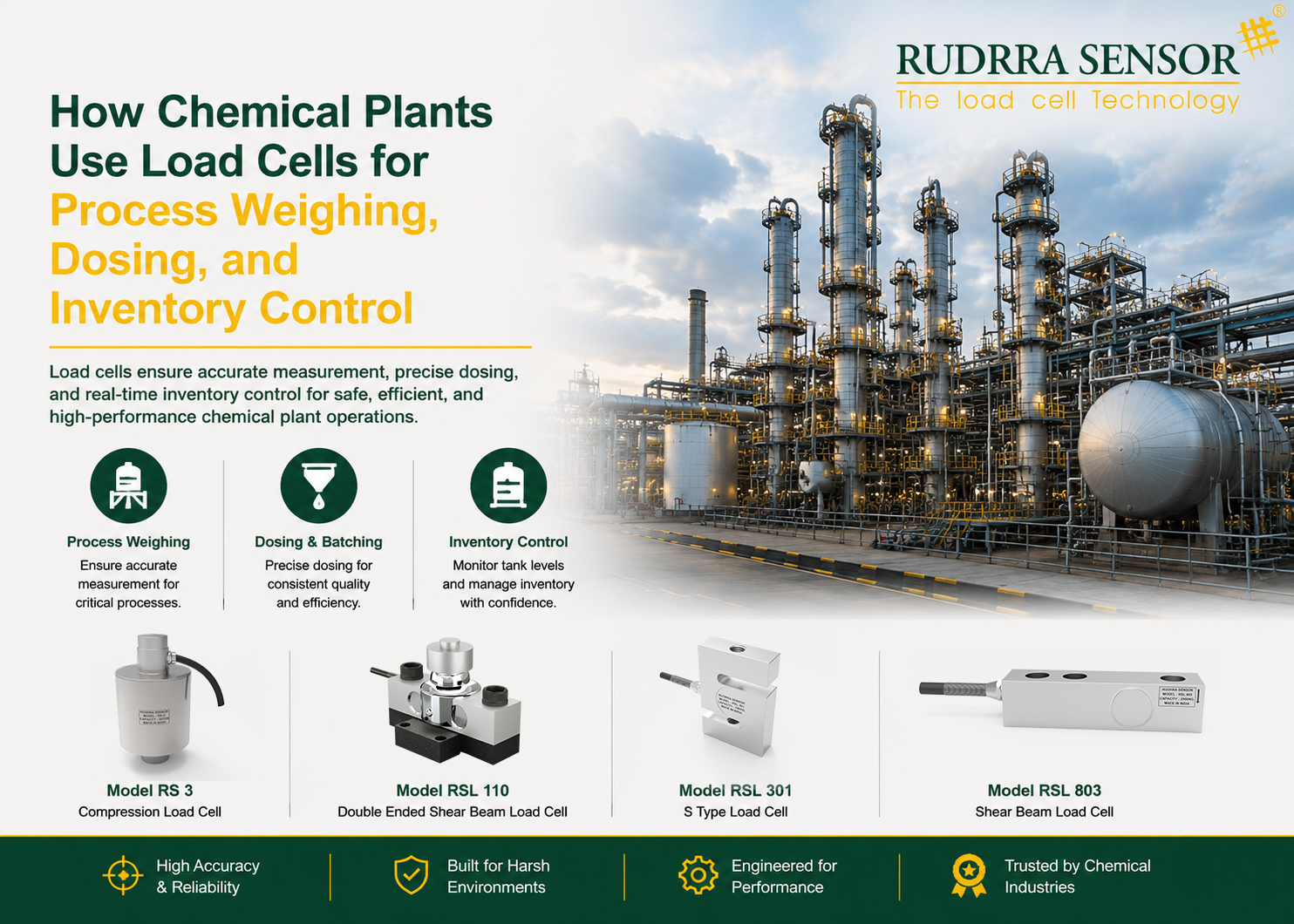
Introduction
The chemical industry relies heavily on precision, consistency, and process control. Whether manufacturing specialty chemicals, agrochemicals, dyes, pigments, adhesives, water treatment chemicals, resins, polymers, or industrial solvents, accurate material measurement plays a crucial role in ensuring product quality and operational efficiency.
A minor error in ingredient measurement can result in product inconsistency, excessive raw material consumption, batch rejection, production downtime, or even safety risks. As chemical manufacturing processes become increasingly automated and quality requirements continue to tighten, the demand for accurate and reliable weighing systems has never been greater.
This is where load cells become essential.
Load cells serve as the foundation of modern industrial weighing systems. They enable chemical plants to accurately measure raw materials, monitor inventory levels, control dosing operations, automate batching processes, and maintain precise production records.
From storage tanks and silos to reactors and dosing systems, load cells help manufacturers gain complete visibility into their processes while reducing waste and improving efficiency.
In this guide, we explore how chemical plants use load cells for process weighing, dosing, and inventory control and why these systems have become indispensable in modern chemical manufacturing.
Why Accurate Weighing Is Critical in Chemical Manufacturing
Chemical manufacturing involves combining multiple ingredients in carefully controlled quantities. The accuracy of these measurements directly impacts product quality, process efficiency, and profitability.
Unlike many industries where minor variations may be acceptable, chemical manufacturing often requires precise formulations and repeatable production conditions.
Accurate weighing is important because it affects:
Product Quality
Chemical formulations often depend on precise ingredient ratios. Even small deviations can alter product performance, color, viscosity, stability, or effectiveness.
For example:
- Incorrect additive levels may affect product characteristics.
- Excess catalyst may accelerate reactions beyond acceptable limits.
- Insufficient active ingredients may reduce product performance.
Load cells help maintain formulation consistency by ensuring that every ingredient is measured accurately.
Production Efficiency
Overfeeding raw materials increases production costs, while underfeeding may require rework or additional processing.
Accurate weight measurement helps manufacturers:
- Reduce material waste
- Improve yield
- Increase process efficiency
- Minimize product giveaway
Regulatory Compliance
Many chemical manufacturers operate under strict quality and regulatory requirements.
Accurate weighing supports:
- Batch traceability
- Process documentation
- Quality assurance
- Regulatory compliance
Safety
Certain chemical reactions require exact ingredient quantities to maintain safe operating conditions.
Weight-based process control helps prevent:
- Overdosing
- Incorrect formulations
- Process instability
- Hazardous operating conditions
What Are Load Cells and How Do They Work?
A load cell is a force measurement device that converts applied weight into an electrical signal.
When a force is applied to the load cell, its sensing element deforms slightly. Strain gauges bonded to the sensing element detect this deformation and generate a proportional electrical output.
This output is then processed by:
- Weight indicators
- Weight transmitters
- PLC systems
- SCADA systems
- Distributed Control Systems (DCS)
The resulting data can be used for:
- Displaying weight
- Monitoring inventory
- Controlling processes
- Automating production
- Generating reports
Modern load cells provide highly accurate and repeatable measurements, making them ideal for demanding chemical applications.
Why Chemical Plants Prefer Weight-Based Measurement
Chemical plants often have the option of measuring materials by either volume or weight.
However, weight-based measurement offers several significant advantages.
Density Variations
The density of many chemicals changes due to:
- Temperature fluctuations
- Composition variations
- Process conditions
Volume measurements may become inaccurate when density changes occur.
Weight measurements remain accurate regardless of density variations.
Improved Accuracy
Load cell-based weighing systems typically provide greater accuracy than volume-based methods.
This is particularly important in:
- Dosing operations
- Batching processes
- Inventory control
Better Process Control
Weight data allows operators to precisely control material additions and monitor consumption.
As a result, weight-based systems are widely preferred in chemical manufacturing environments.
Key Applications of Load Cells in Chemical Plants
Load cells are used throughout chemical production facilities.
Common applications include:
Storage Tank Weighing
Monitoring liquid chemical inventory.
Hopper Weighing
Measuring powders, granules, and dry ingredients.
Silo Weighing
Tracking bulk raw material inventory.
Reactor Weighing
Controlling chemical reactions and ingredient additions.
Batching Systems
Automating formulation preparation.
Dosing Systems
Controlling chemical additions.
Filling Systems
Ensuring accurate package weights.
Inventory Management
Monitoring raw materials and finished products.
Each of these applications contributes to improved process control and operational efficiency.
Tank Weighing Systems in Chemical Manufacturing
Tank weighing is one of the most common load cell applications in chemical plants.
Storage tanks may contain:
- Solvents
- Acids
- Alkalis
- Resins
- Water treatment chemicals
- Process liquids
- Specialty chemicals
Traditional level sensors estimate inventory based on liquid height.
However, level measurement systems can face challenges such as:
- Foam formation
- Density changes
- Irregular tank geometry
- Temperature effects
Load cell-based tank weighing systems measure actual weight rather than liquid level.
This provides more accurate inventory information.
Benefits of Tank Weighing Systems
Real-Time Inventory Visibility
Operators always know exactly how much material remains in the tank.
Improved Procurement Planning
Accurate inventory data supports better purchasing decisions.
Reduced Stockouts
Continuous monitoring helps prevent unexpected material shortages.
Better Production Scheduling
Production planning becomes easier when inventory levels are accurately known.
Improved Process Control
Weight-based measurements provide precise material consumption tracking.
Recommended Load Cells for Tank Weighing
Depending on tank design and capacity, chemical plants commonly use:
Compression Load Cells
Suitable for:
- Large tanks
- Vertical vessels
- High-capacity applications
Single Ended Shear Beam Load Cells
Suitable for:
- Small to medium-sized tanks
- Process vessels
- Ingredient tanks
Load Cell Assemblies
Provide:
- Safe load introduction
- Easy installation
- Protection against side loads
Tank weighing systems often combine load cells with weight transmitters for integration into automation systems.
Hopper Weighing Applications in Chemical Processing
Many chemical manufacturing processes involve handling powders, granules, pigments, and dry additives.
These materials are commonly stored and processed using hoppers.
Load cells installed beneath hoppers enable accurate measurement of material quantity during:
- Storage
- Feeding
- Batching
- Mixing
- Dosing
Benefits of Hopper Weighing
Accurate Material Measurement
Weight-based monitoring ensures precise ingredient quantities.
Improved Process Control
Operators can monitor consumption rates in real time.
Reduced Material Waste
Accurate feeding minimizes overconsumption.
Better Batch Consistency
Consistent ingredient measurement improves product quality.
Automation Support
Hopper weighing systems can be integrated with automated control systems.
Common Hopper Applications
Chemical plants use hopper weighing systems for:
- Pigments
- Powders
- Fillers
- Fertilizers
- Plastic additives
- Specialty chemicals
Recommended Load Cells for Hopper Weighing
Single Ended Shear Beam Load Cells
Ideal for compact hopper installations.
S-Type Load Cells
Suitable for suspended hopper applications.
Compression Load Cells
Used in larger hopper systems requiring higher capacities.
Silo Weighing and Bulk Material Storage Monitoring
Chemical plants frequently store bulk raw materials in silos.
Examples include:
- Fertilizers
- Powders
- Minerals
- Resins
- Plastic granules
- Bulk additives
Traditional level sensors may struggle with:
- Bridging
- Rat-holing
- Dust accumulation
- Material compaction
Load cells eliminate these issues by measuring actual material weight.
Benefits of Silo Weighing
Accurate Inventory Tracking
Operators know exactly how much material is available.
Improved Production Planning
Material shortages can be anticipated before they occur.
Better Supply Chain Management
Procurement decisions become data-driven.
Reduced Manual Inspection
Continuous monitoring reduces labor requirements.
Recommended Load Cells for Silo Applications
Compression Load Cells
Most common for large silos.
Double Ended Shear Beam Load Cells
Widely used for high-capacity weighing applications.
Load Cell Assemblies
Provide structural protection and accurate load transfer.
Load Cells in Reactor Vessel Weighing
Chemical reactions often take place inside reactor vessels where precise ingredient additions are critical to product quality and process safety. Reactor weighing systems use load cells to continuously monitor the weight of materials entering and leaving the vessel.
Unlike flow meters or level sensors, load cells provide direct weight measurement, ensuring that every ingredient is added according to the production recipe.
Why Reactor Vessel Weighing Is Important
Accurate Ingredient Addition
Load cells help ensure that each raw material is added in the correct quantity.
Batch Traceability
Weight data can be recorded and linked to production batches for quality control and regulatory compliance.
Improved Process Control
Operators can monitor material additions in real time and make adjustments when required.
Reduced Product Variability
Consistent ingredient measurements help maintain product uniformity across production batches.
Common Reactor Applications
- Specialty chemicals
- Resins
- Adhesives
- Paints and coatings
- Agrochemicals
- Water treatment chemicals
- Pharmaceutical intermediates
Recommended Load Cells
- Compression Load Cells
- Single Ended Shear Beam Load Cells
- Load Cell Assemblies
Load Cells in Industrial Batching Operations
Batching is one of the most important applications of load cells in chemical manufacturing.
A batching system combines multiple ingredients according to a predefined formula or recipe. The accuracy of each ingredient directly impacts product quality and consistency.
How Load Cells Improve Batching Accuracy
Precise Ingredient Measurement
Each ingredient is weighed individually before being added to the process.
Automated Batch Control
Weight signals can be integrated with PLC and SCADA systems to automate ingredient addition.
Reduced Human Error
Automation minimizes operator-dependent weighing mistakes.
Improved Product Consistency
Accurate measurements ensure that every batch meets production specifications.
Typical Chemical Batching Applications
- Fertilizer production
- Specialty chemicals
- Dyes and pigments
- Industrial cleaners
- Adhesives
- Polymer manufacturing
Recommended Load Cells for Batching Systems
Shear Beam Load Cells
Ideal for batching vessels and process tanks.
Compression Load Cells
Suitable for large-capacity batching systems.
S-Type Load Cells
Useful for suspended vessel applications.
Load Cells in Dosing Systems
Chemical dosing involves adding a precise quantity of material into a process.
Examples include:
- Acids
- Alkalis
- Additives
- Catalysts
- Colorants
- Preservatives
Even minor dosing inaccuracies can impact product quality and process efficiency.
Why Load Cells Are Used in Dosing Systems
High Accuracy
Weight-based dosing is often more accurate than volumetric dosing.
Continuous Monitoring
Operators can monitor dosing performance in real time.
Reduced Material Waste
Precise dosing minimizes overfeeding and underfeeding.
Improved Product Quality
Accurate ingredient additions help maintain consistent formulations.
Types of Weight-Based Dosing Systems
Gravimetric Dosing
Uses load cells to measure material weight directly during dispensing.
Loss-in-Weight Feeding
The system monitors weight reduction in a hopper to control material feed rates.
Commonly used for:
- Powders
- Granules
- Additives
Gain-in-Weight Feeding
Measures the increasing weight of a receiving vessel during filling operations.
Commonly used for:
- Liquids
- Chemicals
- Process additives
Inventory Monitoring Using Load Cells
Inventory management is one of the most valuable applications of load cells in chemical plants.
Without accurate inventory data, manufacturers may experience:
- Material shortages
- Production interruptions
- Emergency purchases
- Excess inventory costs
Load cells provide continuous inventory monitoring for tanks, silos, hoppers, and process vessels.
Benefits of Inventory Monitoring
Real-Time Material Visibility
Operators always know available inventory levels.
Improved Procurement Planning
Purchasing decisions can be based on actual inventory data.
Reduced Production Downtime
Material shortages can be identified before production is affected.
Better Supply Chain Management
Inventory information can be integrated into ERP systems.
Applications of Inventory Monitoring
Tank Inventory Monitoring
Used for:
- Solvents
- Water treatment chemicals
- Process liquids
- Acids
Silo Inventory Monitoring
Used for:
- Powders
- Fertilizers
- Plastic granules
- Bulk chemicals
Hopper Inventory Monitoring
Used for:
- Additives
- Pigments
- Fillers
- Process ingredients
Integration with Industrial Automation Systems
Modern chemical plants increasingly rely on automation and digitalization.
Load cells can integrate with:
- PLC Systems
- SCADA Systems
- DCS Platforms
- MES Software
- ERP Systems
- Industry 4.0 Solutions
This integration allows automatic process control and data-driven decision-making.
Advantages of Automation Integration
Automated Production Control
Material additions can be controlled automatically.
Production Reporting
Weight data can be logged for quality documentation.
Inventory Management
Inventory levels can be monitored continuously.
Predictive Maintenance
Abnormal weight patterns may indicate process issues before failures occur.
Benefits of Load Cells in Chemical Manufacturing
The widespread use of load cells in chemical plants is driven by the numerous operational benefits they provide.
Improved Accuracy
Load cells provide precise weight measurement for process control and inventory management.
Reduced Material Waste
Accurate weighing minimizes overconsumption and product giveaway.
Enhanced Product Quality
Consistent ingredient measurement improves formulation accuracy.
Better Inventory Control
Real-time inventory visibility supports efficient material management.
Increased Automation
Load cells enable automated batching, dosing, and monitoring systems.
Improved Traceability
Weight data can be recorded for regulatory compliance and quality assurance.
Lower Operating Costs
Improved efficiency reduces waste and production losses.
Better Decision-Making
Real-time weight information supports operational planning.
Common Challenges in Chemical Weighing Applications
While load cells offer significant advantages, proper system design and installation are essential for achieving optimal performance.
Corrosive Environments
Many chemical plants handle aggressive substances that can damage improperly selected equipment.
Solution
Use stainless steel load cells with appropriate environmental protection ratings.
Pipe Forces
Rigid piping can transfer unwanted forces to tanks and vessels.
Solution
Use flexible connections and proper installation practices.
Temperature Variations
Temperature changes can affect weighing performance.
Solution
Select load cells designed for the expected operating temperature range.
Vibration
Nearby machinery may create measurement instability.
Solution
Use vibration isolation techniques and appropriate filtering.
Wind Loads
Outdoor tanks and silos may be affected by wind forces.
Solution
Install proper mounting assemblies and structural restraints.
How to Select the Right Load Cell for Chemical Applications
Choosing the correct load cell requires careful evaluation of application requirements.
Consider Load Capacity
The load cell must support:
- Dead load
- Live load
- Dynamic load conditions
- Safety factors
Evaluate Environmental Conditions
Consider:
- Corrosion exposure
- Moisture levels
- Washdown requirements
- Temperature conditions
Determine Accuracy Requirements
Critical dosing systems often require higher accuracy than inventory monitoring applications.
Select Appropriate Mounting Assemblies
Proper mounting hardware improves:
- Safety
- Accuracy
- Installation efficiency
Consider Automation Requirements
If the system integrates with PLC or SCADA platforms, appropriate transmitters and indicators should be selected.
Recommended Rudrra Sensor Products for Chemical Industry Applications
Different chemical applications require different load cell technologies.
| Application | Recommended Products |
| Tank Weighing | Compression Load Cells, Load Cell Assemblies |
| Hopper Weighing | Single Ended Shear Beam Load Cells |
| Silo Weighing | Double Ended Shear Beam Load Cells |
| Suspended Vessels | S-Type Load Cells |
| Inventory Monitoring | Weight Transmitters |
| Process Control | Weight Indicators |
| Batching Systems | Shear Beam Load Cells |
| Dosing Systems | Weight Transmitters & Weight Indicators |
Frequently Asked Questions (FAQ)
How are load cells used in chemical plants?
Load cells are used for tank weighing, hopper weighing, silo monitoring, batching, dosing, reactor vessel weighing, inventory control, and automated process management.
Why is accurate weighing important in chemical manufacturing?
Accurate weighing ensures product consistency, reduces material waste, improves process efficiency, supports regulatory compliance, and enhances safety.
Which load cells are commonly used in tank weighing systems?
Compression load cells and shear beam load cells are commonly used depending on tank size, capacity, and installation requirements.
What is gravimetric dosing?
Gravimetric dosing is a weight-based dosing method that uses load cells to accurately measure and control material additions.
How do load cells improve inventory management?
Load cells provide real-time weight information that helps monitor inventory levels in tanks, silos, hoppers, and storage vessels.
Can load cells integrate with PLC and SCADA systems?
Yes. Modern load cells can be connected to weight transmitters and indicators that communicate with PLC, SCADA, DCS, and ERP systems.
Are load cells suitable for corrosive chemical environments?
Yes. Stainless steel load cells with suitable environmental protection ratings are commonly used in chemical plants.
What are the benefits of tank weighing systems?
Tank weighing systems provide accurate inventory monitoring, improved process control, reduced stockouts, and better production planning.
How often should load cells be calibrated?
Calibration frequency depends on process criticality, operating conditions, and regulatory requirements. Periodic verification is recommended.
What is the difference between process weighing and inventory weighing?
Process weighing focuses on controlling manufacturing operations, while inventory weighing is used to monitor material availability and stock levels.
Which industries use process weighing systems?
Chemical, pharmaceutical, food processing, agriculture, plastics, water treatment, and specialty manufacturing industries all use process weighing systems.
What factors should be considered when selecting a load cell?
Capacity, accuracy, environmental conditions, mounting arrangement, automation requirements, and application type should all be considered.
Conclusion
Chemical manufacturing depends on precision, consistency, and process control. From raw material storage and inventory monitoring to batching, dosing, and reactor operations, load cells provide the accurate weight measurements necessary for efficient and reliable production.
By enabling real-time process visibility, improving formulation accuracy, reducing material waste, and supporting automation initiatives, load cells have become a critical component of modern chemical plants.
Whether the application involves tank weighing, hopper weighing, silo monitoring, batching systems, dosing operations, or inventory control, selecting the right load cell solution can significantly improve operational efficiency, product quality, and profitability.
As chemical manufacturers continue to embrace automation, Industry 4.0 technologies, and data-driven decision-making, load cell-based weighing systems will remain essential for achieving higher levels of productivity and process control.
Need Help Selecting the Right Load Cell for Your Chemical Application?
Rudrra Sensor offers a comprehensive range of load cells, load cell assemblies, weight indicators, and weight transmitters designed for industrial weighing applications.
Whether you need a solution for:
- Tank Weighing Systems
- Hopper Weighing Systems
- Silo Weighing Systems
- Batching Plants
- Dosing Systems
- Inventory Monitoring
- Industrial Automation
our team can help you identify the most suitable weighing solution for your application.
Contact Rudrra Sensor today to discuss your project requirements and explore the right load cell solution for your chemical manufacturing process.