


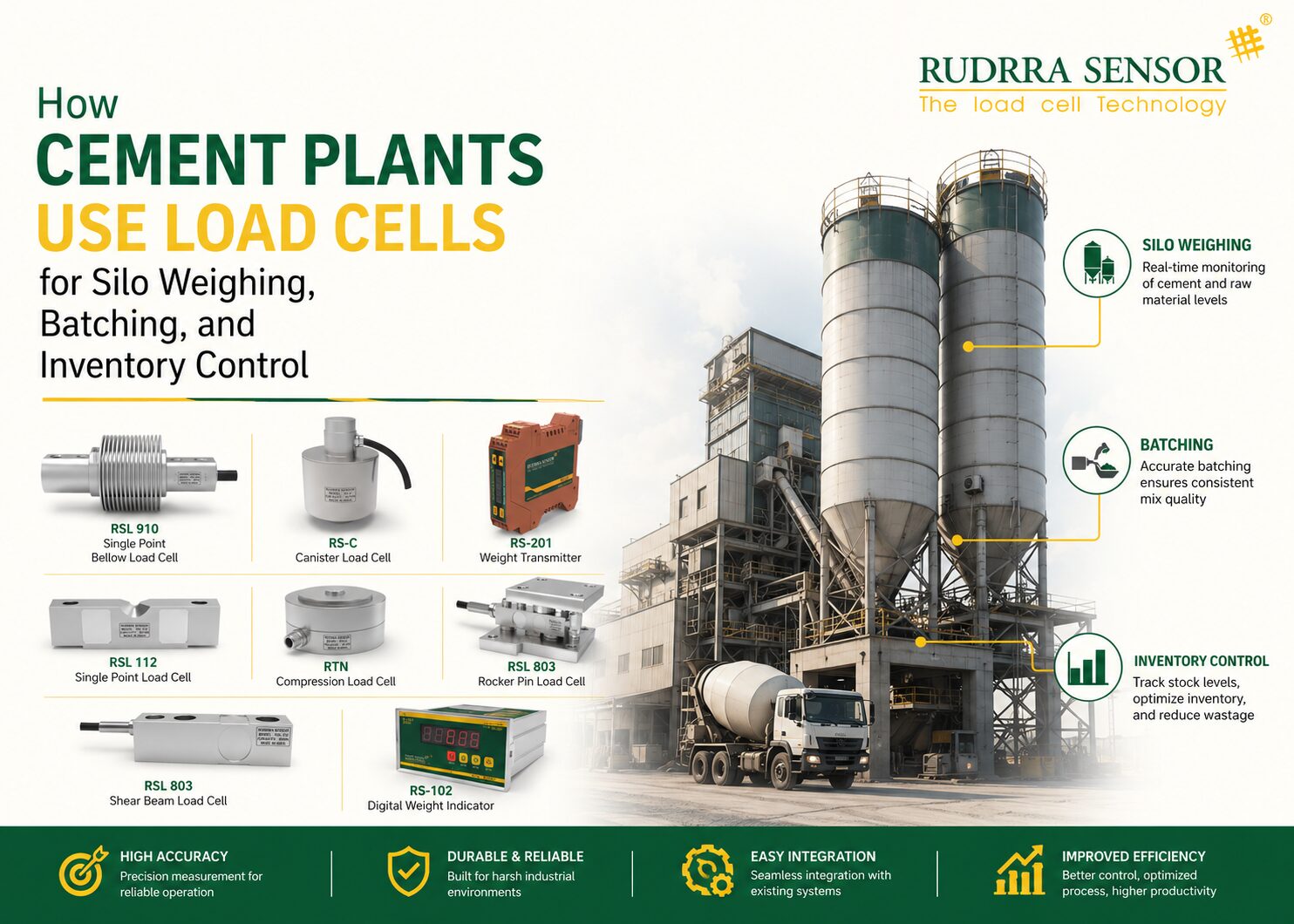
Introduction
The cement industry operates on a massive scale, handling thousands of tons of raw materials, clinker, additives, and finished products every day. Maintaining accurate control over these materials is essential for ensuring consistent product quality, maximizing production efficiency, reducing waste, and controlling operating costs.
Modern cement plants rely heavily on weighing technology throughout the manufacturing process. From raw material storage and clinker handling to batching operations and finished product inventory management, accurate weight measurement plays a vital role in plant performance.
One of the most reliable technologies used for industrial weighing is the load cell.
Load cells provide precise weight measurement for silos, hoppers, bins, batching systems, conveyors, and storage vessels. By converting mechanical force into electrical signals, load cells enable cement manufacturers to monitor inventory levels, automate production processes, improve batching accuracy, and optimize plant operations.
As cement manufacturers increasingly adopt automation, Industry 4.0 technologies, and data-driven production strategies, load cell-based weighing systems have become an essential component of modern cement plants.
This guide explores how cement plants use load cells for silo weighing, batching, and inventory control and why these systems are critical for efficient cement production.
Why Accurate Weighing Is Critical in Cement Manufacturing
Cement production involves multiple stages of material handling, blending, processing, and storage. Each stage depends on accurate measurement of raw materials and finished products.
Even small measurement errors can lead to:
- Inconsistent cement quality
- Production inefficiencies
- Material wastage
- Inventory discrepancies
- Increased operating costs
- Production interruptions
Accurate weighing helps cement manufacturers maintain tight control over production processes.
What Are Load Cells and How Do They Work?
A load cell is a force measurement device that converts applied weight into an electrical signal.
When a force is applied to the load cell, its sensing element deforms slightly. Strain gauges bonded to the sensing element detect this deformation and generate a proportional electrical output.
This output is then processed by:
- Weight indicators
- Weight transmitters
- PLC systems
- SCADA systems
- Distributed Control Systems (DCS)
The resulting data can be used for:
- Displaying weight
- Monitoring inventory
- Controlling processes
- Automating production
- Generating reports
Modern load cells provide highly accurate and repeatable measurements, making them ideal for demanding chemical applications.
Product Quality Consistency
The quality of cement depends heavily on the correct proportions of raw materials such as:
- Limestone
- Clay
- Shale
- Iron ore
- Gypsum
- Fly ash
- Slag
Any deviation in ingredient proportions can affect:
- Compressive strength
- Setting time
- Durability
- Performance characteristics
Load cells help ensure that raw materials are measured accurately before blending and processing.
Production Efficiency
Accurate weight measurement allows operators to optimize:
- Material usage
- Batch accuracy
- Process control
- Inventory management
This leads to improved production efficiency and reduced operational waste.
Inventory Visibility
Cement plants often store large quantities of:
- Raw materials
- Clinker
- Additives
- Finished cement
Without accurate inventory information, plants may experience:
- Unexpected shortages
- Emergency procurement
- Production downtime
- Excess stock holding costs
Load cells provide continuous inventory visibility throughout the production process.
Understanding the Cement Manufacturing Process
To understand where load cells are used, it is important to understand the major stages of cement production.
Although specific processes vary among manufacturers, a typical cement plant includes:
Raw Material Storage
Raw materials are received and stored in:
- Silos
- Storage bins
- Hoppers
Raw Material Preparation
Materials are crushed, blended, and prepared for kiln processing.
Clinker Production
The prepared raw mix is heated in rotary kilns to produce clinker.
Clinker Storage
Clinker is stored before grinding operations.
Cement Grinding
Clinker is combined with additives such as gypsum and fly ash.
Cement Storage
Finished cement is stored in silos before packaging or dispatch.
Packaging and Dispatch
Finished products are packed and transported to customers.
Load cells can be found in nearly every stage of this process.
What Are Load Cells and How Do They Work?
A load cell is a force measurement device that converts applied weight into an electrical signal.
When a load is applied, the sensing element deforms slightly. Strain gauges attached to the sensing element detect this deformation and generate a proportional electrical output.
This signal is processed by:
- Weight indicators
- Weight transmitters
- PLC systems
- SCADA systems
- DCS platforms
The resulting weight information can be used for:
- Inventory monitoring
- Process control
- Batch management
- Production reporting
- Automation
Because of their accuracy and reliability, load cells are widely used in cement manufacturing environments.
Why Cement Plants Prefer Weight-Based Measurement
Many cement plants have the option of measuring materials by either volume or weight.
However, weight-based measurement offers significant advantages.
Material Density Variations
Bulk materials often experience density changes due to:
- Moisture content
- Particle size variations
- Compaction
- Storage conditions
Volume measurements can become inaccurate when density changes occur.
Weight measurements remain reliable regardless of density variations.
Improved Inventory Accuracy
Weight-based inventory systems provide actual material quantity rather than estimated volume.
This improves:
- Production planning
- Procurement decisions
- Inventory control
Better Process Control
Weight measurements provide precise information for batching and blending operations.
This helps maintain product consistency and process stability.
Load Cells in Reactor Vessel Weighing
Chemical reactions often take place inside reactor vessels where precise ingredient additions are critical to product quality and process safety. Reactor weighing systems use load cells to continuously monitor the weight of materials entering and leaving the vessel.
Unlike flow meters or level sensors, load cells provide direct weight measurement, ensuring that every ingredient is added according to the production recipe.
Why Reactor Vessel Weighing Is Important
Accurate Ingredient Addition
Load cells help ensure that each raw material is added in the correct quantity.
Batch Traceability
Weight data can be recorded and linked to production batches for quality control and regulatory compliance.
Improved Process Control
Operators can monitor material additions in real time and make adjustments when required.
Reduced Product Variability
Consistent ingredient measurements help maintain product uniformity across production batches.
Common Reactor Applications
- Specialty chemicals
- Resins
- Adhesives
- Paints and coatings
- Agrochemicals
- Water treatment chemicals
- Pharmaceutical intermediates
Recommended Load Cells
- Compression Load Cells
- Single Ended Shear Beam Load Cells
- Load Cell Assemblies
Load Cells in Raw Material Storage Silos
Raw materials represent the foundation of cement production.
These materials are typically stored in:
- Limestone silos
- Fly ash silos
- Gypsum silos
- Slag silos
- Additive storage silos
Accurate inventory monitoring is essential for maintaining uninterrupted production.
Challenges of Traditional Level Measurement
Many plants rely on level sensors to estimate inventory.
However, bulk materials often create problems such as:
Material Bridging
Material forms arches that prevent proper flow.
Rat-Holing
Material flows only through a central channel while large quantities remain stored.
Dust Accumulation
Dust can interfere with sensor performance.
Irregular Material Surfaces
Uneven surfaces can reduce measurement accuracy.
Because of these challenges, level measurement alone may not provide reliable inventory information.
Why Load Cells Are Preferred for Silo Inventory Monitoring
Load cells measure actual weight rather than material level.
This provides:
- Higher accuracy
- Real-time inventory visibility
- Improved procurement planning
- Better production scheduling
Silo Weighing Systems in Cement Plants
Silo weighing is one of the most important load cell applications in cement manufacturing.
Large storage silos often contain hundreds or thousands of tons of material.
Load cells installed beneath the silo structure continuously measure total weight.
Benefits of Silo Weighing Systems
Real-Time Inventory Monitoring
Operators can instantly determine available material quantities.
Improved Procurement Planning
Material replenishment can be scheduled more effectively.
Reduced Production Interruptions
Potential shortages can be identified before they affect production.
Better Supply Chain Management
Inventory data supports more efficient logistics operations.
Common Silo Applications
Limestone Silos
Monitor raw material inventory.
Fly Ash Silos
Track supplementary cementitious materials.
Slag Silos
Monitor grinding additives.
Cement Storage Silos
Manage finished product inventory.
Clinker Silos
Track intermediate production materials.
Recommended Load Cells for Silo Weighing
Compression Load Cells
Widely used in heavy-capacity silo applications.
Double Ended Shear Beam Load Cells
Suitable for high-capacity industrial weighing systems.
Load Cell Assemblies
Provide safe load introduction and structural protection.
Clinker Inventory Monitoring Using Load Cells
Clinker represents one of the most valuable materials in cement production.
Accurate clinker inventory monitoring is essential because clinker availability directly affects cement output.
Load cell-based weighing systems help operators monitor:
- Clinker production
- Clinker consumption
- Storage levels
- Material flow rates
This information supports better production planning and inventory management.
Load Cells in Cement Batching Operations
Batching is one of the most critical processes in cement manufacturing. Whether preparing raw meal for kiln feeding or blending clinker with gypsum and supplementary materials, precise batching directly impacts product quality and production efficiency.
A batching system ensures that each material is added in the correct proportion according to the production recipe.
Typical materials include:
- Limestone
- Clay
- Iron ore
- Gypsum
- Fly ash
- Slag
- Pozzolanic materials
Even small variations in material proportions can affect cement properties such as:
- Strength
- Setting time
- Durability
- Consistency
Load cells help cement plants achieve accurate and repeatable batching by providing real-time weight measurement.
How Load Cells Improve Batching Accuracy
Precise Material Measurement
Each ingredient is weighed before being discharged into the process.
Automated Batch Control
Weight signals can automatically control:
- Feeders
- Valves
- Gates
- Conveyors
Reduced Human Error
Automated weighing minimizes operator intervention and improves consistency.
Improved Product Quality
Consistent ingredient proportions result in consistent cement quality.
Typical Batching Applications in Cement Plants
Raw Meal Preparation
Load cells measure raw materials before kiln processing.
Clinker Grinding
Load cells control clinker-to-gypsum ratios.
Specialty Cement Production
Load cells ensure accurate additive dosing for specialty cement formulations.
Cement Blending
Load cells maintain consistency across blended products.
Load Cells in Cement Blending and Mixing Systems
Modern cement manufacturing often requires blending multiple materials to achieve desired product characteristics.
Common blending materials include:
- Clinker
- Gypsum
- Fly ash
- Slag
- Pozzolans
Accurate blending improves:
- Product consistency
- Mechanical strength
- Setting performance
- Customer satisfaction
Why Accurate Blending Matters
Consistent Product Quality
Every batch must meet specified performance requirements.
Reduced Waste
Accurate blending reduces off-spec production.
Better Process Efficiency
Operators can optimize material usage and production rates.
Regulatory Compliance
Many cement products must comply with national and international standards.
Recommended Load Cells for Blending Applications
Compression Load Cells
Suitable for large blending vessels.
Single Ended Shear Beam Load Cells
Commonly used in medium-capacity systems.
Double Ended Shear Beam Load Cells
Ideal for high-capacity blending operations.
Load Cells in Cement Grinding Operations
After clinker production, grinding operations transform clinker into finished cement.
Grinding systems often require accurate monitoring of:
- Clinker feed rates
- Additive quantities
- Material flow rates
Load cells support these operations by providing precise weight information.
Applications in Grinding Systems
Additive Feeding
Control the addition of gypsum and supplementary materials.
Material Consumption Monitoring
Track clinker usage in real time.
Process Optimization
Improve grinding efficiency through accurate material control.
Production Reporting
Generate reliable production data for management and quality assurance.
Finished Cement Inventory Monitoring
Once production is complete, finished cement is stored in silos before packaging or dispatch.
Maintaining accurate inventory information is essential for:
- Sales planning
- Logistics management
- Customer fulfillment
- Production scheduling
Load cell-based inventory monitoring systems provide continuous visibility into finished cement inventory levels.
Benefits of Finished Product Monitoring
Real-Time Inventory Data
Operators always know available stock quantities.
Better Dispatch Planning
Logistics teams can schedule deliveries more effectively.
Reduced Stock Discrepancies
Weight-based monitoring provides accurate inventory information.
Improved Customer Service
Orders can be fulfilled more efficiently.
Inventory Monitoring Across the Cement Plant
Inventory management extends beyond finished products.
Cement plants must monitor inventory throughout the production process.
Raw Material Inventory
Examples:
- Limestone
- Clay
- Iron ore
- Fly ash
- Slag
Work-in-Progress Inventory
Examples:
- Raw meal
- Clinker
Finished Product Inventory
Examples:
- OPC Cement
- PPC Cement
- PSC Cement
- Specialty Cement Products
Benefits of Plant-Wide Inventory Monitoring
Better Production Planning
Inventory data helps optimize production schedules.
Reduced Material Shortages
Potential supply issues can be identified early.
Improved Procurement Decisions
Purchasing teams can make data-driven decisions.
Reduced Working Capital
Accurate inventory information helps prevent overstocking.
Integration with Industrial Automation Systems
Modern cement plants increasingly rely on automation and digital technologies.
Load cells integrate seamlessly with:
- PLC Systems
- SCADA Systems
- DCS Platforms
- ERP Software
- Manufacturing Execution Systems (MES)
- Industry 4.0 Platforms
This integration transforms weighing systems into intelligent process control tools.
Benefits of Automation Integration
Automated Material Handling
Material transfers can be controlled automatically.
Real-Time Monitoring
Operators gain instant access to inventory and process data.
Production Analytics
Weight data supports process optimization initiatives.
Predictive Maintenance
Weight trends can help identify operational issues before failures occur.
Benefits of Load Cells in Cement Manufacturing
Load cells deliver significant advantages throughout the cement production process.
Improved Inventory Accuracy
Weight-based monitoring provides reliable inventory information.
Better Product Quality
Accurate batching and blending improve consistency.
Reduced Material Waste
Precise measurement minimizes overconsumption.
Enhanced Process Control
Operators can make informed decisions based on real-time weight data.
Increased Automation
Load cells support automated production and inventory systems.
Improved Operational Efficiency
Accurate weighing helps optimize production processes.
Better Supply Chain Management
Inventory visibility improves procurement and logistics planning.
Lower Operating Costs
Reduced waste and improved efficiency contribute to cost savings.
Common Challenges in Cement Plant Weighing Applications
Cement manufacturing environments can be demanding.
Proper system design is essential for achieving reliable weighing performance.
Dust Exposure
Cement plants generate large quantities of airborne dust.
Solution
Use sealed load cells with appropriate environmental protection ratings.
Vibration
Heavy equipment may introduce vibration into weighing systems.
Solution
Use proper mounting assemblies and signal filtering techniques.
Temperature Variations
Outdoor installations may experience significant temperature changes.
Solution
Select load cells designed for industrial environments.
Structural Movement
Large silos and storage structures may experience expansion and contraction.
Solution
Use engineered load cell assemblies designed for silo applications.
Wind Loads
Outdoor silos are exposed to wind forces.
Solution
Install proper restraints and mounting hardware.
Selecting the Right Load Cell for Cement Applications
Selecting the correct load cell depends on multiple factors.
Load Capacity
The load cell must support:
- Dead load
- Live load
- Dynamic forces
- Safety margins
Environmental Conditions
Consider:
- Dust exposure
- Moisture
- Temperature
- Outdoor installation requirements
Accuracy Requirements
Different applications require different accuracy levels.
Examples:
- Inventory Monitoring → Moderate Accuracy
- Batching Systems → High Accuracy
- Process Control → High Accuracy
Installation Requirements
Consider:
- Tank design
- Silo structure
- Mounting arrangement
- Maintenance accessibility
Automation Requirements
Ensure compatibility with:
- Weight Indicators
- Weight Transmitters
- PLC Systems
- SCADA Platforms
Frequently Asked Questions (FAQ)
How are load cells used in cement plants?
Load cells are used for silo weighing, batching, blending, clinker inventory monitoring, finished product inventory management, and process automation.
Why is accurate weighing important in cement manufacturing?
Accurate weighing improves product quality, process efficiency, inventory control, and material utilization.
What is silo weighing?
Silo weighing uses load cells installed beneath a silo structure to continuously monitor material weight.
Why are load cells preferred over level sensors?
Load cells measure actual material weight and are not affected by density changes, bridging, rat-holing, or uneven material surfaces.
Which load cells are commonly used in cement silos?
Compression load cells and double ended shear beam load cells are commonly used in cement silo applications.
How do load cells improve inventory management?
They provide real-time inventory visibility, helping operators manage material availability and procurement.
Can load cells integrate with PLC and SCADA systems?
Yes. Modern load cells can communicate with automation systems through indicators and transmitters.
What materials are monitored using load cells in cement plants?
Limestone, fly ash, slag, gypsum, clinker, raw meal, and finished cement are commonly monitored.
What are the benefits of load cell-based batching systems?
They improve accuracy, consistency, automation, and product quality.
How often should cement plant weighing systems be calibrated?
Calibration schedules depend on process requirements and operational conditions, but periodic verification is recommended.
Are load cells suitable for outdoor silo installations?
Yes. Industrial-grade load cells are designed to operate in outdoor environments when properly installed.
What factors should be considered when selecting a load cell?
Capacity, accuracy, environmental conditions, mounting configuration, and automation requirements should all be evaluated.
Conclusion
Accurate weighing is fundamental to efficient cement manufacturing. From raw material storage and clinker monitoring to batching operations and finished product inventory management, load cells provide the reliable weight data required for modern cement production.
By enabling real-time inventory visibility, improving batching accuracy, reducing material waste, and supporting automation initiatives, load cells help cement plants achieve higher levels of productivity and operational efficiency.
As the cement industry continues to adopt Industry 4.0 technologies and data-driven manufacturing practices, load cell-based weighing systems will play an increasingly important role in optimizing plant performance and maintaining competitive advantage.
For applications such as silo weighing, clinker inventory monitoring, batching systems, blending operations, and process automation, selecting the right load cell solution is essential for long-term operational success.
Call to Action
Looking for Reliable Load Cells for Cement Plant Applications?
Rudrra Sensor offers a comprehensive range of industrial load cells, load cell assemblies, weight indicators, and weight transmitters designed for demanding cement industry applications.
Whether your project involves:
- Silo Weighing Systems
- Cement Batching Plants
- Clinker Inventory Monitoring
- Raw Material Storage
- Process Automation
- Industrial Weighing Systems
Our team can help you select the right weighing solution for your application.
Contact Rudrra Sensor today to discuss your cement plant weighing requirements and discover the most suitable load cell solution for your operation.