


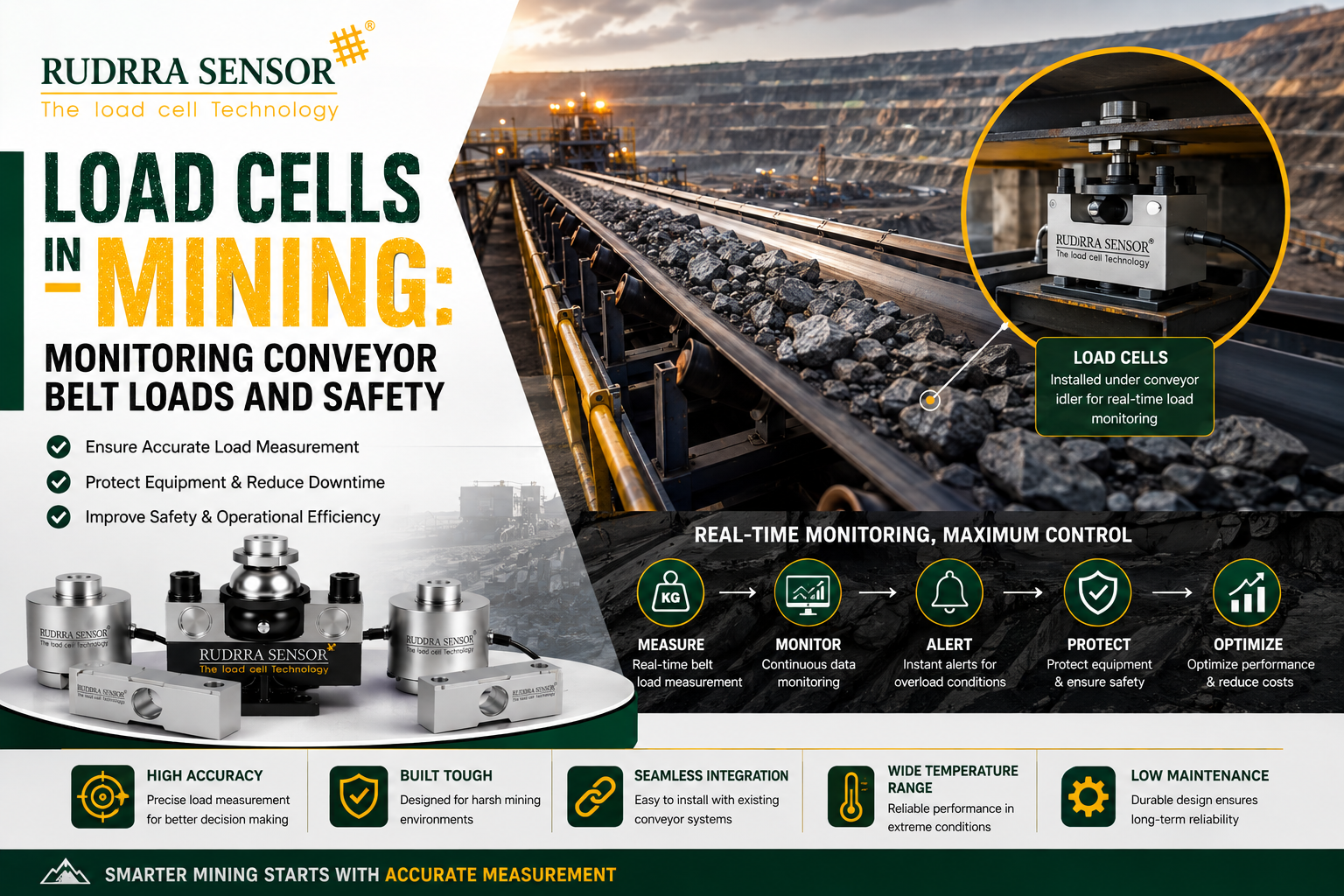
Introduction
Few pieces of equipment work harder, in tougher conditions, for longer periods of time than a mine’s conveyor belt system. Running 24 hours a day, often for years without a full shutdown, mining conveyors move raw material — coal, iron ore, copper concentrate, aggregate, overburden — from the point of extraction to processing, stockpiling, or export, sometimes across distances of many kilometers and through terrain that would be impossible for road or rail transport to match economically. A single major conveyor system on a large open-pit or underground operation can move many thousands of tonnes of material per hour, and the belt’s load, tension, and mechanical condition at any given moment directly determine whether that material keeps moving safely and efficiently, or whether the operation faces a costly, potentially dangerous failure.
Load cells sit at the center of how mining operations measure, control, and protect these conveyor systems. They provide the throughput data that feeds production reporting and process control, the tension feedback that keeps a belt running within its safe mechanical envelope, and — critically — the overload and safety monitoring that helps prevent the kind of belt failures, spillage events, and mechanical incidents that can injure personnel, damage equipment, and halt production for days or weeks. Mining is also one of the harshest operating environments in industrial measurement: constant vibration, heavy dust and abrasive material contamination, extreme temperature swings between underground and surface operations or across different climate zones, and mechanical shock from oversized rock and tramp material passing through the system.
This blog is a deep, practical look at how load cells are used across mining conveyor systems — from belt weighing for production accounting, to tension monitoring for mechanical protection, to overload and safety interlock systems designed to prevent belt damage and personnel risk. We will cover the technical trust factors that separate a genuinely mining-rated load cell from a repurposed industrial sensor, walk through real-world case studies, and look at the standards and safety practices that matter most in this sector.
At Rudrra Sensor, we’ve supported mining operators and conveyor system integrators with load cells engineered for the specific demands of mine-site conveyor applications — from surface stockpile conveyors to underground haulage systems. This article draws on those application patterns to give mine engineers, maintenance planners, and procurement teams a genuinely useful reference for specifying conveyor load cell systems that will actually perform reliably in real mining conditions.
It’s worth framing why conveyor load monitoring deserves this level of dedicated attention rather than being treated as a routine instrumentation afterthought. A mining conveyor is rarely a single, isolated piece of equipment — it is typically one link in a long chain connecting extraction, processing, and dispatch, meaning a single conveyor failure can halt an entire production circuit, not just the section of the conveyor itself. At the same time, conveyors are mechanically simple in principle (a moving belt, a drive system, a series of supporting idlers) but operate continuously under conditions — dust, vibration, moisture, temperature extremes, and in some cases explosive atmosphere risk — that would be considered exceptional in most other industrial settings. This combination of high consequence and harsh operating reality is exactly why mining conveyor load cell specification deserves the same level of engineering rigor that mine operators already apply to other safety and production-critical systems.
Why Load Monitoring Matters on Mining Conveyors
Production accounting depends on accurate belt weighing
Mining operations live and die by tonnage — production reporting, resource reconciliation, customer billing for shipped product, and royalty or tax calculations in many jurisdictions all depend on accurate measurement of material moved across the conveyor system. A belt weigher (also called a belt scale) uses load cells positioned under one or more idler frames along the conveyor to continuously measure the weight of material passing over that section, combined with belt speed data to calculate a running total of tonnes conveyed. Errors here are not abstract — a systematic weighing bias of even a few percent, sustained across millions of tonnes of annual production, translates into a very substantial reconciliation discrepancy between what a mine believes it has produced and what has actually left the site, with direct financial and, in many jurisdictions, regulatory reporting consequences.
To put the scale of this in perspective, a single major overland conveyor on a large open-pit operation can move several thousand tonnes of material per hour, meaning even a short period of undetected measurement bias can accumulate into a discrepancy of thousands of tonnes before it is identified through downstream reconciliation checks such as rail load-out weighing, stockpile survey, or customer receipt weighing. Because these downstream checks are often the first point at which a systematic belt weigher error becomes visible, and because the time lag between the error occurring and being detected can span weeks or months of production, accurate, well-maintained belt weighing is not merely a matter of instrument specification — it is a core input into a mine’s entire production accounting integrity.
Belt tension control prevents mechanical failure
Conveyor belts must be maintained within a specific tension range to function correctly — too little tension and the belt can slip on the drive pulley (particularly under high load or during starting), leading to reduced throughput, excessive pulley and belt wear, and potential belt tracking problems; too much tension accelerates belt, pulley, and bearing wear and increases the risk of belt or splice failure under load. Load cells integrated into take-up systems (the mechanism that maintains belt tension, typically via a counterweight, winch, or gravity take-up arrangement) provide the continuous tension feedback that automated tensioning control systems depend on to keep the belt within its safe operating window across the full range of load and speed conditions the conveyor experiences.
Overload protection prevents catastrophic belt and structural failure
Conveyor belts and their supporting structure — idlers, pulleys, drive systems, and the steel or concrete structure carrying the belt itself — are engineered for a specific maximum load and tension. An overload event, whether from a blocked chute causing material buildup, a control system fault allowing excessive feed rate, or an unexpected surge in feed material, can exceed these design limits, risking belt rupture, structural damage, or a pulley or drive system failure. Load cell-based overload monitoring, integrated into the conveyor’s control and safety interlock system, allows an automatic shutdown or feed-rate reduction before an overload condition progresses to actual mechanical failure.
Belt slip and stall detection protect against fire and mechanical damage
When a conveyor belt stalls or a section becomes jammed while the drive system continues attempting to move it, sustained friction between the stationary belt and the drive pulley or idlers can generate significant heat, creating a genuine fire risk, particularly in underground coal mining environments where combustible dust and gas concentrations make this an especially serious hazard. Load cell and associated sensor data (often combined with speed sensors) feeding into belt protection systems can detect the abnormal load and tension signatures associated with a slip or stall condition and trigger an automatic shutdown before sustained frictional heating becomes a fire hazard.
Structural and safety monitoring for long, elevated, or inclined conveyors
Major mining conveyor systems, particularly long overland conveyors connecting a mine to a processing plant or port facility, or steeply inclined conveyors used in underground and some surface mining configurations, place significant structural demands on their supporting gantries, trestles, and anchor points. Load cells integrated into structural support points and anchor systems provide ongoing verification that these structures remain within their designed load envelope, supporting both routine structural integrity monitoring and early detection of developing issues before they progress to structural failure.
Personnel and equipment safety around loading and transfer points
Beyond the belt itself, load cells are used at conveyor loading points, transfer chutes, and feeder systems to monitor for blockages, excessive material buildup, and abnormal loading patterns that can create both mechanical failure risk and direct personnel safety hazards at points along the conveyor route where maintenance and operations personnel routinely work in close proximity to moving equipment.
Where Load Cells Are Used Across Mining Conveyor Systems
Belt weighers (belt scales) for production measurement
The most widespread application, belt weighers use one or more load cell-supported idler frames along a section of the conveyor to continuously measure the load per unit length of belt, combined with a speed sensor (typically a tachometer on an idler or pulley) to calculate instantaneous flow rate and cumulative tonnage. Multi-idler configurations, using several consecutive weighing idlers rather than a single point, generally achieve better accuracy by averaging out the effect of material distribution variability along the belt and mechanical noise from any single idler.
Take-up tension monitoring systems
As discussed above, load cells integrated into gravity, winch, or hydraulic take-up systems provide continuous belt tension feedback, particularly important on long conveyors and high-power drive systems where tension must be actively managed across varying load and starting conditions to prevent both slip and over-tensioning.
Drive pulley and shaft load monitoring
Some conveyor systems incorporate load cells or load pins at the drive pulley shaft bearings to monitor the actual load being transmitted through the drive system, supporting both production verification (as an alternative or supplement to belt weigher data) and drive system protection, since abnormal shaft loading can indicate developing mechanical issues such as pulley lagging wear, misalignment, or bearing degradation.
Overload and blockage detection at transfer points and chutes
Load cells integrated into transfer chute structures, feeder systems, and loading point support structures monitor for the abnormal load buildup associated with material blockages or chute plugging, feeding alarm or automatic shutdown logic that prevents a blockage event from escalating into structural damage or a more serious mechanical failure.
Structural monitoring on overland and inclined conveyor systems
For major overland conveyor systems, particularly those spanning significant distances or crossing challenging terrain, and for steeply inclined or vertical lift conveyor configurations used in some underground and surface mining applications, load cells at key structural support and anchor points provide ongoing structural health monitoring data, often as part of a broader instrumentation program that also includes displacement, vibration, and strain monitoring on critical structural members.
Stockpile reclaim and load-out weighing
At the downstream end of the mining material handling chain, load cells integrated into stockpile reclaim conveyors, load-out systems for rail or truck transport, and ship-loading conveyor systems at port facilities provide the final production and shipping verification weighing that closes the loop on the material accounting chain from extraction through to dispatch.
Crusher and screening plant feed monitoring
Load cells on feed conveyors into crushing and screening circuits help regulate feed rate to match the downstream equipment’s processing capacity, preventing both under-utilization (from feeding too slowly) and overload conditions in crushers and screens that can cause equipment damage or reduced processing efficiency.
Underground haulage conveyor applications
Underground mining conveyor systems face particular challenges around confined space, ventilation and fire safety requirements, and often more restrictive access for maintenance compared to surface operations, making reliable, low-maintenance load cell instrumentation especially valuable for weighing, tension monitoring, and belt protection functions in these applications.
How Mining Conveyor Load Cells Differ From Standard Industrial Load Cells
Extreme dust and particulate contamination resistance
Mining environments generate substantial airborne dust from drilling, blasting, crushing, and material handling operations, along with the fine particulate that settles continuously onto equipment surfaces throughout a mine site. Load cells used in mining conveyor applications require robust sealing — commonly IP65 to IP68 depending on the specific installation location — along with housing designs that resist the ingress of fine, abrasive dust into any moving or sensitive internal components.
Vibration and shock resistance from continuous operation and tramp material
Conveyor belts operate under continuous vibration from idler rotation, belt flex, and material impact at loading points, and mining conveyors specifically are prone to occasional shock loading from oversized rock, tramp metal, or other unexpected material passing through the system. Load cells specified for this environment require fatigue ratings and mechanical designs suited to both the continuous background vibration and occasional significant shock events over a multi-year service life.
Wide temperature range across surface and underground environments
Surface mining operations in many regions experience substantial seasonal and diurnal temperature swings, from sub-zero winter conditions to intense summer heat on exposed steel conveyor structures, while underground mining environments can present a different but equally demanding thermal challenge, particularly in deep or geothermally active mines where ambient underground temperatures can be significantly elevated. Load cells must be specified with a compensated temperature range matched to the specific surface or underground conditions of the installation.
Corrosion resistance for wet and chemically aggressive environments
Many mining operations involve wet processing circuits, acidic or alkaline process water, and general moisture exposure from both natural conditions and process water management, making corrosion-resistant materials — commonly stainless steel — an important specification consideration for conveyor load cells exposed to these conditions, particularly in metalliferous and coal processing applications where process chemistry can be locally aggressive.
Explosion protection for underground coal and other gassy mining environments
Underground coal mining, and some other underground mining environments where combustible gas or dust can accumulate, require load cells and associated electrical equipment certified for use in potentially explosive atmospheres, following hazardous area classification and certification frameworks broadly similar in principle to those used in the oil and gas sector, though with specific mining-industry certification standards and requirements that differ in detail from general industrial or petrochemical hazardous area certification.
Robust cabling and connector design for harsh mechanical environments
Cabling on mining conveyor systems is exposed to abrasion from moving components, potential impact from falling material, and general mechanical wear from the demanding physical environment around conveyor structures. Armored cable, robust connector designs, and careful cable routing and protection are standard requirements for reliable long-term operation in this environment, considerations that go well beyond typical indoor industrial cabling practice.
High-cycle fatigue life for continuous, long-duration operation
Given that major mining conveyor systems often operate continuously with minimal planned downtime, sometimes for years between major shutdowns, load cells in these applications must be engineered for a very high cumulative loading cycle count over their service life, making fatigue rating a particularly important specification parameter, similar in principle to the fatigue considerations discussed for other continuously operating industrial applications, but at an unusually demanding scale given typical mining conveyor duty cycles.
A Practical Specification Checklist
Before requesting a quotation for a mining conveyor load cell system, working through a structured checklist helps ensure the specification reflects the actual operating conditions the sensor will face:
- Application type — belt weighing, take-up tension monitoring, drive pulley load monitoring, transfer point overload detection, or structural monitoring.
- Belt capacity and expected load range, including both normal operating throughput and any credible surge or upset conditions.
- Environmental exposure — surface or underground location, temperature range, dust levels, moisture/wet processing exposure, and any specific chemical exposure relevant to the site.
- Hazardous area classification, particularly relevant for underground coal and other gassy mining environments where explosion protection certification is required.
- Required accuracy class, driven by whether the application is primarily for production accounting/billing (requiring higher accuracy) or general operational monitoring and protection.
- Vibration, shock, and fatigue duty cycle, based on the realistic continuous operating hours and any known tramp material or shock loading history for the specific conveyor.
- Signal output and integration requirements, matched to the plant’s control system, belt weigher integrator/totalizer, or safety interlock system.
- Corrosion protection requirements, based on the specific wet processing, underground, or coastal/humid environmental exposure relevant to the site.
- Maintenance access constraints, particularly for underground installations or remote sections of long overland conveyors where maintenance access is more difficult than a typical surface plant location.
- Calibration and verification plan, including how the installed system will be periodically checked against reference standards, especially important for belt weighers used in production accounting or commercial billing.
Trust Factors: Technical Benchmarks for Mining Conveyor Load Cells
| Trust Factor | Why It Matters | Typical Benchmark |
| IP/environmental sealing | Protects against dust, moisture, and washdown exposure | IP65 minimum for general conveyor use; IP67/IP68 for wet or submersion-prone locations |
| Shock and vibration rating | Withstands continuous operation and tramp material impact | Rated for repeated shock events well above nominal working load |
| Fatigue life | Ensures service life under high-cycle continuous operation | Multi-million cycle rating suited to continuous, long-duration duty |
| Temperature range | Withstands surface and underground climate extremes | Wide compensated range matched to specific site conditions |
| Corrosion resistance | Withstands wet processing and general moisture exposure | Stainless steel or equivalent corrosion-resistant housing |
| Accuracy class | Supports production accounting and billing requirements | Belt weigher systems commonly targeting accuracy within a few percent of true throughput under proper installation and calibration |
| Hazardous area certification | Required for underground coal and other gassy environments | Certification matched to the specific mine’s gas/dust classification |
| Overload capacity | Protects against blockage and surge load events | Mechanical overload rating well above normal operating load |
| Cable and connector robustness | Withstands abrasive, mechanically harsh conveyor environment | Armored cabling and robust, sealed connector design |
| Calibration traceability | Confirms measurement accuracy is verifiable for reconciliation | Certificate traceable to a recognized national/international standard |
Why belt weigher accuracy depends on more than the load cell alone
It’s worth emphasizing that belt weigher accuracy is a system-level outcome, not solely a function of the load cell’s own specification. Belt tension variation, idler alignment and condition, belt tracking, material distribution across the belt width, and speed sensor accuracy all contribute to overall system accuracy alongside the load cell itself. This is a critical point for mine engineers troubleshooting belt weigher accuracy complaints: replacing load cells with “more accurate” units will not resolve an accuracy problem that actually stems from poor idler alignment, belt mistracking, or inconsistent material loading — a distinction directly analogous to the mounting-related accuracy issues discussed in other load cell application sectors, and one of the most common sources of unresolved belt weigher accuracy complaints across the industry.
Why fatigue life deserves particular attention in mining applications
Given the continuous, high-cycle operation typical of major mining conveyor systems — often running the vast majority of hours in a year with only planned maintenance shutdowns — the cumulative loading cycle count experienced by a conveyor load cell over its service life can be substantially higher than in many other industrial applications with more intermittent duty cycles. A load cell that appears adequately specified based on a cursory capacity check can be significantly under-rated for the true fatigue demand of continuous mining conveyor operation, making explicit fatigue life specification, rather than reliance on general capacity rating alone, an important part of a properly engineered specification.
Relevant standards and regulatory frameworks
- National mine safety and health regulatory frameworks — such as those administered by mining safety regulators in various jurisdictions — govern conveyor safety system requirements, including belt protection, fire safety, and structural integrity considerations relevant to load cell-based monitoring systems, though specific requirements vary significantly between jurisdictions and mining sectors.
- Hazardous area certification frameworks relevant to underground coal and other gassy mining environments, following broadly similar principles to ATEX/IECEx certification used in other industries, though often governed by specific mining-industry certification bodies and standards distinct from general industrial hazardous area certification.
- OIML R50 and related belt weigher metrological standards provide an international reference framework specifically for continuous totalizing automatic weighing instruments (the formal metrological category belt weighers fall under), relevant particularly for belt weigher installations used for commercial billing, royalty calculation, or regulatory production reporting purposes.
- ISO 9001 manufacturing quality certification and ISO/IEC 17025 calibration traceability remain relevant general quality and metrology benchmarks applicable to mining conveyor load cells as in other application sectors.
Case Study 1: Resolving a Persistent Belt Weigher Reconciliation Discrepancy
The situation: A coal mining operation was experiencing a persistent, unexplained discrepancy between its primary belt weigher’s cumulative production figures and independent verification measurements from downstream rail load-out weighing, a reconciliation gap that had been present for an extended period and was complicating the site’s production reporting and stockpile inventory management.
The challenge: Initial troubleshooting focused on the load cells themselves, including a full replacement of the belt weigher’s load cells with new units — which did not resolve the discrepancy, indicating the root cause lay elsewhere in the weighing system rather than in the sensors’ basic condition or calibration.
The solution: A more thorough investigation, informed by the understanding that belt weigher accuracy depends on system-level factors beyond the load cells alone, identified that the weigh idler section had developed a slight misalignment relative to the rest of the conveyor’s idler frames, introducing a systematic bias into the measured load as material distribution across the belt width shifted slightly at the weighing point compared to the belt’s condition elsewhere along its length. The idler alignment was corrected, and the belt weigher was then recalibrated against a certified reference (material test or chain test method) to confirm accuracy following the mechanical correction.
The outcome: Following the alignment correction and recalibration, the belt weigher’s cumulative production figures came into close agreement with the independent rail load-out weighing data, resolving the reconciliation discrepancy that had persisted through the earlier, unsuccessful load cell replacement effort. The site’s engineering team subsequently incorporated a periodic idler alignment check into its belt weigher maintenance program, rather than relying solely on load cell calibration checks as the primary accuracy verification activity.
Lessons for similar projects: This case is a clear illustration of a theme relevant across many load cell application sectors: an accuracy problem is not automatically a sensor problem, and replacing load cells without first properly diagnosing the actual root cause can waste significant time and cost while leaving the underlying issue — in this case, a mechanical alignment fault — unresolved. A structured troubleshooting approach that considers the full weighing system, not just the load cells in isolation, is essential for resolving persistent belt weigher accuracy issues. It’s also worth noting the specific detail that made this case difficult to diagnose initially: the misalignment was subtle enough that it did not produce an obvious visual defect or an error message from the belt weigher’s own diagnostic system, meaning the site’s engineering team only uncovered it once they deliberately broadened their investigation beyond the sensor itself to the surrounding mechanical structure — a useful reminder that a belt weigher reporting a plausible, stable reading is not the same as a belt weigher reporting an accurate one.
Case Study 2: Preventing Belt Damage Through Automated Overload Protection
The situation: A metalliferous mine operating a long overland conveyor connecting its processing plant to a rail load-out facility had experienced a costly belt failure incident, traced back to a transfer chute blockage that caused material to build up and overload a section of the conveyor before operators became aware of the developing problem through visual observation alone.
The challenge: The conveyor’s existing monitoring relied primarily on operator visual inspection and basic motor current monitoring, neither of which reliably or quickly detected the specific combination of gradually increasing belt load and localized structural stress associated with a developing chute blockage before it progressed to actual mechanical damage.
The solution: Load cells were installed at key transfer chute support structures and at the belt weigher location immediately downstream of the loading point, feeding continuous load data into the plant’s control system with defined alarm and automatic shutdown thresholds calibrated to detect the specific loading signature associated with a developing blockage, well before the load approached levels that risked structural or belt damage.
The outcome: Within the following operational period, the new monitoring system successfully detected and triggered an automatic shutdown for a subsequent partial chute blockage event before it progressed to the point of causing belt or structural damage, allowing the blockage to be cleared during a brief, planned maintenance intervention rather than resulting in another costly unplanned failure and extended production interruption similar to the original incident.
Lessons for similar projects: This case demonstrates the practical safety and cost value of moving from indirect, observation-based monitoring to direct, quantitative load measurement with automated protection logic. Operator visual observation, however diligent, cannot match the speed and reliability of automated load-based detection for catching developing mechanical problems before they escalate — a particularly valuable capability for long conveyor systems where visual coverage of the entire route by operations personnel is inherently limited. It’s also worth highlighting the specific design choice that made this solution effective: rather than relying on a single, generic load threshold anywhere along the conveyor, the monitoring was deliberately placed at the specific structural points and loading locations identified as most vulnerable to a blockage-driven overload, reflecting a targeted, risk-informed instrumentation strategy rather than a blanket approach applied uniformly along the entire conveyor length.
Case Study 3: Belt Slip and Fire Risk Mitigation on an Underground Coal Conveyor
The situation: An underground coal mining operation identified belt slip incidents on a main haulage conveyor as a recurring safety concern, given the fire risk associated with sustained frictional heating between a slipping belt and stationary drive components in an underground coal environment where combustible dust and methane presence make fire prevention an especially critical safety priority.
The challenge: The conveyor’s existing protection relied on a basic speed differential trip between the belt and drive motor, which was effective at detecting a complete stall but was slower to detect and respond to partial slip conditions — where the belt continued moving but at reduced speed relative to the drive, still generating meaningful frictional heat at the slip interface without triggering the existing stall-based protection logic.
The solution: The conveyor’s take-up tension monitoring system was upgraded with hazardous-area-certified load cells providing continuous, high-resolution tension data, combined with more sophisticated protection logic that could detect the characteristic tension and load signature associated with partial belt slip — not just complete stall — triggering a faster automatic response including belt speed reduction or shutdown well before sustained partial slip could generate a meaningful fire risk.
The outcome: The upgraded system successfully detected several partial slip events in the following operational period that would not have triggered the previous stall-based protection logic, allowing prompt investigation and correction of the underlying causes (in this case, related to belt tension calibration drift following a take-up system maintenance activity) before any incident with fire risk implications could develop.
Lessons for similar projects: This case highlights the safety value of monitoring systems capable of detecting a full range of abnormal conditions — not just the most severe, easily detected failure mode (complete stall) but also more subtle developing conditions such as partial slip that still carry meaningful safety risk in sensitive environments like underground coal mining. For safety-critical conveyor protection in gassy underground environments, protection system design should be evaluated against the full spectrum of realistic failure modes, not just the most obvious one.
Case Study 4: Structural Load Monitoring on a Steeply Inclined Surface Conveyor
The situation: A surface mining operation running a steeply inclined overland conveyor to lift material from a lower pit bench to a higher elevation processing facility needed to verify the structural performance of the conveyor’s support gantry and anchor points under actual operating conditions, following a design review that identified the incline conveyor’s structural loading as more complex and less well understood than the mine’s other, more conventional conveyor systems.
The challenge: The original structural design calculations for the incline conveyor’s support structure were based on theoretical loading assumptions that had not been directly verified against actual measured loads since the conveyor entered service, and the mine’s engineering team wanted quantitative confirmation that actual structural loading remained within the design envelope before committing to a planned capacity upgrade for the conveyor system.
The solution: Load cells were installed at several of the incline conveyor’s key structural support and anchor points, selected based on the structural design review’s assessment of the most critical load-bearing locations, with data logged over an extended period covering the conveyor’s full range of normal operating conditions, including startup, steady-state operation at varying load levels, and shutdown sequences.
The outcome: The resulting data confirmed that actual structural loading at the monitored points remained within the original design envelope under normal operating conditions, providing the quantitative verification the engineering team needed to proceed with confidence on the planned capacity upgrade project. The monitoring also identified that loading during certain startup sequences was somewhat higher than the steady-state operating loads that had been the primary focus of the original design calculations, prompting a minor refinement to the conveyor’s startup control sequence to reduce peak structural loading during this specific operating phase.
Lessons for similar projects: This case reinforces a theme seen across other applications in this article and in related sectors: direct, quantitative load measurement provides verification of design assumptions that purely theoretical engineering calculation cannot offer on its own, and can reveal operationally relevant insights — such as the startup loading pattern identified here — that were not the original focus of the investigation but nonetheless provide valuable input for ongoing operational optimization.
Common Specification and Installation Mistakes to Avoid
Given the continuous operation, harsh environmental exposure, and, in some applications, direct safety consequences involved in mining conveyor systems, specification and troubleshooting mistakes in this sector tend to carry meaningful operational and cost consequences. The following are the issues most frequently encountered across belt weighing, tension monitoring, and overload protection applications in the field.
Diagnosing belt weigher accuracy problems as purely a sensor issue
As Case Study 1 demonstrated, belt weigher accuracy depends on the full mechanical system — idler alignment, belt tracking, material distribution — not solely on the load cells themselves. Replacing load cells without first properly diagnosing the actual root cause of an accuracy problem often fails to resolve the issue while incurring unnecessary cost and downtime.
Relying solely on indirect or operator-observation-based monitoring for overload protection
As Case Study 2 demonstrated, indirect monitoring methods such as motor current or operator visual inspection cannot match the speed and reliability of direct, load-cell-based monitoring for detecting developing mechanical problems before they escalate to failure, particularly on long conveyor systems where comprehensive visual coverage is inherently limited.
Designing protection logic around only the most severe failure mode
As Case Study 3 demonstrated, protection systems designed to catch only the most obvious failure mode (complete stall) can miss more subtle but still safety-relevant conditions such as partial slip. Particularly in safety-critical underground applications, protection logic should be designed against the full realistic spectrum of failure modes, not just the easiest one to detect.
Underestimating fatigue life requirements for continuous mining duty cycles
Given the very high cumulative cycle counts typical of continuously operating mining conveyors, a load cell that appears adequately rated based on a general capacity check may be significantly under-specified for the true fatigue demand of the application, leading to premature failure well short of the expected service life.
Insufficient environmental sealing for the specific dust, moisture, or underground exposure
Mining environments vary considerably between sites and even between different locations on the same site — a load cell rated for general outdoor conveyor use may be inadequate for a wet processing area, an underground installation, or a location with unusually severe dust exposure. Sealing and environmental protection should be matched to the genuine, specific conditions of the installation location, not a generic assumption about “mining environment” exposure.
Overlooking hazardous area certification requirements in gassy underground environments
For underground coal and other gassy mining environments, installing load cells without correct, documented hazardous area certification represents both a regulatory compliance risk and a genuine safety hazard, and certification requirements should be confirmed early in the specification process, not addressed as an afterthought.
Failing to verify design assumptions with actual measured data on complex structural applications
As Case Study 4 demonstrated, theoretical structural design calculations, while a necessary starting point, benefit significantly from verification against actual measured loading data, particularly for structurally complex applications such as steeply inclined conveyors where loading patterns may be less straightforward than for conventional horizontal conveyor configurations.
Inadequate cable and connector protection for the mechanically harsh conveyor environment
Conveyor-side cabling is exposed to abrasion, potential impact damage, and general mechanical wear that standard indoor industrial cabling practices do not adequately address. Under-specifying cable and connector robustness is a common and avoidable source of intermittent signal faults and premature system failures in mining conveyor load cell installations.
The common thread: mining conveyors demand system-level thinking, not component-level assumptions
Across all four case studies and the mistakes listed above, a consistent pattern emerges: reliable, accurate mining conveyor load monitoring depends on understanding the full mechanical and operational system the load cell operates within, not simply selecting a sensor with an adequately high capacity rating. Idler alignment, belt tracking, protection logic design, fatigue duty cycle, and structural context all shape whether a load cell installation actually delivers the accuracy, protection, or verification value the mine needs — a theme that should inform both initial specification and ongoing troubleshooting throughout the system’s operational life.
Cost vs. Value: Justifying Investment in Mining-Grade Conveyor Load Cells
Mining-grade conveyor load cells, engineered for the environmental, fatigue, and safety demands described throughout this article, represent a meaningful investment relative to general industrial sensors. The value case is strong when considered against the operational and safety stakes involved:
- Production accounting accuracy: As Case Study 1 demonstrated, resolving belt weigher accuracy issues has direct financial value for production reconciliation, resource accounting, and any commercial billing or royalty calculations dependent on accurate throughput measurement.
- Avoided belt and structural failure costs: As Case Study 2 demonstrated, automated overload protection can prevent the kind of costly, extended production interruption associated with major belt or structural failure events, a cost that typically far exceeds the investment in properly specified monitoring equipment.
- Fire and personnel safety risk reduction: As Case Study 3 demonstrated, particularly in underground coal and other gassy environments, load cell-based belt protection directly supports fire prevention and personnel safety, consequences that carry weight well beyond simple operational cost avoidance.
- Structural integrity confidence for capacity upgrade and expansion decisions: As Case Study 4 demonstrated, verified structural loading data supports confident engineering decision-making for capacity upgrades and ongoing structural integrity management, reducing the risk of costly design errors or unexpected structural issues emerging after an upgrade is implemented.
- Reduced unplanned downtime through early problem detection: Across all the applications discussed, moving from reactive, failure-driven maintenance to proactive, load-data-informed monitoring generally reduces the frequency and severity of unplanned conveyor downtime, a significant cost factor given how central conveyor availability is to overall mine production capacity.
- Extended service life reduces long-term cost: A correctly specified, properly sealed and fatigue-rated mining conveyor load cell will typically outlast an under-specified industrial substitute by a considerable margin, spreading the higher initial investment over many more years of reliable service in an application where replacement access can itself be costly and disruptive.
Framing this investment in terms of total cost of ownership and operational risk reduction, rather than simple unit price comparison, reflects how mining operations typically already approach broader equipment and maintenance investment decisions.
Choosing the Right Supplier for Mining Conveyor Load Cells
Given the demanding combination of environmental, fatigue, and — for underground gassy environments — hazardous area certification requirements involved, supplier selection matters significantly for mining conveyor load cell projects:
- Demonstrated experience in mining or heavy bulk material handling applications, since the failure modes and environmental demands differ meaningfully from general industrial weighing
- Ability to support the full range of mining conveyor applications — belt weighing, tension monitoring, overload protection, and structural monitoring — rather than only a narrow product category
- Hazardous area certification expertise for underground coal and other gassy mining applications, where relevant to your specific site
- Documented fatigue and environmental testing behind their mining-rated product line, reflecting genuine engineering for the demanding duty cycles typical of continuous mining conveyor operation
- Calibration traceability and documentation support suited to production accounting, regulatory reporting, and commercial billing requirements where applicable
- Willingness to engage in system-level troubleshooting support, given how often, as Case Study 1 illustrated, accuracy or reliability issues trace back to mechanical or installation factors beyond the load cell itself, requiring a supplier genuinely willing to investigate the full system rather than simply selling replacement sensors
At Rudrra Sensor, we work with mining operations and conveyor system integrators to understand the specific environmental conditions, duty cycle, and safety requirements of each application before recommending a load cell configuration — because, as the case studies above illustrate, reliable mining conveyor load monitoring depends as much on correct system-level engineering as it does on the sensor’s own specifications.
Emerging Trends in Mining Conveyor Load Monitoring
Integration with broader mine-wide production and maintenance systems
Belt weigher and load monitoring data is increasingly integrated into comprehensive mine-wide production tracking and predictive maintenance platforms, correlating conveyor load and condition data with broader operational data to support more sophisticated production optimization and maintenance planning than standalone conveyor monitoring systems previously allowed.
Wireless and remote monitoring for extended overland and difficult-access conveyor sections
For long overland conveyor systems and difficult-to-access sections such as underground installations or remote structural monitoring points, wireless load cell and telemetry designs are increasingly used to extend reliable monitoring coverage without the cost and maintenance burden of running extensive cabling to every monitoring point.
Advanced analytics for predictive belt and structural maintenance
Beyond simple threshold-based alarming, mining operations are increasingly applying more sophisticated data analytics to continuous load and tension data streams, looking for gradual trend changes that might indicate developing mechanical issues — belt wear, idler degradation, structural fatigue — well before they would trigger a simple threshold-based alarm, supporting a more genuinely predictive rather than purely reactive maintenance approach.
Greater standardization of belt weigher verification practices
As production accounting and regulatory reporting requirements around mining production data continue to receive scrutiny, there is a broader industry trend toward more standardized, rigorous belt weigher verification and calibration practices, reducing the kind of unresolved accuracy discrepancies illustrated in Case Study 1 through more disciplined, system-level verification protocols rather than relying solely on load cell-level calibration checks.
Enhanced self-diagnostic capability for remote and difficult-access installations
Given the maintenance access challenges typical of many mining conveyor installations — long overland routes, underground locations, elevated structural monitoring points — there is growing interest in load cells with enhanced onboard diagnostic capability, supporting the kind of proactive, planned maintenance response illustrated in earlier case studies in this series, rather than relying solely on complete sensor failure as the trigger for maintenance intervention.
Increasing use of conveyor load data in broader decarbonization and energy efficiency initiatives
As mining operators increasingly focus on energy efficiency and decarbonization across their operations, accurate belt loading and tension data is being used to inform conveyor drive optimization efforts — for example, identifying opportunities to run conveyors more efficiently relative to actual load conditions rather than fixed speed settings — connecting what was traditionally a production and safety monitoring function to a broader operational efficiency and sustainability agenda.
Frequently Asked Questions (FAQs)
Q1: Why did replacing the load cells not fix the belt weigher accuracy problem in Case Study 1?
Because the actual root cause was a mechanical idler alignment issue introducing a systematic measurement bias, not a fault in the load cells themselves. Belt weigher accuracy depends on the full mechanical system — idler alignment, belt tracking, material distribution — not solely on the sensor’s own condition or calibration, which is why a proper root-cause investigation is essential before assuming a sensor replacement will resolve an accuracy issue.
Q2: Do all mining conveyor load cells need hazardous area certification?
No — this requirement applies specifically to underground coal and other gassy mining environments where combustible gas or dust accumulation is a genuine risk. Surface conveyor applications and most non-gassy underground mining environments do not typically require the same hazardous area certification, though local regulatory requirements should always be confirmed for the specific site and jurisdiction.
Q3: How often should mining conveyor belt weighers be calibrated?
This depends on the specific application, regulatory requirements, and how heavily the data is relied upon for commercial or regulatory purposes, but periodic verification against a certified reference method (such as a material test or chain test) at defined intervals, combined with routine visual and mechanical inspection of idler alignment and belt condition, is standard practice for maintaining reliable belt weigher accuracy over time.
Q4: Can load cell monitoring really help prevent conveyor fires, as described in Case Study 3?
Yes — by providing continuous, high-resolution tension and load data that can reveal the specific signature of partial belt slip conditions, not just complete stall, load cell-based protection systems can trigger a faster automatic response to developing frictional heating risk than less sensitive, stall-only protection logic, which is particularly valuable in underground coal and other environments where fire risk from sustained frictional heating is a serious safety concern.
Conclusion
Mining conveyor systems operate under a genuinely demanding combination of continuous operation, harsh environmental exposure, and — particularly for underground coal applications — direct safety consequences that extend well beyond simple production efficiency. The four case studies above — a belt weigher accuracy problem traced to mechanical alignment rather than sensor fault, automated overload protection preventing a repeat of a costly belt failure, upgraded belt slip detection reducing fire risk in an underground coal environment, and structural load monitoring verifying design assumptions on a complex inclined conveyor — all point to a consistent theme: reliable, accurate, and genuinely protective mining conveyor load monitoring depends on understanding and properly engineering the full system the load cell operates within, not simply selecting a sensor with an adequately high capacity rating.
If your operation is specifying or troubleshooting load monitoring for mining conveyor systems, the questions worth asking align with the themes running throughout this article: if accuracy is in question, has the full mechanical system — not just the load cells — been properly investigated? Is the protection logic designed against the full realistic range of failure modes relevant to your specific application, not just the most obvious one? Is the sensor genuinely rated for the fatigue, environmental, and — where relevant — hazardous area demands of your specific installation? And can your supplier back this up with genuine mining sector experience and a willingness to engage in system-level troubleshooting, not just component sales?
At Rudrra Sensor, we approach every mining conveyor load monitoring project with these questions in mind, because in this sector, reliable load measurement is inseparable from production accuracy, mechanical protection, and — in many applications — genuine personnel and process safety.
Need a load cell solution engineered for your mining conveyor application? Get in touch with the Rudrra Sensor engineering team to discuss your belt capacity, environmental conditions, and safety requirements, and we’ll help you specify a system built for the real operating demands of your site.