


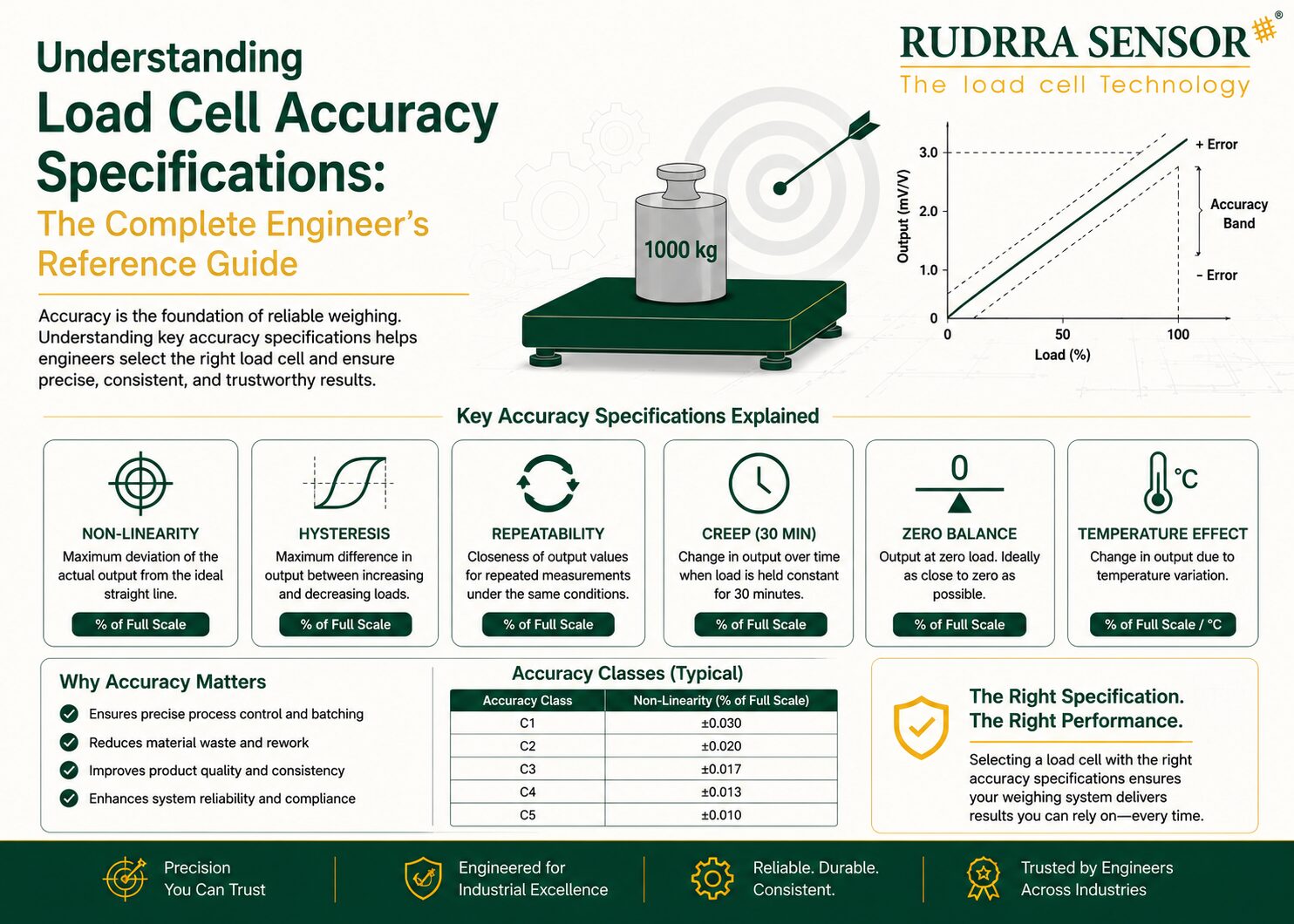
Understanding Load Cell Accuracy Specifications: The Complete Engineer’s Reference Guide
Introduction
In industrial weighing, accuracy is not just a specification—it is the foundation of reliable measurement, process control, and product quality. Every weighing application, from a small laboratory balance to a 200-ton weighbridge, depends on the ability of a load cell to measure force consistently under real-world operating conditions.
Modern industries such as pharmaceuticals, chemicals, food processing, cement, steel, logistics, automotive, aerospace, and industrial automation rely on load cells for applications including batching, filling, dosing, tank weighing, hopper weighing, silo inventory monitoring, material testing, and process control. In each of these applications, inaccurate measurements can lead to production losses, inconsistent product quality, increased material waste, regulatory non-compliance, and costly downtime.
Despite its importance, load cell accuracy is often misunderstood. Many buyers compare products based only on capacity, price, or brand, assuming that two 5-ton load cells will perform similarly. In reality, two load cells with the same rated capacity can deliver very different levels of performance depending on their accuracy specifications, material quality, manufacturing process, and environmental protection.
This is why every professional engineer should understand the technical parameters listed in a load cell datasheet. Specifications such as combined error, non-linearity, hysteresis, repeatability, creep, zero balance, and temperature effects provide a far more complete picture of a load cell’s real-world performance than capacity alone.
This guide has been created as a comprehensive technical reference for engineers, OEM machine builders, system integrators, procurement professionals, and maintenance teams. Rather than providing simple definitions, it explains what each accuracy specification means, how manufacturers measure it, how it influences industrial weighing systems, and how to use this information when selecting or comparing load cells.
Whether you are designing a new weighing system, upgrading an existing installation, or evaluating suppliers, understanding these accuracy specifications will help you make informed engineering decisions and achieve more reliable, repeatable, and cost-effective weighing performance.
Why Load Cell Accuracy Matters
A load cell is the primary sensing element in an industrial weighing system. Every subsequent component including the load indicator, digital weight transmitter, PLC, SCADA system, and control software depends on the accuracy of the signal generated by the load cell.
If the load cell introduces errors, no amount of software correction can fully compensate for poor measurement quality.
For example:
- In a batching plant, inaccurate load measurements can alter ingredient ratios, leading to inconsistent product quality and increased raw material consumption.
- In a chemical dosing system, small measurement errors can affect reaction chemistry, reduce yield, or create safety concerns.
- In a cement plant, inaccurate silo weighing can distort inventory records and disrupt production planning.
- In material testing machines, measurement errors can produce incorrect force readings, compromising quality assurance and certification.
- In food and pharmaceutical manufacturing, inaccurate weighing may result in underfilled or overfilled products, affecting regulatory compliance and customer satisfaction.
Accuracy also influences long-term operational costs. Selecting a high-quality load cell with stable measurement performance can reduce recalibration frequency, minimise maintenance, decrease production downtime, and improve overall process efficiency.
What Is Load Cell Accuracy?
Load cell accuracy describes how closely the measured output corresponds to the actual applied force across the load cell’s specified operating range.
A perfectly accurate load cell would always produce the exact electrical output expected for every applied load. However, because of material properties, manufacturing tolerances, strain gauge behaviour, and environmental influences, all load cells exhibit small deviations from the ideal response.
Manufacturers therefore describe accuracy using a group of performance characteristics rather than a single numerical value. These characteristics include:
- Combined Error
- Non-Linearity
- Hysteresis
- Repeatability
- Creep
- Zero Balance
- Temperature Effect on Zero
- Temperature Effect on Span
Together, these parameters provide a realistic picture of how the load cell will perform in industrial environments.
Accuracy vs Precision vs Resolution
These three terms are frequently confused, yet they describe different aspects of measurement performance.
| Parameter | Definition | Practical Example |
| Accuracy | How close the measured value is to the true value | A 1,000 kg load is measured as 999.9 kg |
| Precision | How consistently the same measurement is repeated | Five consecutive readings remain almost identical |
| Resolution | The smallest measurable increment displayed by the system | The indicator displays changes as small as 0.1 kg |
A weighing system can have high resolution without being highly accurate, and it can produce precise but consistently offset measurements if calibration or installation is incorrect. Understanding these differences helps engineers interpret datasheet specifications more effectively and select load cells suited to their application requirements.
How Manufacturers Define Load Cell Accuracy
One of the biggest misconceptions in industrial weighing is that a load cell has a single “accuracy” value. In reality, manufacturers do not define accuracy using one number. Instead, they evaluate multiple performance characteristics under controlled laboratory conditions.
During product development and quality testing, manufacturers subject each load cell to a series of tests that measure its behaviour under different loading and environmental conditions. These tests assess not only how accurately the load cell measures force but also how consistently it performs over time.
A typical accuracy evaluation includes:
- Combined Error
- Non-Linearity
- Hysteresis
- Repeatability
- Creep
- Zero Balance
- Temperature Effect on Zero
- Temperature Effect on Span
Each parameter describes a different aspect of measurement performance. Together, they determine whether a load cell is suitable for applications such as tank weighing, batching plants, material testing, weighbridges, packaging systems, or industrial automation.
Understanding Accuracy Specifications in a Load Cell Datasheet
When reviewing a load cell datasheet, engineers often encounter several unfamiliar technical terms. Rather than treating these as independent values, they should be viewed as a complete performance profile.
The following table provides an overview of the most important specifications.
| Specification | What It Measures | Why It Matters |
| Combined Error | Overall measurement performance | Quick comparison between load cells |
| Non-Linearity | Deviation from an ideal straight-line response | Accuracy across the measuring range |
| Hysteresis | Difference between loading and unloading | Consistency during cyclic loading |
| Repeatability | Consistency of repeated measurements | Stable production processes |
| Creep | Output drift under constant load | Long-term weighing stability |
| Zero Balance | Initial output without load | Calibration and installation |
| Temperature Effect | Influence of temperature changes | Outdoor and harsh environments |
Understanding these parameters helps engineers compare products objectively instead of relying solely on capacity, brand, or price.
Combined Error Explained
What Is Combined Error?
Combined Error is a single specification that summarises the overall measurement performance of a load cell by combining several individual sources of error.
Depending on the manufacturer, Combined Error typically includes:
- Non-Linearity
- Hysteresis
- Repeatability
Some manufacturers may also include additional performance factors, so engineers should always review the datasheet notes for the exact definition.
Why Combined Error Is Important
Instead of analysing multiple specifications individually, Combined Error provides a quick way to compare the overall accuracy of different load cells.
Typical values are expressed as a percentage of Full Scale (FS):
| Combined Error | Typical Application |
| ±0.05% FS | General Industrial Weighing |
| ±0.03% FS | Process Weighing |
| ±0.02% FS | High-Accuracy Industrial Systems |
| ±0.01% FS | Laboratory and Precision Testing |
A lower Combined Error generally indicates tighter manufacturing tolerances and better measurement performance.
However, Combined Error should never be the sole basis for selecting a load cell. Environmental conditions, installation quality, calibration, and application-specific requirements also play significant roles in overall system accuracy.
Practical Example
Consider two 10-ton load cells:
| Model | Combined Error |
| Load Cell A | ±0.05% FS |
| Load Cell B | ±0.02% FS |
Although both have the same capacity, Load Cell B is expected to provide more accurate and consistent measurements across its operating range, making it more suitable for precision batching or force measurement applications.
Understanding Non-Linearity
What Is Non-Linearity?
In an ideal load cell, the output signal increases in perfect proportion to the applied load. If the applied force doubles, the electrical output should also double, forming a straight-line relationship.
In practice, no load cell is perfectly linear. Small deviations from this ideal response are known as Non-Linearity.
Visualising Non-Linearity
Imagine plotting load versus output on a graph.
- The ideal response is a straight line.
- The actual response may curve slightly above or below that line.
The maximum deviation between the actual response and the ideal line is reported as Non-Linearity.
Example
Expected output:
| Applied Load | Ideal Output |
| 250 kg | 5.00 mV |
| 500 kg | 10.00 mV |
| 750 kg | 15.00 mV |
Actual output:
| Applied Load | Actual Output |
| 250 kg | 5.02 mV |
| 500 kg | 9.98 mV |
| 750 kg | 15.03 mV |
These small differences represent Non-Linearity.
Why Does Non-Linearity Occur?
Several factors contribute to this behaviour, including:
- Elastic properties of the load cell body
- Strain gauge characteristics
- Mechanical machining tolerances
- Bonding quality of strain gauges
- Heat treatment processes
- Material behaviour under load
Even premium industrial load cells exhibit some degree of Non-Linearity.
Applications Where Non-Linearity Is Critical
Low Non-Linearity is particularly important in:
- Material Testing Machines
- Aerospace Testing
- Precision Filling Systems
- Pharmaceutical Manufacturing
- Laboratory Equipment
- Force Measurement Systems
Typical Datasheet Values
| Performance Level | Non-Linearity |
| Standard Industrial | ±0.05% FS |
| Good Industrial | ±0.03% FS |
| High Precision | ±0.02% FS |
| Laboratory Grade | ±0.01% FS |
Engineer’s Tip
If your process requires accurate measurements across the entire weighing range rather than at just one point, choose a load cell with lower Non-Linearity.
Understanding Hysteresis
What Is Hysteresis?
Hysteresis is the difference in load cell output when the same load is approached from two different directions:
- Increasing load
- Decreasing load
Ideally, both measurements should be identical. In reality, slight differences occur due to the mechanical properties of the load cell.
Practical Example
Suppose a load cell is gradually loaded to 1,000 kg and then unloaded.
At 500 kg during loading:
Output: 10.00 mV
At 500 kg during unloading:
Output: 10.02 mV
Although the applied load is the same, the output differs slightly.
This difference is Hysteresis.
Why Does Hysteresis Occur?
Hysteresis is primarily caused by:
- Internal material stress
- Elastic deformation
- Mechanical friction
- Strain gauge behaviour
- Structural memory of the load cell body
Applications Sensitive to Hysteresis
Hysteresis becomes particularly important in systems that experience frequent loading and unloading cycles, such as:
- Packaging Machines
- Filling Machines
- Material Testing Equipment
- Compression Testing Machines
- Robotic Force Measurement Systems
- Automated Assembly Lines
Typical Values
| Application | Typical Hysteresis |
| General Industrial | ±0.03% FS |
| High Precision | ±0.02% FS |
| Laboratory | ±0.01% FS |
Engineer’s Tip
For cyclic weighing applications, lower Hysteresis improves consistency and reduces process variation over time.
Understanding Repeatability
What Is Repeatability?
Repeatability measures a load cell’s ability to produce the same output every time the same load is applied under identical conditions.
It is one of the most important indicators of measurement stability in industrial production.
Practical Example
A 1,000 kg weight is applied five times.
Measured values:
- 1,000.00 kg
- 999.99 kg
- 1,000.01 kg
- 1,000.00 kg
- 1,000.00 kg
These readings demonstrate excellent Repeatability.
Now consider another load cell:
- 998.9 kg
- 1,001.3 kg
- 999.4 kg
- 1,002.0 kg
- 998.7 kg
This load cell exhibits poor Repeatability, making it unsuitable for high-precision industrial processes.
Why Repeatability Matters
Many automated systems rely on performing the same operation thousands of times every day.
Poor Repeatability can result in:
- Inconsistent batches
- Product weight variation
- Incorrect dosing
- Increased rejects
- Reduced production efficiency
Industries Where Repeatability Is Essential
- Pharmaceutical Manufacturing
- Food & Beverage Processing
- Chemical Processing
- Packaging Industry
- Material Testing
- Industrial Automation
Typical Values
| Performance Level | Repeatability |
| Standard Industrial | ±0.03% FS |
| Good Industrial | ±0.02% FS |
| High Precision | ±0.01% FS |
Engineer’s Tip
For batching plants, dosing systems, and automated filling lines, Repeatability is often more critical than absolute accuracy because consistent measurements ensure stable production quality.
Understanding Creep
What Is Creep?
Creep is the gradual change in a load cell’s output when a constant load is applied over a specified period.
Although the applied force remains unchanged, the measured output slowly drifts due to microscopic deformation within the load cell material and strain gauge assembly.
Unlike Non-Linearity or Hysteresis, which occur during loading and unloading, Creep is a time-dependent characteristic.
Practical Example
A 20-ton storage tank is installed on four compression load cells.
Immediately after filling:
Measured Weight: 20,000 kg
After 15 minutes:
Measured Weight: 19,998 kg
After 30 minutes:
Measured Weight: 19,997 kg
No material has been removed from the tank.
The gradual change in output is caused by Creep.
Why Does Creep Occur?
Creep is influenced by:
- Elastic deformation of the load cell body
- Long-term strain gauge behaviour
- Adhesive characteristics
- Mechanical stress relaxation
- Temperature variations
High-quality load cells are designed to minimise creep through precision machining, advanced strain gauge technology, and controlled manufacturing processes.
Typical Datasheet Specification
Manufacturers often specify creep over a defined time period:
| Time | Typical Value |
| 20 Minutes | ±0.02% FS |
| 30 Minutes | ±0.02% FS |
| 60 Minutes | ±0.03% FS |
Applications Where Creep Matters Most
- Tank Weighing Systems
- Hopper Weighing Systems
- Silo Inventory Monitoring
- Chemical Storage Tanks
- Cement Silos
- Bulk Material Storage
- Long-duration Process Weighing
Engineer’s Tip
For applications where the load remains on the sensor for extended periods, prioritise low creep specifications over exceptionally low Non-Linearity. Long-term stability has a greater impact on operational accuracy.
Understanding Zero Balance
What Is Zero Balance?
Zero Balance is the electrical output generated by a load cell before any load is applied.
Ideally, the output should be exactly zero.
In reality, manufacturers allow a small offset due to normal manufacturing tolerances.
Typical specification:
±1% Rated Output
Why Is Zero Balance Important?
Zero Balance affects:
- Initial calibration
- Indicator setup
- Signal offset
- System commissioning
Modern weight indicators and digital weight transmitters compensate for this during calibration, but excessively high Zero Balance may indicate transportation damage or incorrect installation.
Understanding Zero Return
Zero Return measures the ability of a load cell to return to its original zero output after being loaded and unloaded.
For example:
- Apply 5 tons.
- Remove the load.
- The output should return to its original zero value.
Poor Zero Return may indicate:
- Mechanical overloading
- Permanent deformation
- Incorrect mounting
- Internal damage
Temperature Effects on Accuracy
Industrial weighing systems rarely operate in laboratory conditions.
Temperature changes affect both the mechanical properties of the load cell body and the electrical characteristics of the strain gauges.
To account for this, manufacturers specify two important parameters.
Temperature Effect on Zero
This specification indicates how much the zero reading changes as the ambient temperature varies.
Typical value: ±0.002% FS/°C
Temperature Effect on Span
Also known as Temperature Effect on Output, this indicates how much the measured value changes due to temperature variation.
Typical value:
±0.002% FS/°C
Applications Sensitive to Temperature
- Outdoor Weighbridges
- Truck Scales
- Cement Plants
- Mining Operations
- Oil & Gas Facilities
- Steel Plants
- Marine Applications
Engineer’s Tip
For outdoor installations, select load cells with excellent temperature compensation rather than focusing only on rated accuracy under laboratory conditions.
Accuracy Classes and Industry Standards
Different applications require different levels of measurement performance.
A weighbridge weighing aggregate trucks has different accuracy requirements than a pharmaceutical batching system.
Typical categories include:
| Application | Recommended Accuracy |
| General Industrial Weighing | Standard Industrial |
| Batching Plants | Medium to High |
| Filling Systems | High |
| Pharmaceutical Manufacturing | Very High |
| Material Testing Machines | Precision Grade |
| Laboratory Equipment | Ultra Precision |
Where required, verify compliance with applicable standards such as OIML, CE, or other industry-specific regulations.
How Accuracy Requirements Vary by Industry
Choosing the right load cell is not about selecting the highest accuracy available—it is about selecting the accuracy that matches the application.
| Industry | Most Critical Accuracy Parameter |
| Cement | Creep |
| Chemical | Repeatability |
| Pharmaceutical | Repeatability + Non-Linearity |
| Food Processing | Repeatability |
| Steel | Overload Stability |
| Logistics | Long-Term Stability |
| Material Testing | Hysteresis + Non-Linearity |
| Packaging | Repeatability |
| Tank Weighing | Creep |
| Silo Inventory | Creep + Temperature Stability |
This application-based approach helps engineers make practical and cost-effective selection decisions.
How to Compare Two Load Cells
Instead of comparing only price, capacity, or brand, evaluate the following parameters together.
| Specification | Load Cell A | Load Cell B |
| Capacity | ✓ | ✓ |
| Combined Error | ||
| Non-Linearity | ||
| Hysteresis | ||
| Repeatability | ||
| Creep | ||
| Temperature Effect | ||
| Safe Overload | ||
| Material | ||
| IP Rating | ||
| Certifications |
This comparison method provides a structured and objective evaluation.
Common Myths About Load Cell Accuracy
Myth 1: Higher Capacity Means Better Accuracy
False.
An oversized load cell may reduce effective resolution and sensitivity.
Myth 2: Higher Price Always Means Better Accuracy
False.
The best choice depends on the application’s technical requirements.
Myth 3: Calibration Can Correct Every Error
False.
Calibration compensates for system offsets but cannot eliminate poor Non-Linearity, Hysteresis, or Creep.
Myth 4: All Load Cells with the Same Capacity Perform the Same
False.
Two 10-ton load cells may differ significantly in accuracy, material quality, environmental protection, and long-term stability.
Myth 5: Accuracy Never Changes After Installation
False.
Environmental conditions, overloading, improper installation, mechanical damage, and ageing can affect long-term performance.
Best Practices for Maintaining Load Cell Accuracy
To maximise measurement reliability:
- Select the correct load cell type for the application.
- Choose an appropriate rated capacity with a suitable safety margin.
- Install the load cell according to manufacturer recommendations.
- Avoid side loading and shock loading.
- Protect cables from electrical interference.
- Maintain proper grounding.
- Calibrate the weighing system periodically.
- Inspect mounting hardware regularly.
- Protect the load cell from moisture, chemicals, and corrosion.
- Replace damaged cables or connectors promptly.
Routine preventive maintenance helps preserve accuracy and extend service life.
Engineer’s Selection Checklist
Before purchasing or installing a load cell, confirm:
- Application type
- Required capacity
- Accuracy requirements
- Environmental conditions
- Operating temperature
- Material compatibility
- IP rating
- Mounting arrangement
- Indicator/transmitter compatibility
- Certification requirements
- Calibration plan
- Maintenance strategy
Frequently Asked Questions (FAQs)
Q1: What is load cell accuracy?
Load cell accuracy describes how closely the measured output matches the actual applied force under specified conditions.
Q2: What is Non-Linearity?
It is the maximum deviation between the actual output curve and the ideal straight-line response.
Q3: What is Hysteresis?
It is the difference in output for the same load during loading and unloading.
Q4: What is Repeatability?
Repeatability indicates how consistently a load cell measures the same load under identical conditions.
Q5: What is Creep?
Creep is the gradual change in output while a constant load remains applied.
Q6: What is Combined Error?
Combined Error is a specification that combines several individual accuracy parameters into a single performance value.
Q7: Why is Temperature Effect important?
Temperature changes influence both the mechanical and electrical characteristics of a load cell, affecting measurement stability.
Q8: Can calibration improve load cell accuracy?
Calibration improves system accuracy by correcting offsets and scaling errors, but it cannot eliminate inherent mechanical characteristics such as Non-Linearity or Creep.
Q9: Which specification matters most?
The answer depends on the application. For example, Repeatability is critical for batching systems, while Creep is more important for long-term tank and silo weighing.
Q10: How often should industrial load cells be calibrated?
Calibration frequency depends on application criticality, operating conditions, and quality management requirements.
Conclusion
Understanding load cell accuracy requires more than reading a single specification. Performance is determined by the interaction of Non-Linearity, Hysteresis, Repeatability, Creep, Zero Balance, Temperature Effects, and Combined Error.
Rather than focusing solely on rated capacity or purchase price, engineers should evaluate the complete accuracy profile provided in the datasheet and match it to the application’s operational requirements.
A well-selected load cell contributes to reliable measurements, consistent product quality, reduced maintenance, and improved process efficiency across industries such as manufacturing, chemicals, pharmaceuticals, food processing, logistics, material testing, and industrial automation.
By interpreting these specifications correctly, engineers can compare products objectively, reduce selection errors, and build weighing systems that deliver dependable long-term performance.
Why Choose Rudrra Sensor?
At Rudrra Sensor, we design and manufacture industrial load cells engineered for accuracy, repeatability, and reliability across demanding applications.
Our portfolio includes:
- Compression Load Cells
- Beam Type Load Cells
- S-Type Load Cells
- Single Point Platform Load Cells
- Column-Type Load Cells
- Weighbridge Load Cells
- Load Cell Assemblies
- Digital Weight Transmitters
- Load Indicators
- Industrial Weighing Accessories
Every product undergoes rigorous quality checks to help deliver dependable performance in applications such as tank weighing, hopper weighing, batching plants, material testing, packaging, industrial automation, and process weighing.
For engineers seeking guidance on selecting the right load cell, interpreting technical specifications, or integrating weighing systems into industrial processes, Rudrra Sensor provides both technical expertise and application-focused support.
Call to Action
If you’re selecting a load cell for a new project or upgrading an existing weighing system, evaluate more than just capacity and price. Understanding the complete accuracy profile will help you choose a solution that delivers reliable performance over its entire service life.
Explore Rudrra Sensor’s range of industrial load cells and related weighing solutions, and consult our engineering resources to make informed decisions for your specific application.