


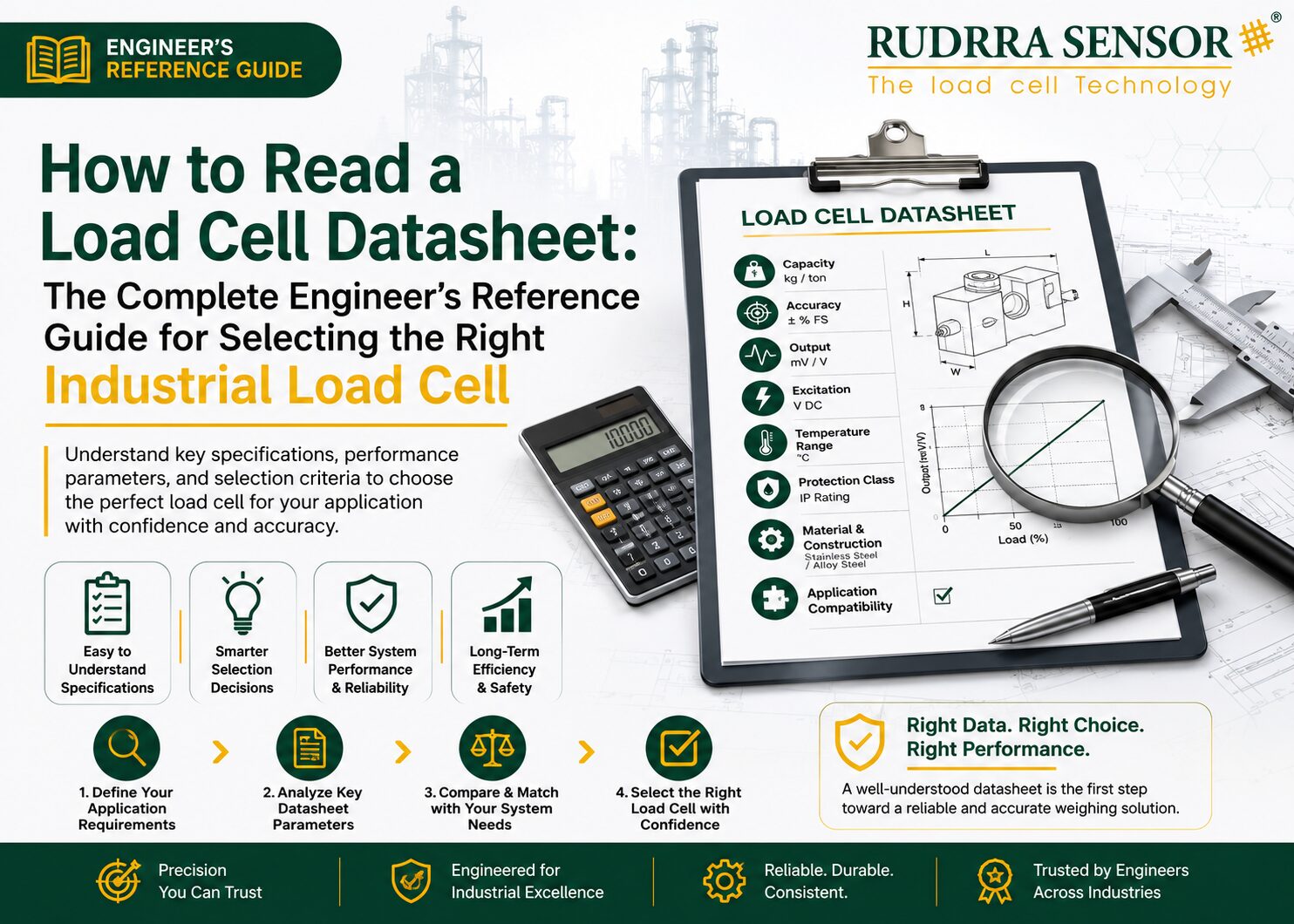
How to Read a Load Cell Datasheet: The Complete Engineer’s Reference Guide
Introduction
Selecting the right load cell is one of the most important decisions when designing or upgrading an industrial weighing system. Whether the application involves a weighbridge, tank weighing system, batching plant, packaging machine, material testing machine, or industrial automation equipment, the performance of the entire system depends on choosing a load cell that matches the technical requirements of the application.
Every industrial load cell is supplied with a datasheet that contains detailed information about its electrical characteristics, mechanical properties, accuracy parameters, environmental ratings, dimensions, wiring configuration, and installation guidelines. This document is far more than a specification sheet—it is the primary engineering reference used to evaluate whether a load cell is suitable for a particular application.
Despite its importance, many buyers and even experienced engineers focus only on a few values such as rated capacity or price. Critical specifications like Rated Output, Safe Overload, Combined Error, IP Rating, Operating Temperature, and Creep are often overlooked. Ignoring these parameters can lead to incorrect product selection, unstable measurements, reduced accuracy, premature failure, and increased maintenance costs.
Understanding how to read a load cell datasheet enables engineers to compare products objectively, integrate weighing systems more effectively, and minimise long-term operational risks. It also helps procurement teams make informed purchasing decisions based on technical suitability rather than cost alone.
This comprehensive guide explains every major section of a load cell datasheet in a practical, easy-to-understand format. From basic concepts to advanced technical specifications, you will learn how to interpret datasheet values, compare different models, and select the right industrial load cell for your application.
Whether you are an instrumentation engineer, OEM manufacturer, automation specialist, maintenance professional, or industrial buyer, this guide will help you confidently interpret load cell datasheets and make technically sound decisions.
What Is a Load Cell Datasheet?
A load cell datasheet is a technical document published by the manufacturer that provides detailed information about a load cell’s electrical, mechanical, accuracy, environmental, and installation specifications. It serves as the primary reference for engineers, OEMs, and buyers when selecting, integrating, and maintaining load cells in industrial weighing and force measurement systems.
Which Load Cell Specifications Matter Most?
Before selecting a load cell, review these critical specifications:
- Rated Capacity
- Rated Output (mV/V)
- Combined Error
- Non-Linearity
- Hysteresis
- Repeatability
- Creep
- Safe Overload
- Ultimate Overload
- IP Rating
- Operating Temperature
- Material
- Excitation Voltage
- Wiring Configuration
Evaluating these specifications together provides a more complete understanding of a load cell’s performance than relying on capacity or price alone.
How Do You Compare Two Load Cell Datasheets?
To compare two load cell datasheets effectively, evaluate the following parameters side by side:
- Capacity
- Rated Output
- Accuracy Specifications
- Safe Overload
- Ultimate Overload
- Material
- IP Rating
- Temperature Range
- Certifications
- Application Compatibility
A structured comparison helps identify the load cell best suited to your operational requirements.
Why Every Engineer Should Understand a Load Cell Datasheet
A load cell is the heart of every industrial weighing system. While indicators, controllers, PLCs, and software process the measurement, the load cell is responsible for converting mechanical force into an accurate electrical signal. If the load cell is incorrectly selected, even the most advanced weighing system cannot achieve reliable results.
This is why understanding the datasheet is an essential engineering skill.
A load cell datasheet provides the technical information needed to determine whether a sensor is suitable for a specific application. It answers important questions such as:
- Can the load cell safely handle the required load?
- Is its accuracy suitable for the process?
- Will it perform reliably in outdoor or corrosive environments?
- Is it compatible with the weight indicator, digital transmitter, or PLC?
- Can it withstand temporary overloads?
- Does it meet industry certifications and compliance requirements?
By reviewing these specifications before purchase or installation, engineers can reduce project risk, improve long-term system reliability, and minimise maintenance costs.
For OEM machine manufacturers, understanding datasheets also helps ensure that the selected load cell integrates seamlessly into machine designs without compromising performance or compliance.
Ultimately, the ability to interpret a load cell datasheet is not just about understanding technical terminology—it is about making informed engineering decisions that improve safety, efficiency, and measurement accuracy.
What Is a Load Cell Datasheet?
A load cell datasheet is a technical specification document issued by the manufacturer that describes the design, performance, operating limits, dimensions, and installation requirements of a specific load cell model.
Unlike a marketing brochure, a datasheet is intended for engineers and technical users. It contains the information required to evaluate the sensor throughout its lifecycle—from product selection and system design to installation, calibration, troubleshooting, and maintenance.
A typical load cell datasheet includes:
- Product overview
- Capacity range
- Mechanical drawings and dimensions
- Mounting recommendations
- Electrical specifications
- Accuracy specifications
- Mechanical performance
- Environmental ratings
- Wiring diagrams
- Material and sealing details
- Certifications
- Recommended applications
Engineers use this information to verify compatibility with weighing indicators, digital weight transmitters, PLCs, junction boxes, and industrial automation systems.
Understanding each section of the datasheet ensures that the selected load cell delivers reliable performance, accurate measurements, and long service life in its intended application.
Anatomy of a Load Cell Datasheet
Although every load cell manufacturer uses a slightly different layout, most industrial load cell datasheets follow a similar structure. Once you understand these sections, you can quickly locate and interpret the information needed to compare products, verify compatibility, and select the right sensor for your application.
Rather than reading a datasheet from top to bottom, experienced engineers review it systematically by evaluating the product overview, mechanical dimensions, electrical characteristics, accuracy specifications, environmental ratings, and installation details.
The following table explains the purpose of each section.
| Datasheet Section | Purpose | Why It Matters |
| Product Overview | Introduces the load cell type, design, and intended applications | Helps determine whether the load cell matches your application |
| Capacity Range | Lists available capacities | Ensures the selected model can safely measure the required load |
| Mechanical Drawing | Provides dimensions, mounting holes, and installation details | Confirms compatibility with the machine or structure |
| Electrical Specifications | Defines output signal, resistance values, excitation voltage, and wiring | Ensures compatibility with indicators, PLCs, and transmitters |
| Accuracy Specifications | Includes Combined Error, Non-Linearity, Hysteresis, Repeatability, and Creep | Determines measurement performance and precision |
| Mechanical Specifications | Covers Safe Overload, Ultimate Overload, and construction material | Protects against overload and mechanical failure |
| Environmental Specifications | Lists operating temperature, IP rating, humidity resistance, and sealing | Ensures reliable performance in the intended environment |
| Wiring Diagram | Shows cable colour codes and terminal connections | Prevents wiring mistakes during installation |
| Certifications | Indicates compliance with recognised industry standards | Important for regulated industries and export projects |
| Ordering Information | Lists available capacities, cable lengths, options, and accessories | Helps specify the correct product during procurement |
Understanding the purpose of each section allows engineers to evaluate the complete performance of a load cell rather than focusing on only one or two specifications.
Typical Layout of a Load Cell Datasheet
Most manufacturers organise their datasheets in the following sequence:
- Product Name and Model Number
- Product Photograph
- Key Features
- Typical Applications
- Capacity Range
- Mechanical Drawing
- Technical Specifications
- Wiring Diagram
- Installation Guidelines
- Ordering Information
- Certifications
- Manufacturer Contact Details
Although the design may differ, the technical information remains largely consistent across reputable manufacturers.
What Information Should You Review First?
When engineers receive a new datasheet, they should avoid immediately comparing price or dimensions. Instead, begin with the specifications that have the greatest impact on performance.
A recommended review sequence is:
- Application Suitability
- Load Cell Type
- Rated Capacity
- Mechanical Dimensions
- Rated Output
- Accuracy Specifications
- Safe Overload
- Material
- IP Rating
- Operating Temperature
- Certifications
- Wiring Configuration
This structured approach helps eliminate unsuitable products before spending time on detailed comparisons.
Common Mistakes Engineers and Buyers Make While Reading Datasheets
One of the most common reasons for poor weighing system performance is not the quality of the load cell itself, but incorrect interpretation of its datasheet.
Many purchasing decisions are based on only two criteria—capacity and price—while other critical technical specifications are ignored. This can result in unstable measurements, reduced accuracy, premature failures, or costly redesigns.
Below are some of the most frequent mistakes and how to avoid them.
Mistake 1 – Selecting Capacity Based Only on Maximum Load
Many buyers assume that choosing the highest available capacity provides additional safety.
In reality, an oversized load cell may reduce measurement resolution and sensitivity, making it difficult to detect small weight changes accurately.
Better Practice
Calculate:
- Dead Load
- Live Load
- Dynamic Load
- Impact Load
- Future Expansion
- Required Safety Factor
Then select the most appropriate rated capacity.
Mistake 2 – Ignoring Accuracy Specifications
Capacity alone does not determine how accurately a load cell measures force.
Two load cells with the same rated capacity can have significantly different performance because of variations in:
- Combined Error
- Non-Linearity
- Hysteresis
- Repeatability
- Creep
Always compare the complete accuracy profile rather than relying solely on capacity.
Mistake 3 – Overlooking Environmental Conditions
A load cell designed for indoor use may fail prematurely if installed in harsh industrial environments.
Factors such as:
- Water
- Dust
- Chemicals
- Humidity
- High temperatures
- Wash-down procedures
- Corrosive atmospheres
must be considered during product selection.
The IP rating and construction material should always match the operating environment.
Mistake 4 – Assuming Every Manufacturer Uses the Same Definitions
Although many specifications follow international standards, some manufacturers define parameters differently.
For example, the calculation of Combined Error may vary depending on the testing method used.
Always read the notes accompanying the specification table before comparing products from different manufacturers.
Mistake 5 – Ignoring Mechanical Drawings
Some buyers purchase a load cell with suitable capacity and accuracy, only to discover that:
- Mounting holes do not align
- Overall height is incorrect
- Thread size is incompatible
- Cable exit interferes with the machine structure
Always verify the mechanical drawing before ordering.
Mistake 6 – Ignoring Electrical Compatibility
A load cell may have excellent performance, but it must also be compatible with the rest of the weighing system.
Check:
- Rated Output
- Excitation Voltage
- Bridge Resistance
- Indicator Compatibility
- PLC Compatibility
- Signal Amplifier Requirements
before making a final selection.
Mistake 7 – Choosing the Lowest Price Instead of the Best Value
Price is an important consideration, but it should not outweigh technical suitability.
A lower-cost load cell may:
- Require more frequent calibration
- Offer lower environmental protection
- Have reduced overload capability
- Deliver lower long-term stability
- Increase maintenance costs
The most economical solution over the equipment’s lifecycle is often not the cheapest initial purchase.
Engineer’s Tip
Before approving any load cell, ask this question:
“Does this datasheet demonstrate that the load cell is suitable for my application—not just that it fits my budget?”
This simple shift in thinking often leads to better engineering decisions and lower total cost of ownership.
How Manufacturers Organize Load Cell Datasheets
Manufacturers present a large amount of technical information in a structured format to make evaluation easier. While layouts vary, almost every industrial load cell datasheet can be divided into four major categories.
Understanding these categories helps engineers review datasheets methodically and ensures that no critical specification is overlooked.
1. Product Overview
The first section introduces the load cell and provides a summary of its intended use.
Typical information includes:
- Load Cell Type
- Capacity Range
- Typical Applications
- Construction Material
- Protection Rating
- Key Features
This section quickly indicates whether the product is designed for applications such as weighbridges, tank weighing, batching systems, material testing, industrial automation, or packaging equipment.
2. Mechanical Information
Mechanical specifications describe the physical characteristics of the load cell.
They typically include:
- Dimensions
- Mounting Details
- Thread Sizes
- Capacity
- Safe Overload
- Ultimate Overload
- Material
- Deflection
These specifications ensure the load cell can be installed correctly and withstand the expected mechanical forces.
3. Electrical Information
This section explains how the load cell communicates with indicators, transmitters, PLCs, and automation systems.
Typical specifications include:
- Rated Output
- Excitation Voltage
- Input Resistance
- Output Resistance
- Zero Balance
- Insulation Resistance
- Cable Details
- Wiring Configuration
Understanding these parameters is essential for proper integration and signal quality.
4. Performance and Environmental Information
The final technical section focuses on how the load cell performs under real operating conditions.
It typically includes:
- Combined Error
- Non-Linearity
- Hysteresis
- Repeatability
- Creep
- Temperature Effect on Zero
- Temperature Effect on Span
- Operating Temperature
- Storage Temperature
- IP Rating
- Certifications
These specifications determine the long-term accuracy, durability, and suitability of the load cell for the intended environment.
Quick Summary
Before selecting a load cell, review the datasheet in this order:
- Confirm the application and load cell type.
- Verify the rated capacity and mechanical dimensions.
- Check electrical compatibility with your indicator, transmitter, or PLC.
- Compare the accuracy specifications.
- Review overload limits and material.
- Verify IP rating and environmental suitability.
- Confirm certifications and ordering details.
Following this structured approach reduces selection errors and helps ensure the weighing system performs reliably throughout its service life.
Understanding Electrical Specifications
Electrical specifications describe how a load cell converts mechanical force into an electrical signal and how that signal interacts with weighing indicators, digital weight transmitters, PLCs, and industrial automation systems.
Unlike mechanical specifications, which define the physical strength of a load cell, electrical specifications determine signal quality, compatibility, stability, and measurement performance.
Even the highest-quality load cell cannot deliver reliable results if its electrical characteristics are incompatible with the weighing electronics or incorrectly interpreted during system design.
When reading a load cell datasheet, engineers should pay particular attention to:
- Rated Output (Sensitivity)
- Excitation Voltage
- Input Resistance
- Output Resistance
- Zero Balance
- Insulation Resistance
- Wheatstone Bridge Configuration
- Wiring Configuration
Understanding these parameters helps ensure proper signal transmission, easier calibration, and long-term measurement stability.
Rated Output (Sensitivity)
What Is Rated Output?
Rated Output, also called Sensitivity, is the electrical signal generated by a load cell when its rated capacity is applied.
It is expressed in:
mV/V (millivolts per volt)
This means the load cell produces a specific number of millivolts for every volt of excitation supplied.
Why Is Rated Output Important?
Rated Output determines how much signal reaches:
- Weight Indicators
- Digital Weight Transmitters
- PLC Analog Inputs
- Signal Amplifiers
- Industrial Controllers
A stronger signal generally improves signal-to-noise ratio and makes the system less susceptible to electrical interference, especially over long cable distances.
Example
Suppose a load cell has:
Rated Output:
2.0 mV/V
Excitation Voltage:
10 VDC
Full Scale Output:
2 × 10 = 20 mV
If excitation changes to 5 V,
Output becomes
10 mV
The ratio remains constant.
Typical Rated Output Values
| Load Cell Type | Typical Rated Output |
| Beam Type Load Cell | 2.0 mV/V |
| Compression Load Cell | 2–3 mV/V |
| S-Type Load Cell | 2–3 mV/V |
| Single Point Load Cell | 2.0 mV/V |
| Column Type Load Cell | 2–3 mV/V |
| Weighbridge Load Cell | 2–3 mV/V |
Common Misconception
Many buyers assume:
Higher Rated Output = Higher Accuracy
This is incorrect.
Rated Output only affects signal strength.
Accuracy depends on:
- Combined Error
- Non-Linearity
- Hysteresis
- Repeatability
- Creep
Engineer’s Tip
For installations with long cable runs or electrically noisy environments, select a load cell with adequate Rated Output and use a quality digital weight transmitter or amplifier.
Excitation Voltage
What Is Excitation Voltage?
A load cell is a passive sensor that requires an external DC supply to energise the Wheatstone bridge circuit.
This supply is known as:
Excitation Voltage
Without excitation voltage, the load cell cannot produce an output signal.
Where Does Excitation Voltage Come From?
Typically supplied by:
- Load Indicators
- Digital Weight Transmitters
- Signal Amplifiers
- PLC Modules
- Industrial Controllers
Typical Values
| Application | Voltage |
| Laboratory Equipment | 5 VDC |
| Industrial Indicators | 10 VDC |
| Automation Systems | 10–12 VDC |
| Heavy Industrial Systems | 12–15 VDC |
Recommended vs Maximum Excitation
Most datasheets specify both:
Recommended Excitation
Example:
10 VDC
Maximum Excitation
Example:
15 VDC
Operating above the recommended limit may increase self-heating, thermal drift, and long-term measurement instability.
Engineer’s Tip
Always verify that the indicator or transmitter provides the excitation voltage recommended by the load cell manufacturer.
Input Resistance
What Is Input Resistance?
Input Resistance is the resistance measured across the excitation terminals of the Wheatstone bridge.
Typical values include:
- 350 Ω
- 700 Ω
- 1000 Ω
Why Is It Important?
Input Resistance determines:
- Current consumption
- Number of load cells that can be connected in parallel
- Power requirements
- Indicator compatibility
Practical Example
If a weighing indicator supports four 350 Ω load cells, connecting additional load cells without recalculating the total bridge resistance may overload the excitation supply and cause unstable measurements.
Engineer’s Tip
When multiple load cells are connected through a junction box, always calculate the equivalent bridge resistance before selecting the indicator or transmitter.
Output Resistance
What Is Output Resistance?
Output Resistance is measured across the signal output terminals of the load cell.
It represents the electrical characteristics of the Wheatstone bridge output.
Typical values are close to:
350 Ω
Why Does It Matter?
Output Resistance affects:
- Signal transmission
- Amplifier compatibility
- Indicator performance
- Long-distance cable behaviour
Common Mistake
Input Resistance and Output Resistance are different parameters and should not be confused. Both should fall within the acceptable range specified by the connected instrumentation.
Zero Balance
What Is Zero Balance?
Zero Balance is the small electrical output produced by the load cell when no load is applied.
Ideally, this value would be zero, but manufacturing tolerances create a slight offset.
Typical specification:
±1% of Rated Output
Why Does It Matter?
Zero Balance affects:
- Initial system calibration
- Indicator setup
- Commissioning
- Signal offset
Modern weighing indicators compensate for this during calibration, but excessive zero offsets may indicate mechanical stress, improper installation, or damage.
Example
Rated Output:
2 mV/V
Zero Balance:
±1%
Actual Offset:
0.02 mV/V
This is considered normal and is removed during calibration.
Engineer’s Tip
Do not attempt to eliminate Zero Balance mechanically. Always use proper electronic calibration procedures.
Insulation Resistance
What Is Insulation Resistance?
Insulation Resistance measures the electrical isolation between the Wheatstone bridge and the load cell body.
It is expressed in: Megaohms (MΩ)
Typical Datasheet Value
Greater than: 5000 MΩ at 50 VDC
Why Is It Important?
High insulation resistance helps prevent:
- Moisture ingress
- Electrical leakage
- Signal instability
- Ground loops
- Noise interference
Applications Where It Is Critical
- Chemical Processing
- Marine Equipment
- Outdoor Weighbridges
- Food Processing
- Pharmaceutical Manufacturing
- Cement Plants
Engineer’s Tip
A gradual reduction in insulation resistance over time often indicates cable damage, moisture ingress, or seal deterioration. Regular inspection can prevent unexpected failures.
Understanding the Wheatstone Bridge Configuration
Nearly all strain gauge load cells use a full Wheatstone bridge because it provides high sensitivity, excellent temperature compensation, and stable measurements.
A typical bridge consists of four matched strain gauges bonded to the load cell’s elastic element.
When force is applied:
- Two gauges experience tension, increasing their resistance.
- Two gauges experience compression, decreasing their resistance.
This balanced arrangement converts mechanical deformation into a precise differential voltage output.
Why Is It Important?
The Wheatstone bridge offers:
- High sensitivity
- Temperature compensation
- Excellent common-mode noise rejection
- Stable and repeatable output
Understanding this principle helps engineers diagnose bridge imbalance, wiring faults, and signal issues during installation or maintenance.
Load Cell Wiring and Cable Connections
Correct wiring is essential for reliable signal transmission and accurate measurements.
Incorrect connections are one of the most common causes of commissioning failures.
Typical 4-Wire Configuration
| Wire Colour | Function |
| Red | Excitation (+) |
| Black | Excitation (–) |
| Green | Signal (+) |
| White | Signal (–) |
Note: Wire colours may vary between manufacturers. Always refer to the specific datasheet supplied with the load cell.
Typical 6-Wire Configuration
In addition to the four standard wires:
- Blue – Sense (+)
- Yellow – Sense (–)
Sense wires compensate for voltage drops in long cable runs, helping maintain higher measurement accuracy.
Common Wiring Mistakes
Avoid these frequent installation errors:
- Reversing excitation and signal wires
- Ignoring cable shielding
- Grounding the shield at multiple points
- Extending cables with mismatched conductors
- Routing signal cables alongside high-voltage power lines
- Skipping junction box balancing in multi-load-cell systems
These mistakes can introduce electrical noise, unstable readings, and intermittent faults.
Engineer’s Quick Reference – Electrical Specifications
| Specification | Purpose | Typical Value |
| Rated Output | Determines signal strength | 2–3 mV/V |
| Excitation Voltage | Powers the Wheatstone bridge | 5–15 VDC |
| Input Resistance | Affects current consumption | 350–1000 Ω |
| Output Resistance | Defines bridge output characteristics | ~350 Ω |
| Zero Balance | Initial no-load signal offset | ±1% RO |
| Insulation Resistance | Prevents leakage and noise | >5000 MΩ |
| Wiring Configuration | Ensures proper system integration | 4-wire or 6-wire |
Key Takeaways
- Electrical specifications determine how effectively a load cell communicates with weighing electronics.
- Rated Output influences signal strength, while accuracy depends on parameters such as Combined Error, Hysteresis, and Repeatability.
- Matching Excitation Voltage, Bridge Resistance, and Wiring Configuration with the indicator or PLC is essential for reliable system performance.
- Proper wiring, shielding, and grounding practices minimise electrical noise and improve long-term measurement stability.
- Understanding these electrical parameters is a critical step before evaluating mechanical and environmental specifications.
Understanding Mechanical Specifications
Mechanical specifications define how much load a load cell can safely measure, how it behaves under overload conditions, and whether it is suitable for a particular installation.
Ignoring these parameters can result in:
- Permanent deformation
- Measurement errors
- Reduced service life
- Frequent recalibration
- Unexpected equipment downtime
- Costly replacement
A well-selected load cell should satisfy both the application’s load requirements and its operating conditions.
Rated Capacity (Nominal Capacity)
What Is Rated Capacity?
Rated Capacity is the maximum load that a load cell is designed to measure continuously while maintaining its specified accuracy and performance.
It is sometimes referred to as:
- Capacity
- Nominal Capacity
- Rated Load
- Maximum Measuring Capacity
This value is one of the first specifications engineers evaluate when selecting a load cell.
Typical Capacity Range
Industrial load cells are available in a wide range of capacities, including:
| Capacity | Typical Applications |
| 1–50 kg | Laboratory equipment, bench scales |
| 50–500 kg | Platform scales, packaging machines |
| 500 kg–5 tons | Tank weighing, batching plants |
| 5–30 tons | Weighbridges, silos, heavy machinery |
| Above 30 tons | Steel plants, mining, infrastructure projects |
How to Select the Correct Capacity
Selecting the correct capacity involves more than identifying the maximum product weight.
Engineers should consider:
- Dead Load (Weight of the structure)
- Live Load (Material being weighed)
- Dynamic Loading
- Shock Loading
- Future Capacity Expansion
- Safety Margin
Example
A tank weighing system has:
- Empty Tank Weight = 2,000 kg
- Maximum Product Weight = 6,000 kg
Total Static Load = 8,000 kg
Instead of selecting an 8-ton load cell, engineers should evaluate dynamic loading, filling impact, and safety factors before determining the appropriate capacity.
Common Mistake
Selecting an excessively high-capacity load cell may reduce measurement resolution and sensitivity.
A properly sized load cell generally provides better measurement performance than one that is significantly oversized.
Engineer’s Tip
Never select a load cell based solely on maximum product weight. Always calculate the total applied load, including structural weight and operational conditions.
Safe Overload
What Is Safe Overload?
Safe Overload represents the maximum temporary load that can be applied without causing permanent damage or affecting the load cell’s calibration.
It is usually expressed as a percentage of Rated Capacity.
Example:
Rated Capacity = 10 tons
Safe Overload = 150%
Maximum Safe Temporary Load = 15 tons
Why Is It Important?
Temporary overloads frequently occur in industrial environments due to:
- Sudden material discharge
- Forklift impacts
- Uneven loading
- Operator error
- Conveyor surges
- Vibration during filling
A suitable Safe Overload rating protects the load cell from these short-duration events.
Engineer’s Tip
Applications with frequent impact loading should prioritise Safe Overload specifications during product selection.
Ultimate Overload
What Is Ultimate Overload?
Ultimate Overload is the maximum force the load cell can withstand before experiencing permanent structural damage or complete failure.
Unlike Safe Overload, this value represents the survival limit of the sensor.
Example:
Rated Capacity = 10 tons
Ultimate Overload = 300%
Mechanical Failure Load = 30 tons
Important Note
Ultimate Overload is not an operating limit.
Repeated loading near this value can permanently damage the load cell, even if immediate failure does not occur.
Side Load and Off-Centre Loading
Load cells are designed to measure force along a specific loading axis.
If force is applied sideways or away from the intended loading point, measurement errors increase and mechanical stress may damage the sensor.
Common Causes
- Poor mounting alignment
- Uneven tank supports
- Conveyor misalignment
- Structural deflection
- Incorrect installation
Applications Where It Matters
- Hopper Weighing Systems
- Tank Weighing Systems
- Silo Weighing
- Industrial Automation Equipment
- Material Testing Machines
Best Practice
Always use recommended mounting accessories and ensure the load is transferred through the intended loading axis.
Load Cell Material
The construction material significantly influences durability, corrosion resistance, fatigue life, and maintenance requirements.
Alloy Steel
Suitable for:
- Weighbridges
- Heavy industrial machinery
- Steel plants
- Cement plants
- Material handling equipment
Advantages:
- High mechanical strength
- Excellent fatigue resistance
- Cost-effective
Limitations:
- Requires protective coating in corrosive environments.
Stainless Steel
Recommended for:
- Food & Beverage
- Pharmaceutical
- Chemical
- Marine
- Medical Equipment
Advantages:
- Excellent corrosion resistance
- Hygienic
- Wash-down compatible
- Long service life
Aluminium
Commonly used in:
- Platform scales
- Retail weighing
- Packaging machines
- Laboratory equipment
Advantages:
- Lightweight
- Economical
- Good sensitivity
Material Comparison
| Material | Strength | Corrosion Resistance | Typical Applications |
| Alloy Steel | Excellent | Moderate | Heavy Industry |
| Stainless Steel | Excellent | Excellent | Food, Pharma, Chemical |
| Aluminium | Moderate | Moderate | Platform & Bench Scales |
IP Rating (Ingress Protection)
What Is an IP Rating?
The IP Rating indicates how well a load cell is protected against:
- Dust
- Water
- Moisture
- Cleaning Chemicals
- Outdoor Exposure
Common IP Ratings
| Rating | Protection Level | Typical Applications |
| IP65 | Dust-tight, water jets | Indoor industrial equipment |
| IP66 | High-pressure water | Manufacturing plants |
| IP67 | Temporary immersion | Outdoor weighing |
| IP68 | Continuous immersion | Tank weighing, weighbridges |
| IP69K | High-pressure wash-down | Food & Pharmaceutical |
Selecting the Right IP Rating
Choose an IP rating based on the operating environment rather than assuming higher is always better.
For example:
- Indoor automation → IP65
- Outdoor weighbridge → IP68
- Food processing → IP69K
Understanding Accuracy Specifications
Accuracy specifications determine how closely the load cell’s output matches the applied force under different operating conditions.
Unlike capacity, which indicates how much weight a load cell can measure, these specifications describe how accurately it performs.
The most important parameters include:
- Combined Error
- Non-Linearity
- Hysteresis
- Repeatability
- Creep
- Temperature Effect on Zero
- Temperature Effect on Span
These values are especially important for applications such as:
- Material Testing
- Pharmaceutical Manufacturing
- Precision Filling
- Industrial Automation
- Batching Systems
Understanding Environmental Specifications
Industrial load cells rarely operate under ideal laboratory conditions.
Most are exposed to:
- Dust
- Moisture
- Chemicals
- Temperature variations
- Mechanical vibration
- Outdoor weather
- Cleaning procedures
Environmental specifications indicate whether the load cell can maintain its performance under these conditions.
Key Environmental Parameters
Typical datasheets include:
- Operating Temperature
- Compensated Temperature Range
- Storage Temperature
- Humidity Resistance
- Corrosion Resistance
- Cable Protection
- Shock Resistance
- Vibration Resistance
Why They Matter
Ignoring environmental limitations can result in:
- Signal drift
- Corrosion
- Moisture ingress
- Electrical leakage
- Reduced lifespan
- Frequent maintenance
Example
A stainless steel IP69K load cell is better suited to a food processing plant than an alloy steel IP65 model, even if both have identical capacities and accuracy.
Understanding Load Cell Certifications
Industrial projects often require compliance with recognised international standards.
Common certifications include:
| Certification | Purpose |
| OIML | Legal-for-trade weighing systems |
| CE | European safety and EMC compliance |
| RoHS | Restriction of hazardous substances |
| ISO 9001 | Quality management system |
Always verify certification requirements before purchasing for regulated industries or export-oriented projects.
Engineer’s Checklist Before Comparing Load Cells
Before finalising your selection, verify the following:
✅ Rated Capacity
✅ Load Cell Type
✅ Mechanical Dimensions
✅ Rated Output
✅ Excitation Voltage
✅ Input Resistance
✅ Output Resistance
✅ Combined Error
✅ Non-Linearity
✅ Hysteresis
✅ Repeatability
✅ Creep
✅ Safe Overload
✅ Ultimate Overload
✅ Material
✅ IP Rating
✅ Operating Temperature
✅ Cable Length
✅ Certifications
✅ Compatibility with Indicator, PLC, or Transmitter
Key Takeaways
- Mechanical specifications determine how safely and reliably a load cell performs under load.
- Selecting the correct Rated Capacity requires considering dead load, live load, dynamic forces, and future expansion.
- Safe Overload protects against temporary overload conditions, while Ultimate Overload defines the sensor’s survival limit.
- Material selection and IP Rating should always match the operating environment.
- Accuracy specifications should be evaluated collectively rather than relying on a single parameter.
- Environmental specifications and certifications are essential for long-term performance and regulatory compliance.
How to Compare Two Load Cell Datasheets
Selecting the right load cell often involves comparing products from multiple manufacturers. While many buyers focus on price or capacity, engineers should evaluate the complete technical specification to ensure the sensor meets the application’s performance, environmental, and integration requirements.
A systematic comparison helps eliminate unsuitable products early and supports informed procurement decisions.
Step 1: Compare the Load Cell Type
Before reviewing specifications, ensure both products are designed for the same application.
Examples include:
- Compression Load Cell
- Beam Type Load Cell
- Single Point Platform Load Cell
- S-Type Load Cell
- Column Type Load Cell
- Pancake Load Cell
- Double Ended Shear Beam Load Cell
Two load cells with the same capacity may not be interchangeable if their operating principles differ.
Step 2: Compare Capacity and Mechanical Dimensions
Verify:
- Rated Capacity
- Mounting Hole Pattern
- Overall Dimensions
- Thread Size
- Height
- Loading Direction
Even minor dimensional differences can affect installation.
Step 3: Compare Electrical Specifications
Evaluate:
- Rated Output (mV/V)
- Excitation Voltage
- Input Resistance
- Output Resistance
- Zero Balance
- Insulation Resistance
Ensure compatibility with:
- Weight Indicators
- Digital Weight Transmitters
- PLC Analog Modules
- Signal Amplifiers
- Industrial Controllers
Step 4: Compare Accuracy Specifications
Do not compare capacity alone.
Review:
- Combined Error
- Non-Linearity
- Hysteresis
- Repeatability
- Creep
- Temperature Effect on Zero
- Temperature Effect on Span
These specifications determine long-term measurement quality.
Step 5: Compare Environmental Ratings
Verify:
- IP Rating
- Operating Temperature
- Storage Temperature
- Corrosion Resistance
- Material
- Cable Protection
Applications such as food processing, chemical plants, marine environments, and outdoor installations require higher environmental protection.
Step 6: Compare Certifications
Depending on your project, verify compliance with:
- OIML
- CE
- RoHS
- ISO 9001
Certain industries and export markets may require additional certifications.
Example Datasheet Comparison Matrix
| Specification | Load Cell A | Load Cell B |
| Load Cell Type | ||
| Capacity | ||
| Rated Output | ||
| Combined Error | ||
| Safe Overload | ||
| Ultimate Overload | ||
| Material | ||
| IP Rating | ||
| Operating Temperature | ||
| Certifications | ||
| Recommended Application |
This comparison table provides a practical framework for evaluating products objectively.
How to Select the Right Load Cell by Industry
Every industry has unique operational requirements. Selecting a load cell based solely on capacity may lead to reduced accuracy, unnecessary maintenance, or shorter service life.
The table below outlines the most important datasheet specifications for common industrial applications.
| Industry | Key Specifications to Prioritise |
| Cement | Safe Overload, Creep, IP68, Alloy Steel Construction |
| Chemical | Stainless Steel, Corrosion Resistance, IP68/IP69K |
| Food & Beverage | Hygienic Design, Stainless Steel, IP69K, Repeatability |
| Pharmaceutical | High Accuracy, Stainless Steel, Repeatability, Wash-down Protection |
| Steel | High Capacity, Fatigue Resistance, Safe Overload |
| Material Testing | Non-Linearity, Hysteresis, Repeatability |
| Packaging | Repeatability, Rated Output, Response Time |
| Industrial Automation | Signal Stability, Electrical Compatibility, Fast Response |
| Tank & Hopper Weighing | Creep Performance, Temperature Stability |
| Weighbridges | IP68, Long-Term Stability, Safe Overload, Lightning Protection |
Understanding industry-specific priorities helps engineers select the most appropriate load cell for long-term performance.
Load Cell Datasheet Evaluation Checklist
Before placing an order, verify that the load cell meets all technical and operational requirements.
Application
☐ Suitable load cell type
☐ Correct measuring principle
☐ Appropriate capacity
☐ Compatible mounting arrangement
Mechanical
☐ Rated Capacity
☐ Safe Overload
☐ Ultimate Overload
☐ Mechanical Dimensions
☐ Construction Material
Electrical
☐ Rated Output
☐ Excitation Voltage
☐ Input Resistance
☐ Output Resistance
☐ Zero Balance
☐ Insulation Resistance
Accuracy
☐ Combined Error
☐ Non-Linearity
☐ Hysteresis
☐ Repeatability
☐ Creep
Environmental
☐ IP Rating
☐ Operating Temperature
☐ Humidity Resistance
☐ Cable Protection
☐ Corrosion Resistance
System Integration
☐ Compatible with Indicator
☐ Compatible with PLC
☐ Compatible with Digital Weight Transmitter
☐ Suitable Cable Length
☐ Certifications Verified
Using this checklist helps reduce selection errors and ensures the load cell integrates seamlessly into the weighing system.
Frequently Asked Questions (FAQs)
Q1: What is a load cell datasheet?
A load cell datasheet is a technical document that explains a load cell’s electrical, mechanical, accuracy, environmental, and installation specifications. It helps engineers and buyers evaluate whether the sensor is suitable for a specific application.
Q2: Why is reading a load cell datasheet important?
Understanding the datasheet helps prevent incorrect product selection, improves weighing accuracy, ensures system compatibility, and reduces maintenance costs.
Q3: Which load cell specification should I check first?
Start by reviewing:
- Load Cell Type
- Rated Capacity
- Application Suitability
- Mechanical Dimensions
- Rated Output
- Accuracy Specifications
- Safe Overload
- IP Rating
Q4: Does a higher capacity mean better performance?
No. Selecting an oversized load cell can reduce measurement resolution. Capacity should match the application’s total load requirements with an appropriate safety margin.
Q5: Does higher Rated Output mean better accuracy?
No. Rated Output determines signal strength, while accuracy depends on Combined Error, Non-Linearity, Hysteresis, Repeatability, and Creep.
Q6: What is the difference between Safe Overload and Ultimate Overload?
Safe Overload is the temporary load a load cell can withstand without permanent damage. Ultimate Overload is the maximum force the load cell can survive before structural failure.
Q7: Why is IP Rating important?
The IP Rating indicates resistance to dust and water. Choosing the correct IP rating improves reliability in harsh industrial environments.
Q8: What material is best for industrial load cells?
- Alloy Steel – Heavy industrial applications
- Stainless Steel – Food, pharmaceutical, chemical, and marine industries
- Aluminium – Platform scales and light-duty weighing systems
Q9: Can two load cells with identical capacities perform differently?
Yes. Accuracy, overload capability, environmental protection, material, and long-term stability may vary significantly between models.
Q10: How do I compare two load cell datasheets?
Compare:
- Capacity
- Accuracy Specifications
- Rated Output
- Safe Overload
- Material
- IP Rating
- Operating Temperature
- Certifications
- Application Suitability
Q11: Which certifications should I look for?
Depending on the application, common certifications include OIML, CE, RoHS, and ISO 9001.
Q12: Can I use one load cell model for every application?
No. Different applications require different load cell designs. Selection should always be based on the specific mechanical, electrical, and environmental requirements.
Conclusion
A load cell datasheet is much more than a specification sheet—it is the foundation for selecting the right sensor for industrial weighing and force measurement applications.
By understanding electrical, mechanical, accuracy, and environmental specifications, engineers can confidently compare products, integrate weighing systems more effectively, and avoid costly selection mistakes.
Rather than focusing only on rated capacity or price, evaluating the complete datasheet ensures the load cell meets the application’s operational demands, environmental conditions, and long-term performance expectations.
Whether you are designing a new weighing system, upgrading existing equipment, or selecting a replacement sensor, the ability to interpret a load cell datasheet is an essential engineering skill that contributes to improved reliability, measurement accuracy, and total cost of ownership.
Why Choose Rudrra Sensor?
Choosing the right load cell requires more than selecting a product—it requires selecting a trusted engineering partner.
At Rudrra Sensor, we design and manufacture industrial load cells and weighing solutions for a wide range of applications, including:
- Weighbridges
- Tank Weighing Systems
- Hopper Weighing Systems
- Silo Weighing Systems
- Batching Plants
- Packaging Machines
- Material Testing Machines
- Industrial Automation Systems
- OEM Machinery
- Process Weighing Solutions
Our product portfolio includes:
- Compression Load Cells
- Beam Type Load Cells
- Single Point Platform Load Cells
- S-Type Load Cells
- Column Type Load Cells
- Weighbridge Load Cells
- Load Cell Assemblies
- Digital Weight Transmitters
- Load Indicators
- Junction Boxes
- Industrial Weighing Accessories
With decades of engineering expertise, application support, and customisation capabilities, Rudrra Sensor helps customers select the most suitable load cell for their operational requirements.
Need Expert Guidance?
If you’re unsure which load cell best suits your application, our engineering team can help.
Whether you’re selecting a sensor for a new installation, replacing an existing load cell, or integrating a complete weighing system, Rudrra Sensor can assist with product selection, technical consultation, and application-specific recommendations.
Explore our range of industrial load cells and weighing accessories or contact our technical experts to discuss your project requirements.